The Road, John Hillcoat, 111 mins, (15)<br/>It's Complicated, Nancy Meyers, 115 mins, (15)
There are no cars, no zombies and no hope in this poetic, cheerless trudge through a post-apocalyptic America
The standard Hollywood angle on the apocalypse seems to have been inspired by the REM song, "It's the End of the World As We Know it (And I Feel Fine)". Never mind that most of the Earth's population has been obliterated, or that most of its land mass is under contaminated water: as long as you're American, a nifty driver and you look like Will Smith, you can have great fun shooting zombies until you track down the Edenic outpost that signifies the rebirth of the ecosystem.
The Road is a very different matter. Adapted from Cormac McCarthy's Pulitzer-winning novel, it's a horribly credible, chillingly beautiful and wholly uncompromising drama. It's the end of the world, all right, but no one feels in the least bit fine.
Quite what caused the end of the world is never specified. There are a few scattered flashbacks which show Viggo Mortensen's domestic idyll with Charlize Theron before everything went pear-shaped, but the bulk of the film is set several years later, when there are no animals or vegetation left alive, and just a handful of humans. Trees are charred and limbless; the sky is grey; towns are deserted. Shot by Javier Aguirresarobe, it's a stunning depiction of "magnificent desolation", as Buzz Aldrin described the Moon. And, rather worryingly, one reason it's so convincing is that it was filmed at locations in the United States that look like that already.
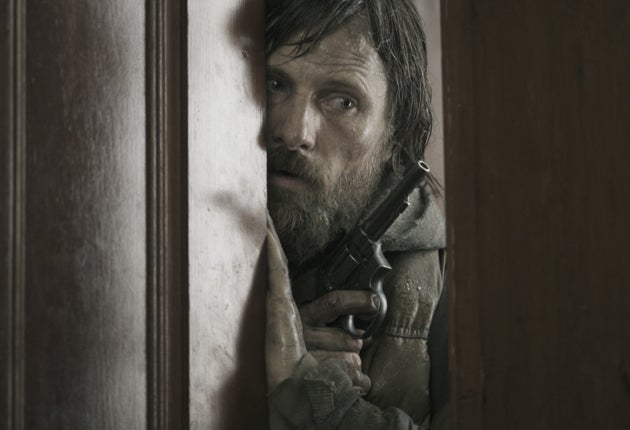
Mortensen plays an unnamed man who is trudging through this wasteland with his unnamed young son (Kodi Smit-McPhee) and a shopping trolley of possessions. They're heading south, but there's nothing in particular waiting for them there, and no displays of heroic action or ingenuity en route. The best they can hope for is to scavenge enough tins of food to keep them going, while evading the fellow survivors who have been reduced to eating human flesh. Mortensen's most urgent wish is that, if he has to, he'll be able to prevent his son's prolonged suffering by shooting him in the head, which gives you some idea of how cheery The Road is.
Mortensen's performance is astounding. Looking a lot more like Gollum than Aragorn, he's shaggily bearded, smeared in grime and shockingly thin, with cheekbones like lemon juicers and teeth like the visual aids in a school anti-smoking lecture. Smit-McPhee is by necessity more chubby cheeked than his counterpart in McCarthy's novel, and the father-son bond isn't quite as moving as it should be. The story could be more exciting, too. It's a series of unconnected episodes – one of them featuring a superb, unrecognisable Robert Duvall – that's a little too effective at getting across the weary dreariness of the characters' travels.
These quibbles aside, what The Road does better than any film I can remember is immerse the viewer in a completely realised other world, without any jolts in tone or logic to break the spell – and all without the aid of 3D glasses. Everything in it contributes to the dismal but magical atmosphere, from the blasted landscapes and the spare, poetic dialogue to Nick Cave and Warren Ellis's haunting backwoods church music and the persistent rumble of earthquakes and falling trees. Directed by John Hillcoat (The Proposition), and scripted by Joe Penhall, it feels like the end of the end-of-the-world genre. After The Road, every other global disaster movie is going to be a picnic.
If Hollywood's post-apocalyptic films are usually packed with action and CGI, Hollywood's romantic comedies usually revolve around tortuous misunderstandings between people who have yet to pay off their student loans. So It's Complicated deserves some credit for taking characters who are well past the first flush of youth and placing them in circumstances that might conceivably happen. Those characters, played by Meryl Streep and Alec Baldwin, were married for 20 years before he left her and married his much younger mistress a decade ago. Since then, Streep has stayed single and built up her chi-chi delicatessen (second only to primary-school teacher as the most fashionable job for rom-com heroines). But then the two exes have a drunken fling on the eve of their son's graduation, which leads them to a novel situation: an illicit affair between a woman and her ex-husband.
Written and directed by Nancy Meyers (Something's Gotta Give, The Holiday), the film is the soft, warm, doughy comfort food it was no doubt intended to be. The screenplay is jovial; the actors twinkle and Mamma Mia! fans should love it. But there's one overriding problem. I won't be the first critic to say this, or even the hundredth, but It's Complicated isn't complicated enough. Streep and Baldwin are so delighted by their liaisons that there's no chance of anyone getting hurt except Baldwin's current wife, Lake Bell – and the film treats her with utter disdain.
Nor does the ending come as any surprise, given that Streep has to choose between Baldwin's vulgar, narcissistic adulterer, and her other suitor, Steve Martin, who may look as if he's coated with Teflon, but who's vulnerable, generous, unattached and an architect (the most fashionable job for rom-com heroes). The air of complacency is made even sleepier by the wealth and privilege which slosh around the characters, a regular annoyance in Meyers' films. Maybe the affair would have been more complicated if it hadn't been conducted in such luxurious boudoirs.

Watch Apple TV+ free for 7 day
New subscribers only. £8.99/mo. after free trial. Plan auto-renews until cancelled.
ADVERTISEMENT. If you sign up to this service we will earn commission. This revenue helps to fund journalism across The Independent.
Watch Apple TV+ free for 7 day
New subscribers only. £8.99/mo. after free trial. Plan auto-renews until cancelled.
ADVERTISEMENT. If you sign up to this service we will earn commission. This revenue helps to fund journalism across The Independent.
Also Showing: 10/01/2010
Mugabe and the White African (90 mins, (12A)
This revelatory documentary tells the story of two white farmers in Zimbabwe who are striving to stop their land being "acquisitioned" by the government.
Although their struggles have ground on for years, the film focuses on their international court case against Robert Mugabe in 2008. It excels as a courtroom drama, a tense thriller, a ringing call to arms, and, most of all, as a humbling portrait of the unflappable, indefatigable farmers and their families.
Exam (96 mins, 15)
Eight job candidates are locked in a concrete bunker and given 80 minutes to write down their answer to one question. The only snag is that they have no clue what the question is. This low-budget British chamber piece has an intriguing scenario, so it's a shame that the po-faced, sci-fi-tinged screenplay fixates on the applicants' efforts to detect invisible ink on their exam papers.
Fireball (94 mins, 15)
Murkily lit Thai martial arts movie combining cage-fighting and...erm...basketball.
Join our commenting forum
Join thought-provoking conversations, follow other Independent readers and see their replies
Comments