White Material, Claire Denis, 102 mins (15)
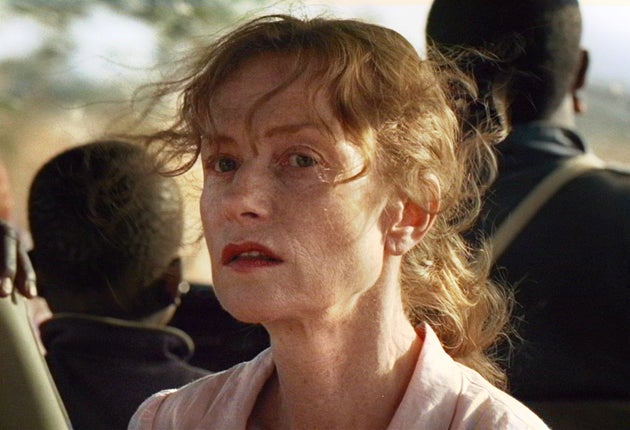
Isabelle Huppert is superb as a Frenchwoman clinging to her plantation in Africa in the midst of chaotic regime change

Get our free weekly email for all the latest cinematic news from our film critic Clarisse Loughrey
Get our The Life Cinematic email for free
French director Claire Denis excels in two very different modes – the intimate and the apocalyptic.
Her last film, 35 Shots of Rum, was one of the best in Denis's intimate vein – a ruminative family portrait that offered a tender but unsentimental picture of togetherness. In her apocalyptic mode, however, Denis is focused on breakdown – of society, emotions and meaning. That's what you get in White Material, an African-set vision of collapse.
The setting is an unnamed country in the throes of regime change. Frenchwoman Maria Vial (Isabelle Huppert) is trying to sustain the coffee plantation she runs with her ex-husband André (Christophe Lambert), but unknown to her, he has other plans. The country is tenuously under the control of a rebel militia whose figurehead, "the Boxer" (Denis regular Isaach de Bankolé), is on the run. With the regular army preparing to regain control, French forces have moved out, warning the remaining white residents that they're on their own if they stay behind. But Maria is determined to stay. Is she heroic, or self-serving and deluded? Denis keeps us wondering.
Despite the above, the story isn't quite so easy to sum up. No doubt you could map out a logical timeline for this flashback-laden drama – which is considerably less fragmented than some Denis films – but then, why would you? In Denis's work, everything operates in a perpetual present tense, in which you're always aware of the moment, or of a series of overlapping moments. Her stories don't pan out with strict coherence, but follow a fluid logic close to that of consciousness itself.
It's not easy to untangle Maria's progress – her various journeys, encounters with hostile militia, spats with André. But all these moments carry a heightened, anxiety-laden charge: they all take place in a continuous hyper-intensified Now, evoking the way that people experience periods of impending calamity.
Huppert is a specialist in such Now-ness, her undemonstrative immersion in her roles always suggesting characters who dissolve into the worlds they inhabit. Huppert, who evokes Maria's tension and drive with superb understatement, is also French cinema's specialist in isolation (see her loner heroine in last month's release Villa Amalia). Magnificent as she is opposite others, she is, above all, a great screen soloist, at her most commanding when playing women apart. Maria is often seen alone on an almost empty screen: her dealings with other characters are never engagements as such, but hurried negotiations. This is one of Denis's most provocative films, and seemingly a rather personal one: as the daughter of a French civil servant she grew up in Africa, an experience that inspired her 1987 debut feature Chocolate.
The subject of White Material is delicate: a white woman clinging to her parcel of African land as the colonial legacy crumbles (imagine how uncomfortable it would be to see a fiction film about heroic whites hanging on in Zimbabwe). The Africans she thought she knew have become an unpredictable threat to Maria: the guards who quiz her with contempt, the wandering platoons of child soldiers, the militant reggae DJ who declares, "for the white material, the party's over". Seeming to voice white European fears of blackness, the film plays on one level as a Heart of Darkness nightmare about Africa's revenge.
But as always with Denis, things are more complex. The director's long-standing engagement with black and African culture (from her immigrant drama No Fear, No Die to the Martiniquan background of 35 Shots) has also allowed her to explore ideas that in other film-makers might be construed as smacking of racist paranoia (her I Can't Sleep was about a gay, black serial killer). Co-written by Denis and Marie N'Diaye, a Goncourt-winning French novelist of Senegalese extraction, White Material addresses the untenable condition of latter-day colonialists clutching at questionable roots. However admirable Maria may be in her determination, she lives in a state of fevered denial, not least with regard to her indulged adult son Manuel (Nicolas Duvauchelle). With typical Denis perversity, this key character only emerges from bed some 40 minutes in, then turns from sullen slacker to feral loon in a flash, not altogether plausibly. (Besides which, Denis's odd casting of the heavily tattooed Duvauchelle has you wondering, distractingly, just how Manuel managed to get himself an armful of yakuza-style ink deep in central Africa.)
With Denis films, her perversity comes as part of the package, along with the brilliance. Cavils that certain things don't entirely work, or make sense, must sometimes be suspended – she works on different levels of abstraction and concreteness from most directors. As a result, it's easy to be wrong about her films. When I first saw 35 Shots, I thought it was minor Denis, and it took a while for its subtleties to dawn on me.
Conversely, White Material knocked me out on first viewing, but now I feel it doesn't really come off: its obliqueness feels more like narrative slackness, and the pay-off is alarming and abrupt after the slow accretion of incident. Still, even in her failed films, Denis has a rare knack of taking you to worlds that you wouldn't necessarily want to visit, and making you experience them with pitiless intensity.
Next Week:
In London River, Jonathan Romney sees Brenda Blethyn caught up in the aftermath of the 7/7 bombings
Subscribe to Independent Premium to bookmark this article
Want to bookmark your favourite articles and stories to read or reference later? Start your Independent Premium subscription today.
Join our commenting forum
Join thought-provoking conversations, follow other Independent readers and see their replies