Akram Khan: 'You have to become a warrior'
He's the darling of the dance world, and beyond, with artists such as Anish Kapoor and Antony Gormley lining up to work with him
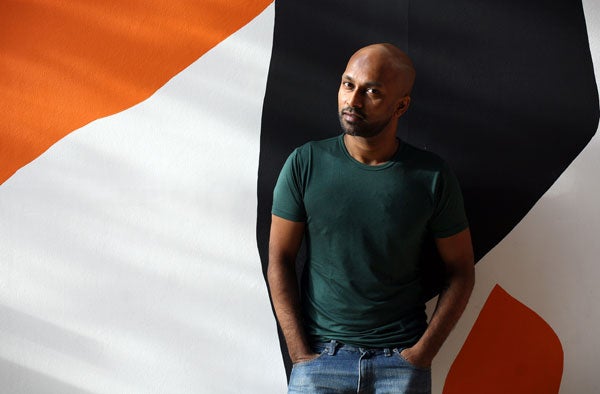
"In Asian culture," says Akram Khan, "you don't have a voice. You just accept what everybody says." It is, I have to say, rather hard to believe now. The darling of the dance world has a reputation for pushing the boundaries of his form, tossing in a visual artist here, a musician there, a writer there, and then maybe adding, just for fun, an actress who's never danced in her life. Hailed as "the great new hope" and "wunderkind" of contemporary dance, "a phenomenon" and "a marvel", he's an (extremely muscular) human whirlwind, leaping from project to project, and travelling the world on an endless, exhaustive, exhausting quest for new ideas, new creative partnerships, new marriages of story and feeling and form. For a man obsessed with the idea of stillness, he's remarkably bad at it. Brilliant on stage, but not so good in life.
Here, on a Saturday night at Sadler's Wells (the only spare hour, apparently, in his entire week) he is all coiled energy and focus. Perched on a plastic chair in a giant rehearsal room that's eerily quiet, this short, bald, brown man has a poised presence that radiates through the room. His voice is quiet and his manner is gentle. "In my community, it was really tough," he says. "I disagreed all the time, but it was in my head." What, this man who has worked with Anish Kapoor, and Hanif Kureishi, and Juliette Binoche, and Kylie Minogue, never stood up to anyone in his community? Ever? "No," he says in that half-whisper, "because it's a form of disrespect."
No wonder, then, that he understands that different kind of respect, the gang culture in which any minuscule signal of the lack of it is enough to pay for with your life. In his new solo work, Gnosis, which opens Svapnagata, a two-week festival of Indian music and dance at Sadler's Wells (co-curated with his friend and regular collaborator, Nitin Sawhney), he plays a hoodie, to a musical background of Dizzee Rascal. "It's something familiar in me," he says, "because that's how I was when I was young. I was a big fan of Michael Jackson and I was really into hip-hop."
That, however, is the second half. The first half is kathak, the classical Indian form that Khan trained in from the age of seven. It's a form that goes back to the nomadic bards of ancient northern India, and one which uses stylised gestures to tell mythological tales. It's the first time he has combined classical and contemporary work in one evening, and the aim, he says, is to explore the story of the Mahabharata in both a traditional and a contemporary context. "I was talking to my wife," he says (the South African dancer Shanell Winlock), "and trying to explain to her about Gandhari, the blind queen in the Mahabharata, but for her to understand I had to tell her everything about it. So that," he adds, "is the beginning of Gnosis. I wanted to talk about inner knowledge, and for me knowledge wasn't in books, because I was pushed to read books."
Ah yes, that strict Asian upbringing again. Work hard, pass your exams, become a doctor or an accountant. With Khan, needless to say, it wasn't quite like that. The son of a Bangladeshi father who ran an Indian restaurant in Wimbledon, and a Bangladeshi mother who had childhood dreams of escape through dance, he started dancing when he was three. "We would do it at mela. It's like an outdoor Indian festival," he says. "I didn't want to, because nobody would sit and watch. People were talking and my mother said 'if you can win this audience, this is the test'. That's where I learnt the most."
By seven, he was studying kathak, under the great kathak dancer Sri Pratap Pawar. At 14, he appeared in Peter Brook's legendary production of The Mahabharata, and the TV version that followed. He always loved dancing, but it was a while before he thought that it was something he could pursue for a career. After studying contemporary dance at De Montfort University and the Northern School of Contemporary Dance, he began presenting solo performances both contemporary and kathak in the 1990s and started his own company, with Farooq Chaudhry, who he describes as his "brother and soulmate", in 2000. Since then, the accolades, and the awards, have poured in: for Sacred Monsters, his astonishing duo with Sylvie Guillem about the quest for perfection; for Bahok, his buoyant exploration of people on the move; for in-i, his moving portrayal, with first-time-dancer Juliette Binoche, of the agony and ecstasy of romantic love; and for Zero Degrees, a truly awe-inspiring collaboration with fellow dancer and choreographer Sidi Larbi Cherkaoui, and sculptor Antony Gormley, that turns a journey through India into a parable about life and death.
It all looks effortless. It isn't, of course. No art is effortless and perhaps dance, which uses the human body as the instrument, least of all. But it does look full of rewards. And yet Khan has said in an interview that the best advice he could give a young dancer would be "don't". Does he mean it? He grins, and for a moment this 35-year-old dance god looks like a teenager. "There's an element of truth in it," he says. "You have to become a warrior and you have to give your body up. There was a point," he adds, "when, for a year, I practised eight, 10, hours a day. It was in an asbestos garage of my father's. There was a cement floor. There was a point when you were crying, but after a while you get used to the pain, so you have to push yourself further."
Bloody hell. And I was cursing that the lift was broken. But isn't this just, well, a tiny bit masochistic? Khan grins again. "It is," he says, "but I think to go deep, you have to kind of give yourself. It's like rugby. I love rugby. My friend used to say 'why are you playing rugby, you're the smallest guy in the whole thing?', but I loved running for my life, the adrenalin of running away from six-foot guys who were ready to pounce on you." Now, he practises for about two hours a day, but tries, he says, "to put 10 hours" into those two. Does he eat fantastically healthily? "No." And smoke? He looks worried, and mentions his mum. And drink? "No. I was working at my dad's restaurant as a waiter and we had these very rowdy, racist men, who were very abusive. I blamed it," he says, "on the alcohol, and vowed that I wouldn't drink."
It reminds me, I tell him, of Zadie Smith's White Teeth, one of the few portrayals in contemporary fiction of the racial abuse of adult Asian men working in Indian restaurants by their young white customers. "Yeah," he says. "It's pretty humiliating. And my father took it. It's a business, after all." So, the usual immigrant experience, then. Identity, in fact, immigrant identity, is the central theme of Khan's work, occasionally, I have to say, to a point where you wish it wasn't. Does he ever feel that it might be time to move on to something else? Khan looks serious now. "Yeah, definitely," he says. "It's interesting, but sometimes it comes back. I went through a phase of really exploring Hindu mythology with Anish [Kapoor]. We did Kaash, with Nitin Sawhney. Ma [a piece inspired by Arundhati Roy's polemic about farmers in India] was about earth. It's usually what's happening in life."
A number of his collaborators, I point out Kapoor, Kureishi, Sawnhey are Asian, and so are some of the writers Arundhati Roy and Aravind Adiga he's said he wants to work with in the future. Is there something there about a shared sensibility? "No," he says firmly, "not at all. It's just because I love their work. It becomes universal." Yes, but so, surely, does the work of a lot of non-Asian artists? "With Anish," he says, "it was just a discovery. I saw his red wall, and it was just at the right time."
Khan thinks Kapoor is a genius. "When I speak to Anish," he says, "he listens, and when he speaks, I listen." What he admires most of all is the way that artists change when they're in the studio, how "they become like a kid with an amazing toy". He seeks out new creative partners by inviting artists he admires to his show, and then for dinner, or coffee. But sometimes, he says, "the wrong chemistry's the right chemistry". He's speaking, it soon becomes clear, about Antony Gormley. "Here's a man," he says, "who's super-tall, giant. I'd have to look up at him and every day without fail he'd come in with another set, to the point where it was like 'oh my God, can we stick to one?' But we did Zero Degrees, and it's probably the most successful, most profound work I've done."
I think it probably is, but it's a tough call because Khan really is an extraordinarily talented choreographer, one who can conjure near-miracles from the human form. At one point, he actually thought he was a genius not in dance, weirdly, but in maths. His grandfather was a mathematical genius (in the Beautiful Mind mould) and, inspired by the mathematical complexities of kathak, Khan began to feel that he might be, too. "There was a point," he says, "where I could codify people mathematically. I could read you like a phone number, depending on the colour of your eyes, your hair, your height." It sounds, I tell him, a little bit crazy. Was it? Khan gives a strange little nervous giggle. "Yah," he says. And did it feel it at the time? "No," he says, "because I was alone."
I have a sudden glimpse of Akram Khan as a child, and then a teenager, isolated in his huge extended family, dreaming, fighting, alone. "The only time I came alive," he says, "was in dance class. When I was a child, the boys wouldn't talk to me. I'd be the only one in the corner of the party, and I'd know 'I'm not invited, my parents are, because I'm not intelligent enough'. And most of the others went to private schools. My sister went to a private school." So, why didn't he? "It was a test of my mum, really," he says. And then he laughs. "Actually, that's a lie. I just never got in. I tried all of them. I didn't get in."
For a moment, he looks sad, but it's clear who's laughing now. Khan, who only left the family home when he married and still lives round the corner, sees his parents every day. His father brings tea in the morning. His mother cooks dinner at night. Khan and his wife have never even switched on their own oven. Now, the boys he grew up with, the accountants who did their homework, and passed their exams, are jealous. His mother is proud. She has always been proud. And his father, the man who night after night suffered the abuse of young white English men, keeps every cutting, every review, every profile. "He rings up the company every week," says Khan. And then he giggles. "It really pisses them off."
'Gnosis' premieres at Sadler's Wells on 16 November. Svapnagata runs until 28 November; www.sadlerswells.com
Join our commenting forum
Join thought-provoking conversations, follow other Independent readers and see their replies
Comments
Bookmark popover
Removed from bookmarks