Aimee Mann's reasons to be cheerful
Aimee Mann's diverse new album, @#%&*! Smilers, is the result of the singer's newly found creative freedom. By Chris Mugan
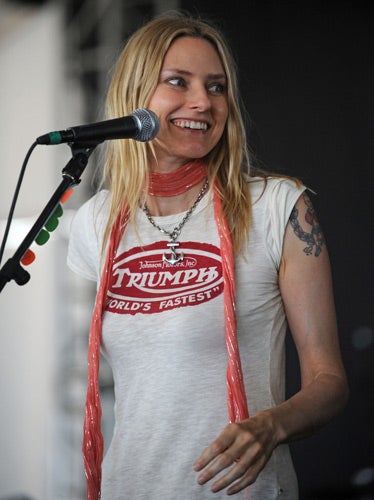
Tall, elegant and with striking blond hair, Aimee Mann makes an unlikely harbinger of music-industry doom. She ought to be an A&R man's dream; as indeed she was, from fronting Eighties pop group 'Til Tuesday though to early solo records Whatever and I'm With Stupid.
Trouble emerged with recordings for her third album. Record company execs asked Mann to return to the studio to provide them with a hit. Instead, she walked out and found sanctuary with film-maker Paul Thomas Anderson, who used her songs to inspire his hit movie Magnolia. Since then, Mann has had no cause to look back, having set up her own label, SuperEgo, which now has its own distribution deal in the UK as well as in the States.
While Mann has enjoyed creative freedom, she has struggled to match the success of the soundtrack that earned her Oscar and Grammy nominations for the track "Save Me". Now she has returned with her best album since indie label debut Bachelor No 2, based around the work her previous label rejected. Her latest album fizzes with variety and invention, both in her writing and musical backing. It also comes with an eye-catching title – @#%&*! Smilers.
She explains its provenance while navigating her way round a full English in her London hotel at 11am. She may still be adjusting her body clock, but is determinedly free from the faddishness of her Los Angeles home – "Your tea can be stronger than coffee, can't it?" she asks hopefully. The album title refers to those aggressive grinners who believe it's their duty to encourage others to copy their inane smirks. "It was originally Fucking Smilers, which you can't really put on a record. I didn't want to make everybody's lives difficult. Me and a friend came across the phrase on a newsgroup, put there by someone fed up with people telling them to smile more."
Mann, like many lyricists, finds the darker side of life more beguiling. "It's obvious, conflicts and problems make for more interesting topics." She denies that she has an antipathy towards people which means she goes round with a constant frown. "I think I'm actually pretty cheerful and optimistic. Almost every single one of my friends is a comedian, so there's a lot of joking around."
Not that you will hear much larking about on Smilers. Instead, its songs explore the dead ends where people end up both in their relationships and lives in general. This will hardly rock the boat for long-term Mann fans, though there is a pleasing breadth of subject matter as the artist offers a variety of perspectives, from the personal snapshot of "31 Today" to the detailed characterisation of "Columbus Avenue", all thanks to the story developed throughout previous album The Forgotten Arm.
"I pretty much base all my characters on real people, exaggerating their situations and '31 Today' is about me, but I was also thinking about people I knew back then – 'getting loaded watching CNN'. There was a guy I went out with for a while who was a musician and had a trust fund, so that's all he did. You can kid yourself that you're staying informed, but really..." Mann herself has turned out fine. Now 47, she is married to another singer-songwriter, Michael Penn, brother of actors Sean and Chris.
Musically, Mann reckons Smilers is her most diverse album since 1995's Stupid. More recent fare has seen her veer from polite background music to trad MOR pop rock. Here, though, the varied writing is matched by differing moods. "Borrowing Time" is led by a woozy synthesiser, while for much of "Medicine Wheel" she is backed only by a stark piano. "Stupid is my favourite record of all the ones I've done because every song had its own world. This is not as extreme because it's one band recorded live so there is a unifying force, but that was the approach."
Mann has picked up a core of key players that allow her to be more free-form in the studio. "They're fantastic musicians and they really care about what they're doing, everybody listens to each other. I've slowly been introduced to the idea that bands should record live and gradually these people have come together." She now believes this is feeding into her live performances, something she has been awkward about in the past. "It's given me a real appreciation of playing live. There hadn't been those moments where you have a real emotional experience with other musicians until I did a few tours as a three-piece and it became more than being on stage hoping I'd sing in tune.

Enjoy unlimited access to 100 million ad-free songs and podcasts with Amazon Music
Sign up now for a 30-day free trial. Terms apply.
ADVERTISEMENT. If you sign up to this service we will earn commission. This revenue helps to fund journalism across The Independent.
Enjoy unlimited access to 100 million ad-free songs and podcasts with Amazon Music
Sign up now for a 30-day free trial. Terms apply.
ADVERTISEMENT. If you sign up to this service we will earn commission. This revenue helps to fund journalism across The Independent.
"There's always something to get anxious about, whether it's a weird fan up front yelling stuff or the monitors shorting out. It's only a disaster because you're trying to keep going. Now I'm letting the music itself calm me." In recent years, Mann has also toured with comics, another edifying influence. "They're always treating everything as opportunities for fun or exploring the possibilities of language, a nice way to approach things on stage, and now I welcome any disasters because it's easier to riff on things that are out of the ordinary than come prepared.
"I'm a really late learner, or a slow learner. I started out incredibly antisocial and depressed, so it took me this long to figure out how to be at ease talking to people and not worrying about every single detail." Nor does she concern herself with the running of her label, though it is clearly in the hands of people she trusts. She believes her previous bosses felt they could pressure her as she was a female artist, and is hardly convinced her peers today are in a much better position.
"Major labels in the States see everybody as raw clay that they can mould into anything, but they have the idea of the female singer-songwriter, who is either the diva or the coffee-house waif and there's not much in between. Both have to be reasonably good-looking and there's an assumption that's the main thing that sells them rather than the music. There are more [solo female artists] around at the moment, but it looks like the industry feels they know how to market them."
In charge of her own destiny, Mann ensures presentation is concentrated less on her and more on the packaging of her records. For the third album in succession, she has brought in a graphic artist to devise its artwork, including a detailed booklet. Lost In Space came with a mordant comic strip, The Forgotten Arm referenced Fifties pulp fiction and now Smilers brings to mind surreal pre-war cartoons, with the title and lyrics subsumed into a zany whole. "My father was in advertising and I love great examples of it. I'm fascinated by propaganda, the whole psychological enterprise. He used to have these books, which I've inherited, Graphis annuals, which had all the best design, posters, book sleeves and anything else."
As Mann progressed as an indie artist, she began to realise the possibilities for her own work, especially when comedian friends introduced her to graphic novels. She is now learning to draw herself and has been approached to devise a graphic novel. The musician is taking lessons from a contact in that field, though realises this could be a long-term project. Then again, as someone who is happy to learn on the job, don't be surprised if next time her art is on the cover.
'@#%&*! Smilers' is out now on SuperEgo
Join our commenting forum
Join thought-provoking conversations, follow other Independent readers and see their replies
Comments
Bookmark popover
Removed from bookmarks