Can Rachid Taha rock the Casbah?
The French-Algerian rocker Rachid Taha tells Andy Morgan why he despairs of his contemporaries but remains in love with life
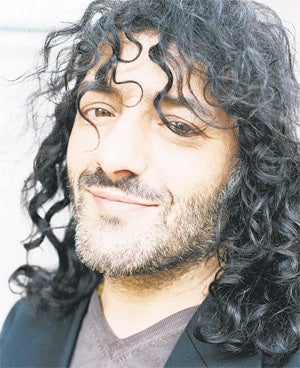
My gaze is glued to one of today's most eccentric rock'n'roll rebels as he stalks the stage in front of the flirtatiously grand Mairie de Paris like a demented scarecrow, a defrocked undertaker, a panto miscreant of the kind that haunts young children's dreams. Rachid Taha is probably the most recognizable person on that bursting stage in the collective eye of the 18,000 strong French crowd, who are both tired and ecstatic after a six hour orgy of African and western musical coupling under the hot Parisian sun.
"Weeee don't laaahhk it!!!! ROCK DA CASBAH! ROCK DA CASBAH!!!" Taha's voice whines atop the rousing racket, like the white spume on a towering wave which teeters and totters but somehow manages not to crash. Pork-pie-hatted Damon Albarn leads the charge together with Taha. Behind them storm a mob-happy crowd of musicians, all rat-arsed on the 90 per cent proof joyousness of the moment. I can see Jamie T, Romeo and Michele from the Magic Numbers, the Kooks, Patrick Wolf, the Kick Horns, too many to register in those incalculable seconds of unity. Africa Express, Rachid et Damon, you, me, white, black, Africa, Europe, roots, pop, rock'n'roll, altogether now... "ROCK THE CASBAH!!"
A few sobering months later, Taha is grudgingly going through the motions of yet another promotional stint for his new album, Bonjour. So hey, let's warm the conversation up over the flame of those sweet memories of the Africa Express gig in Paris.
"It was a sort of Rotary Club gathering, but it didn't go far,' he says. 'In fact, to begin with, what is Africa Express? What's it for?" Erm... to promote African music to a wider audience. Come on, Rachid, mate, you can go along with that can't you?
"Well it isn't the case at all pal!" My skin turns a chicken texture. "Nothing's really changed. I don't see many African artists making it in France right now, or Arabic ones. We're still in the era of the West and America holding on to their role as the arbiters of pop music, of Africa and everything else, even the economy and life itself. Africa is just left to die, just as African culture is just left to die too."
Taha has never gone in for cosy certainties or hippy-hugging harmony. He is a strange growling Franco-Algerian Stetson-wearing rock 'n' roll animal embodiment, of the outlaw archetype.
Those with only a shallow knowledge of Franco-Algerian complexities are prone to misunderstand Taha. They call him a rai artist, alluding to the grinning Algerian pop music style that has dominated the North African diaspora for three decades. It's a bit like calling Iggy Pop a New Romantic. The misclassification used to irk Taha, but not any more apparently.
"I couldn't give a toss, I'm beyond that now," he says. They miscast Taha as a defender and proselytiser of Algerian and North African culture. In fact, a bit like John Wayne in the desperate low-point of one of those John Ford westerns, Taha is an intellectual loner firing his Winchester at smug hypocrisy and half-baked platitudes on all sides. He despairs of most of his fellow North African artists, regarding them as little more than the lazy pilferers of a great musical tradition. He insists that the likes of Khaled, Cheb Mami, Faudel and other pin-ups of the Maghreb make him feel sad rather than angry.
"There's no infrastructure in North Africa equivalent to the one in the west," he explains. "Over there, you don't record a cassette, you just fill it up. Singers are still considered buffoons. There's no real intellectual or cultural interest in what they do, so they're content to just sing for important personages and nothing more. And when they become stars, they bourgeoisify themselves very quickly."

Enjoy unlimited access to 100 million ad-free songs and podcasts with Amazon Music
Sign up now for a 30-day free trial. Terms apply.
ADVERTISEMENT. If you sign up to this service we will earn commission. This revenue helps to fund journalism across The Independent.
Enjoy unlimited access to 100 million ad-free songs and podcasts with Amazon Music
Sign up now for a 30-day free trial. Terms apply.
ADVERTISEMENT. If you sign up to this service we will earn commission. This revenue helps to fund journalism across The Independent.
Taha went back to Algeria, a country which he left with his parents at the age of 10 to live in a village in eastern France, for a series of concerts in 2006.
"They were in French cultural centres. It's always frustrating to play in places like Algeria. I always come back dissatisfied, with a suitcase full of pain. Either it's all very intellectual and bourgeois, or you go popular and play in stadiums. Or it's nothing at all, except weddings perhaps. But can you see me playing at barmitzvahs and weddings?"
You might have expected all these brain-burning struggles and disillusionments to turn Taha into a moody, cynical man. But the opposite is true. He protects himself by staying on the eternal offensive, shooting from the hip with little regard for the consequences and remaining determinedly in lust with life.
Back in the late 1970s, when Taha was in his early twenties and working in a heating appliance factory in a suburb of Lyon, he started a club called Les Refoulés ("The Rejects") where he would splice bits of Oum Khalthoum and other Aarbic pop classics onto Led Zeppelin, Bo Diddley and Kraftwerk backbeats. His first serious group, Carte de Sejour ("Resident's Permit") was a kind of Maghreb-punk shock machine who stuck it to the French Man with a remake of Charles Trenet's classic "Douce France". Imagine Asian Dub Foundation gobbing out "The White Cliffs of Dover" in the early 1980s and you should get the feel of Taha's talent for upsetting cosy collective sanctities.
Then came hits such as "Voilà Voilà", a flame-fisted techno-rant against the rise of the extreme right in France, and a rocking cover of "Ya Rayah", a classic elegy on emigration written by the great Dahmane El Harrachi. Taha's version remains one of the most popular hits of modern North African music. Both these songs, and a clutch of revolutionary albums, were the product of Taha's 22-year association with the British producer Steve Hillage, a marriage that recently ended when Taha decided to work with Gaetan Roussell, a close friend and the lead singer of the massive French rock band Louise Attaque.
"You have to leave home at some point, you have to kill your daddy," Taha says about the breakup. "I can thank that relationship for where I am today, but to be honest, I was totally fed up. I think of Steve from time to time, and maybe I'll go back to him one day, but I don't look back. Nostalgia is not for me."
But where exactly is Rachid Taha today? With the success of "Voilà Voilà", "Ya Rayah", and his participation alongside Khaled and Faudel in the epic 1-2-3 Soleil concert at the Bercy stadium in Paris, which yielded a million-selling live album, Taha was definitely a big star in France in the 1990s. But he never bothered to capitalise on that status. Commercial strategies and speculations just bore him frigid. When I ask Taha about the collapsing recorded music industry in France he just quips, "hang on, I'll pass you my Financial Director and you can talk to him." Ok, 'nuff said.
The truth is, Taha is on the same solitary road that he's always walked. Bonjour is an optimistic album, with songs of love, respect, hope and, yes, a little anger too, riding astride his signature pounding rockabilly beats and Bo Diddley stomps, all meshed together with swirling Arabic riffs and motifs. One remarkable song called "Selu", exhorts all of us, and no doubt Taha himself, to "consult the angels", who he then proceeds to list: Khalil Gibran, Mahmoud Darwish, Naib Mahfouz, Cheikh Hamada, Youssef Chahine, Blond Blond, Kateb Yacine, Frantz Fanon and Camaró*de la Isla.
I ask Taha about de la Isla, the doomed poet-hero of Spanish Flamenco. "He was the greatest singer of all time, alongside Elvis Presley," answers Taha. "He was also the last punk." I almost say, "except you Rachid, except you," but I just keep schtumm. We can't all be honest outlaws.
'Bonjour' is out now on Wrasse records
Join our commenting forum
Join thought-provoking conversations, follow other Independent readers and see their replies
Comments
Bookmark popover
Removed from bookmarks