Courtney Pine - 'I became one of the most hated saxophonists of all time'
Despite his billing as one of Britain's most celebrated and influential jazz artists, Courtney Pine tells Ian Burrell that it hasn't been an easy ride to the top table
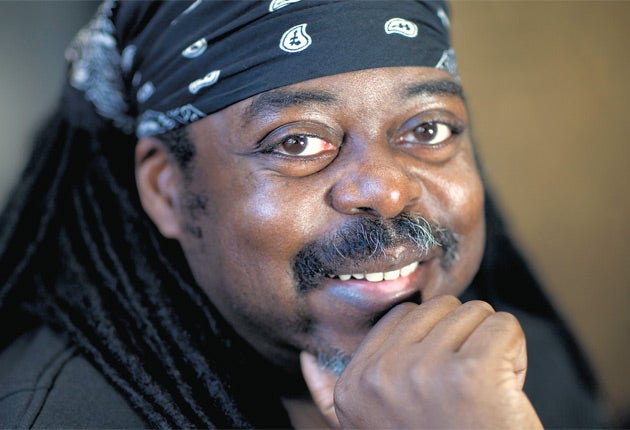
He might be Britain's most famous saxophonist, but Courtney Pine spends an awful lot of time in the dog house. Sometimes he's in the metaphorical kennel to which the jazz establishment consigns those who don't conform to its maxims. But more often he's down in the garden shed, practising his musicianship in the place he really does call "the dog house".
Recently, the sound of the instrument wafting across the gardens of Harrow, north-west London, has not been the saxophone but the rare timbre of the bass clarinet. For the first time in his long career, Pine has made an album on which he exclusively plays this "much hipper instrument", which he hopes will become "a new voice in the jazz world".
The album, Europa, is eclectic, a collection of the sounds and flavours of the European countries that Pine has toured for more than two decades. "I've been to Budapest, the Red Square and Turkey, and I'm picking up tunes and instruments and languages and I've tasted the food – and I'm thinking, 'How can I put this story into one album?'"
Tall and broad with long dreadlocks gangling from beneath a black bandana, Pine is a striking figure. His thrilling 1986 debut album, Journey to the Urge Within, transformed the jazz world and gave a platform to new British black musicians such as the pianist Julian Joseph, drummer Mark Mondesir and singer Cleveland Watkiss. The son of Jamaican immigrants, Pine later released Closer to Home, which highlighted his Caribbean roots and his teenage career as a reggae musician. He is also closer to the streets than some of his jazz contemporaries and has done collaborative work with drum'n'bass and hip-hop artists.
All of which might make an album inspired by Scandinavia and Eastern Europe, with song titles in Spanish and Norwegian, seem like a departure. Not at all, he says, arguing that the recording is a "continuation" of his story, another reflection of his life. "I've always talked about my African, Caribbean and European roots, so this makes sense. I could go and do a George Gershwin tribute or the songs of Louis Armstrong, but this is about my environment and my travels."
Although the album won't be released until 25 February, he will perform the material for the first time at the London Jazz Festival on 15 November with the band that he handpicked for the project. The jazz bassist Alec Dankworth, son of John and Cleo Laine, has lived in Spain and inspired some of the Spanish elements on Europa. On piano, Pine has the classically-trained Zoe Rahman, who was nominated for the Mercury Prize in 2006. He is working with his "favourite drummer" Mondesir for the first time in 17 years.
He is hoping that the recording will leave a lasting legacy. "The album is deep, man. It's not an album I should be doing. I should be making disco commercial records with [grime rapper] Tinchy Stryder! But I just had this wake up moment – 'When are you going to do one of those albums?' I thought 'Okay, I've got my own label, I'm still gigging, I've got the bass clarinet and the musicians, let's do it now'."
The earthiness of the bass clarinet, he says, makes it ideal to tell the story of these European journeys. Asked if he's trying to raise the bar, he compares learning to play the instrument to doing the pole vault. "The reason why it hasn't been used so much in jazz is because it's so very hard to play," he says, citing American bass clarinet greats Bennie Maupin and Eric Dolphy, and European exponents Louis Sclavis from France and Henri Bok from Holland.
Pine, like some of those others, is a saxophonist who first played the clarinet at school. Now 46, his journey to the top table of British jazz has been less straightforward than some assume. Speaking in Soho, the epicentre of the London jazz world, he says he has rarely headlined at that neighbourhood's famous Ronnie Scott's club, so that when people tell him they "Saw you at Ronnie's" he treats the compliment with some suspicion. He saw his first jazz gig at that same venue as a 15-year-old, being mesmerised by the American trumpeter Freddie Hubbard, in spite of the attempts of the club's doormen to persuade the teenager that he wouldn't enjoy it.

Enjoy unlimited access to 100 million ad-free songs and podcasts with Amazon Music
Sign up now for a 30-day free trial. Terms apply.
ADVERTISEMENT. If you sign up to this service we will earn commission. This revenue helps to fund journalism across The Independent.
Enjoy unlimited access to 100 million ad-free songs and podcasts with Amazon Music
Sign up now for a 30-day free trial. Terms apply.
ADVERTISEMENT. If you sign up to this service we will earn commission. This revenue helps to fund journalism across The Independent.
His hopes of taking his study of the saxophone into the realms of higher education were thwarted when he was "kicked out" of school while doing his music A-level and told there was "no point" in him trying to reach university. At 16, Pine was already travelling the country at weekends with the reggae band Inity Rockers and some of his teachers, he suspects, may have wanted to take him down a peg. The experience clearly still rankles, though he is now a professor of music at Thames Valley University with honorary doctorates at Westminster and Southampton.
When he achieved fame, the jazz world, instead of rejoicing at the renewed interest in the genre, was not universal in its enthusiasm. "Because I hooked up a deal with Island Records and got lots of promotion I became one of the most hated north London saxophonists of all time," he recalls. Even now, there is "this jazz police in this country that claim they know everything about jazz," he says, adding that "this music is stronger than them."
Though he praises the London Jazz Festival for the diversity of its programme, other international events have succumbed to the commercial demands of a financially pressured music industry, meaning that an artist like Pine, who releases his material on his own label Destin-E, struggles to get bookings, in spite of having performed to crowds of 8,000 in his career.
As a teenager, Pine was aware of the iniquities of the music business when he played with reggae acts on television programmes in the Eighties and realised that some of the pop artists could neither sing nor dance. "I thought what's going on, you have this person miming on stage and getting paid six grand and you've got musicians like the great Harry Beckett playing in a pub for change," he says, referring to the great British trumpeter who died this year. "I just stuck to my guns." So he still practises religiously in the dog house, a red mark on his lip a permanent sign of dedication to his craft. His compositions usually begin on his Yamaha C3 grand piano and he composes from score using a laptop and the Sibelius computer programme.
The album that will follow Europa will be a collaborative work with some of the great veterans of British jazz. "John Dankworth has gone and Harry Beckett has gone," he says regretfully. "I want to do an album called Legends with guys like [trombonist] Rico [Rodriguez], [pianist] Russ Henderson and [saxophonist] Andy Hamilton, who is 92. I need to do something with these guys from the old school. As opposed to working with the younger musicians, I want to go the other way."
Courtney Pine appears on a double bill with New Orleans trumpeter Christian Scott at Royal Festival Hall, London SE1 (www.londonjazzfestival.org.uk) on Monday 15 November
Five to see at the London Jazz festival
Herbie Hancock, Royal Festival Hall, Saturday 13 & Sunday 14 November
A member of Miles Davis's second great quintet, the Grammy Award-winning pianist will perform the live version of his latest recording, 'The Imagine Project'.
Sonny Rollins at 80 Barbican, Saturday 20 November
The last of the great bebop saxophonists is still on form; his energy astonished the audience at last year's sold out show.
Juliette Greco Royal Festival Hall, Sunday 21 November
A muse for Sartre, Camus and Cocteau, Greco (above) sings songs by Brel and Gainsbourg and performs her first London show in 10 years.
Cleo Laine Barbican, Tuesday 16 November
The queen of British jazz is sadly without her partner of decades, Sir John Dankworth, but will appear alongside the next generation of Dankworths, bassist Alec and singer Jacqui.
Chucho Valdés Barbican, Thursday 18 November
The greatest Cuban pianist, alongside eight-piece The Afro-Cuban Messengers, performing their new release, 'Chucho's Steps'.
Join our commenting forum
Join thought-provoking conversations, follow other Independent readers and see their replies
Comments