David Bowie - An absolute beginner
After David Bowie's first album flopped he ran a folk night in Beckenham, studied mime and, fortunately, wrote Space Oddity, the hit that saved his career. Now his unloved debut is being re-released. Will Hodgkinson reports
It is hard to believe now, but there was a time when David Bowie wasn't quite sure how one went about becoming a pansexual glam rock superstar. In 1968, four years into an unsuccessful musical career, he recorded "In The Heat Of The Morning", a sinister love song with an urgent melody that his then manager, Ken Pitt, considered the perfect vehicle with which to project this unknown singer to stardom. Bowie's label, Deram, rejected the song, as they had his previous offering, "Let Me Sleep Beside You". It was the final nail in the coffin for what had not been a fruitful relationship between label and singer.
The reissue of the 1967 album David Bowie gives us a picture of one of our most creative pop stars scrabbling about in the trough of showbusiness, in search of an identity. Having released a handful of unsuccessful R&B singles as Davy Jones and the Lower Third, Bowie was trying pretty much everything on his debut album, perhaps with the notion that something must stick. There is Pink Floyd-style eccentricity ("Uncle Arthur"), matinee-idol crooning ("When I Live My Dream") and groovy London pop ("Love You Till Tuesday"). There is even an attempt to introduce buddhist philosophy to the 60s teen scene, with "Silly Boy Blue". None of it worked, but it all fed into the making of a unique star.
Bowie was a fan of the British vaudeville actor-singer Anthony Newley and the "space mysticism" (his words) of Pink Floyd's Syd Barrett. He was living in a converted ambulance, virtually penniless, touring the country and performing in small clubs. Pitt came across him on 17 April 1966, when he was playing London's Marquee Club.
"David oozed charisma and was in total command of himself," says Pitt. "I was particularly struck by the artistry with which he used his body, as if it were an accompanying instrument." Pitt was also impressed by Bowie's choice of material. Alongside the usual R&B covers was a rendition of "You'll Never Walk Alone". "It was daring and delightful. From then on my ambitions were his ambitions and I hoped that one day I would be able to concentrate on him as my only client."
Pitt noted Bowie's interests in pop, mime, music hall and storytelling, and saw in him the possibility of an all-new, all-singing, all-dancing, multi-operational pop artist. He took him to the theatre for the first time — to see Joe Orton's Loot, among other productions — and encouraged an interest in literature, citing Bowie's enthusiasm for André Gide's If It Die and Albert Camus' The Outsider. He played him the first record by the Velvet Underground, brought back from a trip to New York.
"I placed the VU on the turntable," Pitt says. "As he so often did when aroused or excited he threw one leg up, tucked it under the chair and sat on it. Particularly delighted with one track, he smiled at me and said, 'I'm going to pinch that'."
Pitt's first attempt to make Bowie a star involved taking a demo to Hugh Mendl of Deram, a progressive pop subsidiary set up by the Decca label in order to revive its dowdy image. Decca's in-house producer, Mike Vernon, was given the job of taking Bowie's strange songs and turning them into something the young, record-buying public might be interested in.
"I had never heard of him," Vernon says. "My first reaction was: he's a young Anthony Newley. There was a dramatic, show-tune influence in the songs and a storytelling approach that was unique at the time. He was hip, even if he wasn't famous, and I realised that producing this record would broaden my horizons. The whole album, from going into the studio to mastering, took a week."
Its creator has done his best to distance himself from it, but David Bowie has an eerie charm, filled as it is with slightly seamy tales of parochial life that could have been lifted from one of the Joe Orton plays Bowie had seen with Pitt. On "There Is A Happy Land" he sings of how "sissy Stephen plays with girls"; on "Uncle Arthur" he recites the tale of a 31-year-old man who runs home to his mollycoddling mother after his girlfriend proves to be a terrible cook. And on "Love You Till Tuesday" he appears to be taking on the guise of a frivolous stalker, creepily referring to himself as "little me" and hiding in apple trees until getting bored of the girl he is shadowing.

Enjoy unlimited access to 100 million ad-free songs and podcasts with Amazon Music
Sign up now for a 30-day free trial. Terms apply.
ADVERTISEMENT. If you sign up to this service we will earn commission. This revenue helps to fund journalism across The Independent.
Enjoy unlimited access to 100 million ad-free songs and podcasts with Amazon Music
Sign up now for a 30-day free trial. Terms apply.
ADVERTISEMENT. If you sign up to this service we will earn commission. This revenue helps to fund journalism across The Independent.
Vernon says: "I remember thinking, 'This is a really quirky record – who on earth will buy it? But when we did 'Love You Till Tuesday' I could see that Bowie was special. I thought, 'If we can come up with a song which has that certain something, this guy might just go somewhere.'"
The song that Deram decided had that certain something was "The Laughing Gnome". Perhaps it is time to re-evaluate this much-mocked novelty single. Backed by a rhythm pinched from the Velvet Underground's "I'm Waiting For The Man", this tale of meeting a little man who looks like a "rolling gnome" and packing him off on a train to Eastbourne, only to come back home and find him living in the chimney, has the kind of perverse wit that has run through Bowie's career.
"'The Laughing Gnome' took almost as long as the entire debut album to record because we had to do all the speeded-up vocals, which was quite difficult in those days," Vernon says, referring to the gnome's chipmunk-like parts, that were provided by Bowie himself. "It became a top-10 hit a few years later, by which time Bowie was famous. It was a terrible embarrassment to him, but to all concerned it was only ever intended as a funny children's record."
Bowie has never talked about his debut in public. Now, David Bowie is being reissued on the same day as the release of a live album from his Reality world tour of 2004. The collision suggests a wish to bury this portrait of his former self. But as Vernon says, "David can't really disown it because that's the way he was at the time".
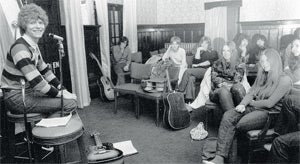
In April 1968, Pitt told Bowie that he needed to write a new song if he was ever going to make it. Bowie had recently seen 2001: A Space Odyssey and, inspired by Stanley Kubrick's success in capturing a sense of existential intergalactic loneliness, he came up with "Space Oddity". Pitt gave a demo of the song to Deram, but the label had gone cold on its would-be star. Bowie retreated to suburban Beckenham to run a Sunday night folk club in The Three Tuns pub and study mime under Lindsay Kemp. Pitt concentrated on making a promotional film, LoveYou Till Tuesday, which included "Space Oddity".
Pitt says: "When one morning a cameraman said to David, 'Well, if it isn't Major Tom,' I suspected that we had finally found that long-hoped- for hit."
David Bowie is released on 25 January on Deram/Universal. David Bowie: A Reality Tour is released on Sony Music
Join our commenting forum
Join thought-provoking conversations, follow other Independent readers and see their replies
Comments
Bookmark popover
Removed from bookmarks