Ed Harcourt - 'I always make music, I write all the time. I can't do anything else'
Singer-songwriter Ed Harcourt breaks a six-year silence to tell Elisa Bray about a new album that draws on unusual instruments purchased on the internet and the contrasting lessons of failure and new fatherhood
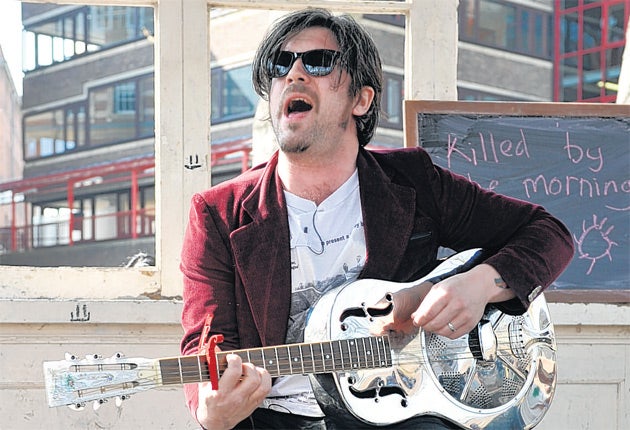
How am I doing?" Ed Harcourt asks, hopefully, midway through our interview at a pub near his west London home. He is, understandably, feeling cautious. This is the singer-songwriter's first interview in six years. He released his last album four years ago.
"I don't think anyone wanted to interview me about The Beautiful Lie," he says. "I think people weren't really interested in it. My friend said it was half anthemic, half anti-social. It's like the bête noire of the albums."
The Beautiful Lie was released two years late in America and Harcourt was dropped by EMI. He began to question what he was doing.
"I didn't really know what to do with myself," he recalls. "I was really bored and sick of myself and my music. I had tried for seven years to make it and break into the mainstream and it didn't happen so I thought, 'I'll have a break, go on the back burner.'" So he went away to write a film score and started collaborating and song-writing with pop artists such as Paloma Faith and Lissie. With an obligation to produce a fifth album for EMI, he was pushed into making a "best of", which seemed somewhat premature, considering he had made only four records and was just 29.
That his break from writing new material was a good move, however, is proven by his newest album, Lustre. The maudlin approach of The Beautiful Lie has been replaced by uplifting songs. Some critics have called it his finest work yet.
"In places [The Beautiful Lie] is rather maudlin and morose and I didn't want to make an album like that," he says. "Every record is like a reaction to the last one. I was a lot more focused and knew what I wanted to do – there was no fluff around the edges. I went in with the 11 songs arranged and ready for recording."
Any thoughts he had about giving up songwriting were not to last. "I think I'm a bit over dramatic, to be honest. Like most egocentric, dictatorial musicians I'm a bit of a control freak and I just said, 'I'm never going to do another album.' I always make music – I'm writing all the time. I can't really do anything else."
Born to a diplomat father, he and his two brothers grew up all around Europe while the family lived at various British embassies. At the age of nine, Harcourt started to learn the piano. He had achieved grade eight by the age of 17 and he was offered a place at university to read music. He turned it down.
"The idea of having to analyse, dissect and everything would com-pletely destroy any enjoyment," he says. "Can you imagine having to write a whole dissertation or spend three months studying one piece of music? You'd never want to listen to that piece of music again."

Enjoy unlimited access to 100 million ad-free songs and podcasts with Amazon Music
Sign up now for a 30-day free trial. Terms apply.
ADVERTISEMENT. If you sign up to this service we will earn commission. This revenue helps to fund journalism across The Independent.
Enjoy unlimited access to 100 million ad-free songs and podcasts with Amazon Music
Sign up now for a 30-day free trial. Terms apply.
ADVERTISEMENT. If you sign up to this service we will earn commission. This revenue helps to fund journalism across The Independent.
He puts on a posh voice and bellows: "'In the 46th bar, the augmented fifth occurs after the glissando...' I couldn't imagine anything worse."
You wonder why he applied to read music in the first place, but then Harcourt could undoubtedly have passed with top marks. At one point, our conversation turns to the American instrument creator Harry Partch Later, Harcourt shows me his studio. Tucked away in Kensal Green, its sound-proofed chambers are filled with eccentric pictures, guitars and obscure antique instruments, many bought on eBay. Like a child wanting to show off toys in a play room he takes me round, demonstrating a mechanical xylophone, a Marxophone dating from 1912, an octophone, an orchestron, mellotrons and a bowed saw.
"I like writing songs around the instrument – the instrument dictates how the song's going to sound," he says. "I've recently been buying lots of plug-ins for instruments like mellotrons and orchestrons, Chamberlain strings and glass harmonicas and cloud chamber bowls."
At 32, Harcourt has achieved a lot as a songwriter and producer. After he released his first album, Here Be Monsters, he supported REM and Neil Finn. He recalls the golden days of being signed to a major label. "When I was on Capitol, I remember coming to [the industry festival] SXSW in Texas for the first time. I got to the airport and this guy walked up to me and said, 'Are you Ed? I'm Brett, I'll be your limousine driver for the four days that you're here.' I was 23 years old and was like, 'OK! Bring it on!' All the people I met there would come in the limousine – we had quite a good time. That definitely added to the bill, I think."
Does he resent EMI for dropping him? "They gave me a head start and I don't think they really knew what to do with me," he says. "But they helped me along the way, which was good. I can't imagine that I helped with their massive debt. I probably helped the debt get bigger."
Of all the people Harcourt has written songs with, there is one artist who makes him nervous – Patti Smith. "I don't know what it is about her," he says. "She's such a force on stage and I played a song with just her singing. And then even more nerve-racking was the Songs of Innocence at the Meltdown that Patti Smith did [in 2005]. We were doing "Inchworm" from Hans Christian Andersen and it was Yoko Ono, Marianne Faithfull, Sinead O'Connor, Patti Smith, Tori Amos, Beth Orton, Miranda Richardson and Tilda Swinton all on stage.
"I was playing piano, just sitting there, not really knowing the song. The man who runs the Festival Hall had his hand on my shoulder, going, 'It's OK'. Sinead O'Connor was looking at me, saying, 'What do I do now?' and I'm like, 'I don't know!'"
Harcourt's home is surrounded by music. He married Gita, the first violinist he auditioned for his band, and she has been touring with him ever since. Their baby daughter is perhaps responsible for the lighter mood of Lustre.
"You can't help but be inspired by it," he says. "Being someone who evidently wears his heart on his sleeve, I tend to write about things that happen to me. I try to put it in a way to communicate so people can relate to it."
The album's final song is called "Fears of a Father". "It's just about trying to be that person and be more responsible. It's a growing-up album, I guess. It's so personal, it's like an open letter to what was, when I wrote it, an unborn child. It's saying I've changed a lot in the last four years – I was always worried that if I matured I would become really boring and conformist and too comfortable. I'm a bit more zen about things, whereas I was a lot more hot-headed, knee-jerk, reactionary. But I'm still passionate about stuff."
Seeing his enthusiasm today, and hearing his latest songs, who could doubt it.
'Lustre' is out now on Piano Wolf
Join our commenting forum
Join thought-provoking conversations, follow other Independent readers and see their replies
Comments
Bookmark popover
Removed from bookmarks