Jon Thor Birgisson: 'I like being a social outcast'
Gaunt, vegan and introverted, as the lead singer of Iceland's biggest export Sigur Ros, Jon Thor Birgisson made for an oblique rock star. Now, however, as he embarks on a solo career, he says he's happier than ever...
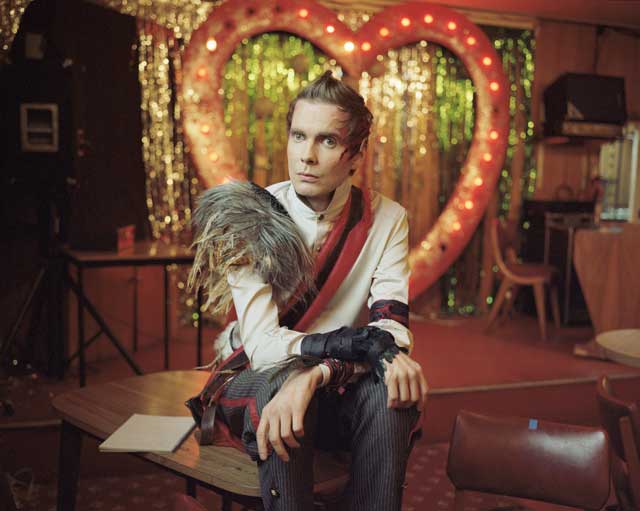
Deep within the base- ment of an East London working-men's club, two men who have never been inside such a place before sit beside one another having pink make-up applied to their faces, glitter to their cheekbones, and feather epaulettes to their shoulder pads. Frequently, they catch one another's eye and giggle in a manner that would doubtless prompt censorious disapproval here on an average night.
One of them is Jon Thor Birgisson, more conveniently known to the world as Jonsi, lead singer of Iceland's biggest musical export, Sigur Ros, and the other is Nico Muhly, a classically trained Philip Glass protégé from New York who has previously composed music for the likes of Björk and Antony and the Johnsons. Together, they have collaborated on Birgisson's debut solo album, Go, a bewitching record that captures the singer at his most uncharacteristically ebullient. For someone who has, in the past, sung mostly in a manner redolent of the world's loneliest polar bear, he now sounds positively happy. It suits him.
"Ha-ppeee?" he repeats, pronouncing the word with several "e"s in his crunchy, consonant-heavy English. "I suppose so, yes. I think what has happened is that my personality is finally coming out. I have allowed it to. I am committing myself to being more, you know... more playful."
The pair are here today to record four songs for a DVD that will, at some point, be repackaged onto a special edition of the album. With limited time in which to promote the record together (an in-demand classical composer, Muhly has, he says, "four billion projects on the go") this is perhaps their best opportunity, and they want to make the most of it. Hence the make-up, and the presence of a pair of peacocks.
Between songs, I ask Birgisson the significance of the birds. He shrugs. "I'm not really sure, actually. But a couple of nights ago, me and Nico got very drunk and we decided it would be good. It would make it more of a performance. At least, that was the idea." He appraises them now with a cool eye, one eyebrow arching. "I have to say, I had hoped they would have got their tail feathers out for us, perhaps during the choruses? But they are not doing much. They just stand there. Pity."
The show over, Birgisson now retreats to a corner table with a bottle of water he will neither drink from nor open, but will fiddle with continually nevertheless. Gaunt, rake-thin, and sporting a Tintin quiff, the 34-year-old is one of the more unlikely rock stars of his generation. Though he grew up with a profound love of (mostly obscure) music, and an ambition to make it himself, he never imagined anyone would care enough to listen. "When you live in Iceland, so very far away from everything else, you have no concept that anything you do will be heard outside of Reykjavik," he says. "I still don't know how we managed it."
Sigur Ros's music always was deliberately oblique – one album was called (), and each of its eight songs were nameless – but though resolutely inward-looking, it nevertheless went out and discovered the world on their behalf. Their 2006 single "Hoppipolla" became a ubiquitous presence on television as the soundtrack to any piece of film that contained in it wonder, whether a spectacular goal on Match of the Day or a piece of David Attenborough-narrated wildlife. The royalty cheques alone would change their lives. "All that was totally crazy," Birgisson says now. "We couldn't escape that song. Trust me, we tried. We went back home to Reykjavik. We hid."
But that, Birgisson insists, was then. He has loosened up considerably since. "I think I have learnt to let go of myself a little bit more now," he suggests. And it's true, he has certainly mastered the art of conversation where once he could only stutter, sigh and maintain an enigmatic (read: frustrating) silence. "I think we were guilty of taking ourselves too seriously back then. It was our defence. We were four very serious young men, full of principles on everything. But, you know, slowly you let go of all that. You grow up. I think I realised that we are all going to die one day whatever happens, and that you can have fun along the way. It is allowed."
After the band's last studio album, Meo suo i eyrum vio spilum endalaust ("With a Buzz in Our Ears We Play Endlessly"), Birgisson decided to do something different. "I'd been in Sigur Ros for 16 years; I'd earnt it." Last year, as Jonsi & Alex, he and his American

Enjoy unlimited access to 100 million ad-free songs and podcasts with Amazon Music
Sign up now for a 30-day free trial. Terms apply.
ADVERTISEMENT. If you sign up to this service we will earn commission. This revenue helps to fund journalism across The Independent.
Enjoy unlimited access to 100 million ad-free songs and podcasts with Amazon Music
Sign up now for a 30-day free trial. Terms apply.
ADVERTISEMENT. If you sign up to this service we will earn commission. This revenue helps to fund journalism across The Independent.
artist-producer boyfriend, Alex Somers, released Riceboy Sleeps, a largely instrumental album of mood music. His solo album, Go, was initially to be an acoustic record of reflective songs but, after involving Muhly, of whom he was an ardent admirer and who promptly added his own "ecstatically joyful" bent, it became something far more sparkly.
The album also marked another significant departure for the singer in that he mostly sings in English. (Previous records have been sung either in Icelandic or his own made-up language, "Hopelandish".) That said, Birgisson still sings in a hard-to-decipher psychobabble that serves mostly to keep his mystery intact. Only the song titles reveal true glimpses of the man within, the most intriguing of which is "Sinking Friendships".
"It's a classic break-up song," he says, smiling awkwardly. "I suppose I have gone through many. Growing up gay in Iceland, I didn't know anybody else like me, so I really didn't know how to... what's the word? Proceed?" He says that he found it impossible to tell the difference between like and love, a condition that brought with it problems. "Basically, I fell in love all the time, with all of my friends. That made for lots of... drama, a lot of awkwardness, and so much misunderstanding. I had to apologise a lot."
For the past few years, Birgisson, a vegan, has been a disciple of raw food, and he speaks about it with a passion he can never quite match when discussing his own music. Having studied the subject and even written a book about it (unpublished, but dispensed freely among friends), he is quite the expert. The fact that so many of us remain ignorant of its benefits fills him with disdain. And if this makes things awkward for a man who likes to eat out a lot, then it's a kind of awkwardness Birgisson has always sought. It's another way for him to stand out from the crowd. "It makes you a social outcast, definitely, but I think I like that. I sometimes think I am drawn to obscure food the same way I am to obscure music. I like to be different. But I also very much like raw food itself. It's wonderful! Tasty! Who wants a horrible burger when they can make their own cheese instead? I make my own, from macadamia nuts. It tastes very..." Nutty? "No, cheesy. You should try some. You'll never look back."
Which reminds him. He checks his watch, and then his stomach, and realises that he has missed lunch. What he really wants to do now is head into Soho for food. I ask him whether it will be difficult to find a restaurant that caters specifically to his requirements?
He grins widely. "No, no. I've phoned ahead. They're expecting me."
Jónsi's EP 'Go Do' is out on 22 March. The album 'Go' is out on 5 April, both on EMI
Join our commenting forum
Join thought-provoking conversations, follow other Independent readers and see their replies
Comments
Bookmark popover
Removed from bookmarks