Regina Spektor - Refugee from Soviet kitsch
Regina Spektor's family fled Moscow for the United States but, she tells Fiona Sturges, it was a conversation on an Israeli mountain that began her transition to New York alt-folk darling
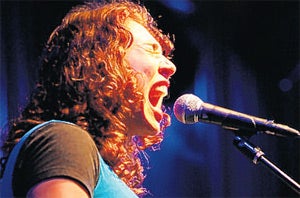
One minute there's nothing, and the next there's a song, explains Regina Spektor, dreamily. "I never know where it comes from. It's as if the words are there in the air around me and I happen to be in the right place at the right time. I feel joy, even euphoria, but also fear. I think: 'What if it doesn't happen next time?'"
The Moscow-born, Bronx-bred musician is trying, with some difficulty, to explain the process of songwriting. But it's as much a mystery to her as it is to those of us who listen. As she tells it, each of her songs are born of a unique coincidence of time, place and the channelling of mystical forces.
Spektor is small and doll-like, with Shirley Temple curls framing a heart-shaped face. Even in the grips of a heinous hangover – last night she performed a new number, "Blue Lips", on Later... with Jools Holland, and then partied into the night – she has a twinkle in her eye that suggests a woman of keen intelligence though ever so slightly away with the fairies.
"Quirky", "kooky" and "oddball" are words frequently applied to Spektor, though they do little justice to her talent. Taking in Weimar cabaret, Russian polka, whimsical folk and sultry blues, her music is heartfelt, eclectic, and laden with atmosphere. She is a brilliant storyteller, conjuring eccentric characters and painting lurid backdrops in the vein of Nick Cave or The Handsome Family. Her influences are as much literary as they are musical. She has described her songs as short plays, which goes some way in conveying the complex plots and sub-plots that lie within. Her singing is as varied as her music, shifting from a hushed whisper to Björk-like ululation and back again. As one rapt reviewer put it: "When she opens her mouth, the universe comes out".
Those who admire Spektor do so with fierce devotion. Recently an impostor used her name to set up an account on Twitter and provided frequent and convincing updates to a following of 30,000, leading to Spektor's inclusion in The Times's Top 50 celebrity tweeters list (the account has since been de-activated). It was proof not only that Twitter can be a playground for fantasists, but that Spektor's fans really do hang on her every word.
They are not above passing judgement either. Last year Spektor performed at a benefit for Planned Parenthood, a charity organisation which is pro-choice. Following the show her manager was inundated with letters from fans who felt that Spektor should not have taken part.
"It was a surprise to me because I had assumed that people who listened to my music would share my views," reflects Spektor. "I'm a strong believer in the many sides and stories, and they had a right to tell me that. But it made me realise there's so much I assume about people, and they assume just as much about me."
Spektor has long resisted attempts both by journalists and fans to pin down the singer behind the songs. "When you're using your own voice people think you are talking directly to them and about yourself," she says. "But I don't want to obscure anything. I have a hard enough time talking about myself in interviews as it feels it might take away from the freedom of the music. I try to stay out of the way of the songs as much as I can."
Her new album Far, the follow-up to 2006's platinum-selling Begin To Hope, offers little in the way of clarification, drawing as it does upon a range of perspectives and voices. There's the divine supplication of "Laughing With", which reflects on life's fundamental horrors and then exhorts us all to lighten up, and "Folding Chair" which archly paints a portrait of domestic and spiritual harmony ("I've got a perfect body but sometimes I forget") and culminates, spectacularly, in Spektor impersonating a dolphin. In "Blue Lips" the singer homes in on human shades – "blue lips, blue veins," – before zooming out to "the blue colour of the planet from far, far away." It's a work of concentrated passion and originality.

Enjoy unlimited access to 100 million ad-free songs and podcasts with Amazon Music
Sign up now for a 30-day free trial. Terms apply.
ADVERTISEMENT. If you sign up to this service we will earn commission. This revenue helps to fund journalism across The Independent.
Enjoy unlimited access to 100 million ad-free songs and podcasts with Amazon Music
Sign up now for a 30-day free trial. Terms apply.
ADVERTISEMENT. If you sign up to this service we will earn commission. This revenue helps to fund journalism across The Independent.
Spektor worked with four different producers on the album, one of whom was Jeff Lynne, of ELO and Traveling Wilburys fame. Spektor knew nothing of his history but after hearing Tom Petty's Highway Companion, which Lynne produced, requested to work with him anyway. While most artists look to a single producer to give the songs on their album a sense of cohesion, for Spektor it was the opposite. "You might want to have some cohesion in your outfit but not in your music," she smiles. "I never write songs for an album and there's never any great concept. The songs that end up on my albums are there because I like them best. If I could have used more producers, I would."
Spektor has always been a prolific songwriter though she confesses that with her current schedule of promotion and performance, the stream of songs has moved "from an open faucet to a steady drip. They still accumulate and I have a huge backlog. There are many songs from the old days still waiting their turn. I would need two years in the studio to record them all."
While she grew up in the Soviet Union, writing pop songs was a long way from Spektor's mind. From birth she was in training as a concert pianist, and played a Petrof piano handed down from her great grandfather. The family lived a comfortable life in Moscow – her father worked as a photographer and her mother was a music professor. But in 1989, nine-year-old Spektor emigrated to the United States along with her parents, aunts, uncles and cousins, and set up home in the Bronx. Their passports were destroyed by border security, ensuring they could never return home. "It was pretty intimidating," Spektor recalls. "Even then it was seen as a real betrayal to leave."
The family had a boom-box on which they listened to old cassettes of the Beatles, Moody Blues and Queen. The young Spektor was also entranced by the hip-hop and Latin music she heard.
Having left her beloved Petrof behind, she practiced piano on an out-of-tune upright in the basement of the local synagogue until her father befriended a Manhattan music professor. His wife was a Peruvian pianist and she agreed to give Regina lessons.
Spektor studied diligently throughout her teens despite the growing feeling that she would never make the grade as a classical pianist. As a consequence, she spent several years "as a very worried little person. All I could think was, 'what the hell was I going to do with my life?'" It never occurred to her that she should sing and write songs, and it took other people to point out the obvious. During a five-week student trip to Israel in 1996, a group of friends overheard her singing as she hiked up a mountain.
"They were really supportive. They would say, 'you have a really good voice, you should do something with that'. After a whole bunch of kids had said this to me I thought, 'holy shit, maybe this is what I should be doing'. They said, 'you should play an instrument,' and I said, 'but I do play an instrument!'"
In the late Nineties Spektor began performing at open-mic nights in Manhattan and found her spiritual home on the Lower East Side's anti-folk scene, which also fostered the careers of The Moldy Peaches and Ben Kweller.
"It wasn't a style, it was a community and an attitude that connected people," she recalls. "It was, like: 'We don't care about the industry and the mainstream. We do whatever we want to do and if people want to listen, that's great'. It was more about words and less about music. Skills were sort of uncool.
"I loved that scene, as it was a very nurturing place to be. Everyone was broke but everyone went to each other's shows, nursing the same beer all night to save money. You would see some great moments in music, even if there were only nine people watching."
In 2001 a friend of a friend invited her to his studio to record a few songs. Spektor put a dozen tracks on a CD and began selling it at gigs. At the same time she took series of temporary jobs. One summer she worked on a butterfly farm, another at a gynaecologist's office. For a time she even worked as an assistant to a private investigator. All the while she lived a sparse existence, collecting free make-up samples at drugstores and skipping meals.
Spektor looks back fondly at the camaraderie of the Lower East Side days, though she is equally cautious about romanticising the past. "I don't want to fall into that trap," she reflects. "It's easy to forget what it was really like being flat broke and spending hours on the subway every day getting in from the Bronx. I miss the time I had which allowed me to write songs and to see friends and family. But now there's so much that I get to do. I get to go to festivals and meet musicians that I've only ever dreamed of hearing live. I get to work with producers of an incredible calibre. All of a sudden I'm playing on Jools Holland and I get to have four wonderful string players. Now I perform in front of thousands. I wouldn't trade that for anything."
'Far' is on Warner Bros. Regina Spektor will perform at Latitude and T in the Park
Join our commenting forum
Join thought-provoking conversations, follow other Independent readers and see their replies
Comments
Bookmark popover
Removed from bookmarks