Review of the Year 2009: Michael Jackson
Off the wall, even in death
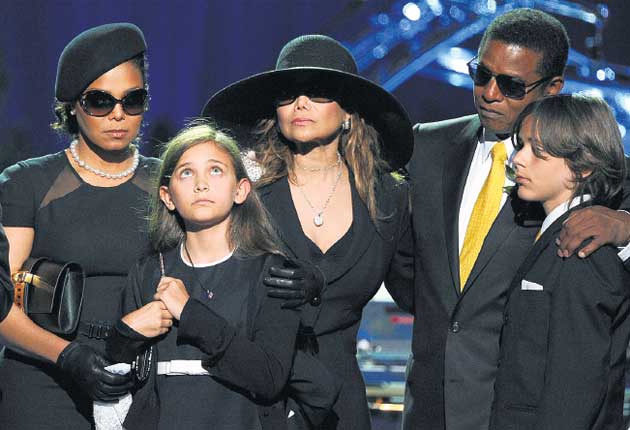
Few things, amid the madness and sensationalism that marked Michael Jackson's extraordinary life and still-mysterious death, were so grimly appropriate as the manner in which the world marked his passing. On 7 July, his body was carried in its solid-gold coffin to a sports arena in downtown Los Angeles, where an 8,000-strong crowd, plus a global TV audience estimated at one billion people, bore witness to popular music's equivalent of a royal funeral.
The memorial service, 12 days after Jackson's sudden death, was at times genuinely moving. It showcased the soaring talent that touched the world, taking him from the rust belt of Indiana to global super-stardom. It demonstrated how he had bridged the gap between black soul and white pop music, selling 750m records, and releasing, in the shape of Thriller, the best-selling record ever. But it also a provided a reminder of the circumstances that contributed, over the final quarter-century of his pantomime existence, to his endlessly sad decline.
Jackson's was a cautionary tale. As a child star in a 1970s family troupe called the Jackson Five, he'd learned how to sing and dance with an improbable poise that few men, or women, will ever match. As a young adult, he'd popularised the moonwalk, and became one of the most gifted songwriters, lyricists and producers of his generation. But the enduring tragedy of his too-short life, borne out in the extravagant headlines that continue to fill newspapers, was that private shortcomings would eventually end up consuming his public genius.
You could see as much in the running order that morning. One speaker was the actress Brooke Shields, a former girlfriend, who failed to mention, in her tearful tribute, that she'd last seen the singer 18 years previously and, like most of his nearest and dearest, had since been cut off. Another was the Reverend Al Sharpton, who boldly claimed there was "nothing strange" about this notorious eccentric who once made friends with a chimpanzee. In the audience, overshadowing the singer in death as he had through life, sat Joe, the abusive father who had already used the tragedy to plug a business venture.
It was, in other words, a bizarre and troubling event that summed up a performer whose life had too much razzle-dazzle, and too little substance. Yet there were times, during gospel songs, show-stopping performances from Mariah Carey and Stevie Wonder, and an affecting moment when his daughter Paris spoke of "the best father you could ever imagine", when you could for a moment peer behind the mask and glimpse the haunting reach of his old possibilities.
History will record that Michael Joseph Jackson died in the summer of 2009 as he prepared for an unlikely comeback tour. He'd managed, in his 50 years, to achieve a level of combined celebrity and notoriety that may never be matched.
For a time, in the 1980s, he was the world's most brilliant performer: an energetic genius, who churned out hit after hit, and built, a few hours' drive from Los Angeles, a gaudy Hearstian home called Neverland. In death, he proved himself still capable of stopping daily life in its tracks.
History will also show that, some time around his 30th birthday, cracks had started to appear in Jackson's character. His appearance began changing; youthful good looks gave way to a bewildered caricature. He had failed to make any real friends and instead accumulated an impenetrable circle of mercenary advisors. "Michael is one of the most talented people I've ever known," his lawyer John Branca later concluded. "At the same time, he's made some of the worst choices in advisors in the history of music."
Over recent years, there'd been money problems. There had been uncomfortable questions about his relationships with children, which, despite his sensational acquittal when he was tried for paedophilia in 2005, he never managed to shake off. For most of his final decade, following a disastrous appearance in a documentary by Martin Bashir, Jackson withdrew into in Howard Hughes-like isolation.

Enjoy unlimited access to 100 million ad-free songs and podcasts with Amazon Music
Sign up now for a 30-day free trial. Terms apply.
ADVERTISEMENT. If you sign up to this service we will earn commission. This revenue helps to fund journalism across The Independent.
Enjoy unlimited access to 100 million ad-free songs and podcasts with Amazon Music
Sign up now for a 30-day free trial. Terms apply.
ADVERTISEMENT. If you sign up to this service we will earn commission. This revenue helps to fund journalism across The Independent.
A welter of confusion and mystery swirled after his sudden death at around noon on 25 June, from a cardiac arrest that followed a sleepless night in which he'd been given a cocktail of dangerous prescription drugs. The world looked for someone to blame. People criticised AEG, the concert promoters who twisted his arm into agreeing, after years in which he'd been largely seen in wheelchairs, to return to stage. They raised eyebrows at Conrad Murray, the doctor with money problems who is likely to face criminal charges in connection with what a coroner has officially ruled a homicide.
In print, on the airwaves and online, a cottage industry of revelation sprang up, with news sources competing to out-bid each other with tales of Jackson's needle-marked body, and gaunt physique. Dubious old associates came out of the woodwork to deliver paid punditry. At some point, the website TMZ became an indispensable source of reliable information.
The public, meanwhile, fell back in love with Jackson's music, causing his net worth to soar, for the first time in years. Prisoners in the Philippines became a YouTube sensation, performing "Thriller". His surviving family began bickering over a billion-dollar estate.
Now, of course, Jackson has been buried. A tribute film, This is It, is fading into obscurity. The LA court system will spend 2010 poring over the gory details of his death, and wrangling over the will continues. But aside from lawyers, it's difficult to find any winners in the troubling tale of Michael Jackson. When he passed away, news anchors spoke of a king being dead; the sad truth was that he'd never really been allowed to live.
Join our commenting forum
Join thought-provoking conversations, follow other Independent readers and see their replies
Comments
Bookmark popover
Removed from bookmarks