The Black Panthers: The soul survivors
The Black Panthers' enduring influence on popular culture is to be marked with a concert at the Barbican. Is it a legacy worth celebrating? By Clive Davis
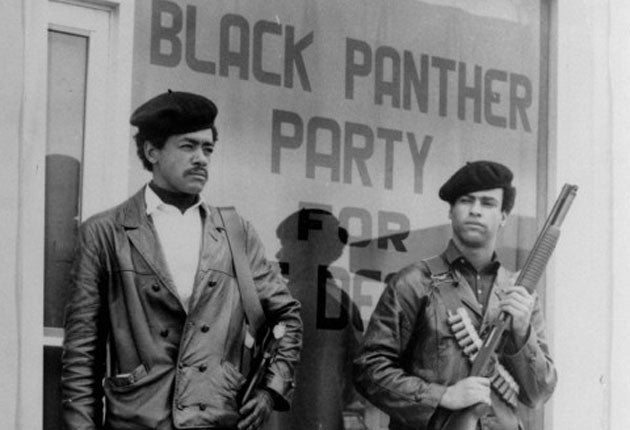
The revolution may have fizzled out before it could be televised, but that hardly deters its admirers from reliving its finest moments. Almost half a century after the Black Panthers began toting guns on the streets of Oakland, and Tom Wolfe lampooned their celebrity supporters in an essay that added a new term to the lexicon – "radical chic" – the Marxist movement and the art and music it inspired are to be celebrated in a world premiere at the Barbican, in the very belly of the capitalist City of London.
A multimedia event featuring the raucous saxophone of Oakland-born David Murray, the project – entitled Tongues on Fire: a Tribute to the Black Panthers – will bring together members of the "conscious" hip-hop group The Roots and the funk metal band Living Colour, as well as Abiodun Oyewole and Umar Bin Hassan, veterans of The Last Poets, the radical versifiers whose streetwise polemics paved the way for a generation of rappers.
At the centre of the show will be the artwork of Emory Douglas, who, as the group's self-styled "Minister of Culture", created strident, Maoist-influenced images of defiant revolutionaries taking on "the pigs" to a soundtrack of power-to-the-people slogans. Documenting what was, according to your point of view, a bold urban rebellion or a mere example of Sixties street theatre, Douglas fashioned an influential vocabulary that was a forerunner of the clenched-fist street art of our own Banksy.
Rich in convoluted artspeak, the promotional material for the concert promises "to highlight the efficacy of the visual, oratorical and musical arts as a means of communicating ideas". Murray's playing, happily, has always been rather more eloquent: a volcanic blend of avant-garde sheets of sound and stately echoes of Ellingtonia, it somehow evokes both the free jazz pioneer Albert Ayler and the old-school romantic Ben Webster. Now 55 and based in Paris, he was a Panther sympathiser in his teens, and recalls helping to give out leaflets when the party's co-founder, Bobby Seale, unsuccessfully ran for mayor of Oakland in 1973.
At the Barbican he will be introducing a clutch of new melodies embellished with eight poems from Bin Hassan and Oyewole, plus verse from The Roots' MC Black Thought (alias Tariq Trotter). If all goes well, it promises to be a stimulating marriage of jazz sophistication and hip-hop energy. Bin Hassan and Oyewole's texts are denser and more enigmatic than the average two-dimensional rap, but they still convey a streetwise sense of urgency: "The Panther is yawning, the rhythm and blues. Conservative smiles on The Five O'clock News. Here comes Rush, here comes the ground. Here comes the fury, here comes the sound."
Is the audience going to be subjected to an evening of right-on agitprop? Valérie Malot, the French promoter behind the show, insists that it is not a celebration of violence, but simply an attempt to summon up the spirit of the age. "It was a violent time. Obama is in the White House now, but you have to remember what it was like to be a black man in America in the 1960s. What we are trying to show is that the revolutionary ideas can disappear and the art can remain."
So the struggle continues, sort of. Even though they dwindled into irrelevance before the end of the Seventies, the Panthers, their guns, their afros and their attitude still help to define popular culture, for better or worse. Few people nowadays read Soul on Ice, the bestselling collection of essays by Eldridge Cleaver, the movement's "Minister of Information". Co-founder Huey Newton was gunned down by a drug dealer in 1989, by which time he had long since fallen from grace, due in part to his addiction to crack cocaine. But thanks to groups such as rappers Public Enemy – who lauded the Panthers in "Party for Your Right to Fight" – the exploits of Newton and Seale have attained mythic status. Mario van Peebles added to the mystique in his 1995 movie, Panther, which depicted them as tribunes of the people who were undermined by an FBI conspiracy to discredit them.
Even in the supposedly "post-racial" atmosphere of Obama's America, the Panthers remain the ultimate bogeymen, as can be seen in the current brouhaha over the antics of the New Black Panther Party, a black supremacist fringe group that has, in fact, been disowned by Newton's spiritual heirs. Claims that the Justice Department turned a blind eye to attempts by activists to intimidate voters at a Philadelphia polling station in 2008 have given wild-eyed right-wing pundits and bloggers another excuse to denounce the Obama administration. In these febrile times any mention of Panthers – even faux-Panthers – is enough to set off a new round of the culture wars.
You don't have to be an avid viewer of Fox News, though, to wonder if the veneration of the ultra-cool Panther ethos is a healthy phenomenon. The dress code may have been hip (David Murray, for one, has fond memories of the leather coats and tams), but what about the ideas? True enough, the movement's famous armed street patrols arose as an understandable response to well-documented police brutality against ordinary citizens. (When they launched the party in 1966, Newton and Seale took advantage of a Californian law that permitted citizens to carry a loaded rifle in public as long as it was publicly displayed and not pointing at anyone.) Using the money donated by their VIP supporters the Panthers also set up free breakfast programmes for children and launched their own schools and medical initiatives.

Enjoy unlimited access to 100 million ad-free songs and podcasts with Amazon Music
Sign up now for a 30-day free trial. Terms apply.
ADVERTISEMENT. If you sign up to this service we will earn commission. This revenue helps to fund journalism across The Independent.
Enjoy unlimited access to 100 million ad-free songs and podcasts with Amazon Music
Sign up now for a 30-day free trial. Terms apply.
ADVERTISEMENT. If you sign up to this service we will earn commission. This revenue helps to fund journalism across The Independent.
But there was a much bleaker side to their activities, documented at length in The Shadow of the Panther, a biography of Newton published by the late African-American journalist Hugh Pearson back in 1994. Pearson had grown up admiring the Panthers, and initially accepted the oft-repeated line that the negative stories about them were largely the invention of the FBI's dirty-tricks unit. But the deeper his research carried him, the more disillusioned he became.
The story he uncovered was one of an idealistic group that degenerated into fierce ideological squabbles, became addicted to violence and exercised a Mafia-like hold over its territory, extorting cash from local businesses. Fuelled by a superhuman intake of Courvoisier and cocaine, Newton soon slipped into paranoia, using his praetorian guard to attack and even kill his opponents, real and imaginary. Women may have been sisters in the struggle, but they were often treated as mere sexual accessories. As for the FBI's campaign of destabilisation, Pearson accepted that it existed but argued that many of the Panthers' woes were self-induced.
When The Shadow of the Panther appeared – buoyed by a lengthy and positive review in The New York Times – Pearson's critics on the ultra-Left frequently denounced him as a sell-out. Yet one of America's most thoughtful and iconoclastic commentators on race, the academic John McWhorter – a regular contributor to The New Republic and the African-American online journal The Root – insists that the book's analysis is fundamentally sound. As he told me: "I am aware of no coherent defence of or second look at the Panthers. They entice as an image, but that's all. In the end, their legacy is some photographs."
Ah, but what photographs. The shots of Newton and Co in their pomp are as redolent of an era as those of Tommie Smith and John Carlos giving their Black Power salute at the 1968 Olympics. (The portrait of Newton seated in a throne-like chair once graced many a student bedsit.) At a time when mainstream images of black masculinity were still thin on the ground, and when white America could barely cope with the decidedly non-threatening Sidney Poitier, the Panthers represented a bold new version of African-American manhood.
Whether or not they left behind a genuine legacy is another matter. Eldridge Cleaver, after going on the run and spending years in exile in Algeria and France, ended his days as a born-again Christian and conservative Republican. (He died in 1998, aged 62.) Bobby Seale gravitated to youth community work, but made headlines again in the late 1980s when he published his Barbeque'*with Bobby cookbook.
It's easy to see why the Panther worldview, with its heady blend of machismo and utopianism, meshes so neatly with that of hip-hop. John McWhorter may be a self-confessed fan of The Roots' discs, but in his recent book, All About the Beat: Why Hip-Hop Can't Save America, he expresses his unease at the way in which rappers' right-on laments about society's ills are greeted by academics and cultural commentators as if they were heavyweight sociological analysis. America has moved on from the Sixties, he says, and the old slogans denouncing white racism no longer resonate with a society which faces more complex challenges. "Hip-hop's politics are sincere," he writes, "but its proponents are unaware that these politics are a dead end."
The same could have been said of the Black Panthers, of course. Perhaps their legacy survives because so many of us have convinced ourselves that symbolism matters more than substance. Huey Newton may be dead, but radical chic lives on.
Tongues on Fire: a Tribute to the Black Panthers, Barbican, London EC2 ( Barbican.org.uk) 11 September
Join our commenting forum
Join thought-provoking conversations, follow other Independent readers and see their replies
Comments
Bookmark popover
Removed from bookmarks