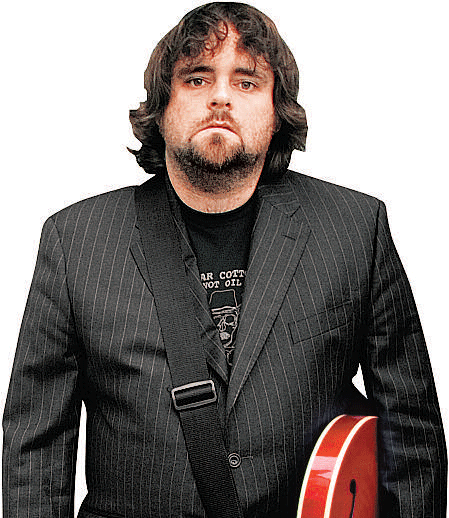
The stocky, articulate Chris T-T looks like Jack Black without the manic twitches, while the lean, equally garrulous Frank Turner resembles Ed Norton’s Disquieting Derek Vinyard in American History X. Both of these bolshy folkies are from Winchester (“I’m furiously middle class,” claims Turner), both sport beards, both swear profusely and they’re both signed to Xtra Mile Recordings, the fiercely independent record label.
The two solo singers were touring their punky, provocative brand of social-folk/antifolk around California when I caught up with them on the LA leg of their trip.
Critical plaudits have been showered on these two passionate singers, but mainstream success eludes them, as does, surprisingly, recognition by the folk community – “I have a weird and possibly controversial relationship with the word ‘folk’,” Turner admits. However, the 26-year-old exhibitionist has already garnered a degree of notoriety for fronting the hardcore punk outfit Million Dead for four years, before the quartet acrimoniously split up in 2005.
After growing up with a love of heavy metal and bands like Iron Maiden (“I could never imagine music could be this cool”), Rancid and Henry Rollins, Turner caught the folk bug after immersing himself in Johnny Cash and Billy Bragg’s music. He duly ditched the deranged gig experiences and started on his never-ending folk tour, playing from his accomplished first two albums, Sleep is for the Week and Love Ire and Song. He’s played extensively around the UK and the US, supporting Biffy Clyro, headlining the Softcore Tour with the singers Jacob Golden and Jonah Matranga and winning over crowds at the Reading and Leeds festivals, both defining moments where he finally felt he’d “moved out of the shadow” of Million Dead.
Chris, on the other hand, first attracted widespread attention on the back of his overtly political mini album 9 Red Songs, from 2005, in which he covered the hefty themes of war, the Countryside Alliance, urban decay and death. One of the highlights of this vexed and plucky record is “Tony’s Heart”, with these memorably scabrous lyrics about our former Prime Minister: “‘It’s his heart,’ they said, ‘Feels like it’s giving out’/ He was admitted to the doctor’s care/ but when they opened Tony up, it wasn’t there.”
The album, which bears obvious comparisons to Billy Bragg at his most enraged, was a defining moment for Chris T-T (which stands for Thorpe-Tracey), a solo artist who had been knocking around the folk and indie circuit since the start of the decade, supporting the likes of Ben Folds, British Sea Power and The Divine Comedy and achieving some renown with droll ditties such as “Eminem is Gay” (“He gives it out like a kid in a sweetshop/Lipstick all over his chainsaw”).
“Since 2005, my politics had been a covert thing rather than overt, until 9 Red Songs where I made a conscious decision to write folk protest songs for a record,” Chris explains. “I wanted to test the water with political songs, and I’m still not convinced it was the right thing to do.”
Chris, who is seven years older than Turner, is a tad less assured in his opinions and actions. While Turner, who was educated at Eton College (“I spend most of the time apologising where I went to school; the place turned me into an anarchist”) and whose grandfather is a bishop, is totally uninhibited about expressing his views, Chris is more circumspect and bashful. “I’m not all that photogenic and I’m not that strong a musician,” he confesses.
Both singers have received a surprising amount of rejection from the English folk community, a notoriously unyielding and insular music scene, dominated by folk dynasties such as the Carthys and the Lakemans. While Chris is philosophical about it, Turner is plain livid.

Enjoy unlimited access to 100 million ad-free songs and podcasts with Amazon Music
Sign up now for a 30-day free trial. Terms apply.
ADVERTISEMENT. If you sign up to this service we will earn commission. This revenue helps to fund journalism across The Independent.
Enjoy unlimited access to 100 million ad-free songs and podcasts with Amazon Music
Sign up now for a 30-day free trial. Terms apply.
ADVERTISEMENT. If you sign up to this service we will earn commission. This revenue helps to fund journalism across The Independent.
“I need to watch my tongue. I disagree with some of the people who run the British folk scene,” says Turner. “There’s a lot of family ties and that’s fine, but even Billy Bragg had trouble getting in with the folk scene and that’s ridiculous. They objected to the fact he was from a punk background.”
“I’m outside of the folk community, too,” says Chris. “There’s a community of what’s called real folk, folk that’s based around the Watersons and Martin Carthy and that scene has only tenuous links to new folk.”
Turner, warming to the subject, adds: “Keeping old songs and traditions alive is wicked, but if it’s a form that doesn’t do anything or go anywhere it loses the most important part of it.”
“Tradition should be vibrant, it should be evolutional. People come down too hard on innovation in folk music, which I think is a shame,” he concludes.
Chris has received a particularly bad time from this community, especially after his prickly song “Preaching to the Converted” from 9Red Songs, which featured lyrics that gently roasted one of his heroes: “Nobody’s got any good red songs anymore/ And Billy Bragg’s gone fishing in his four by four.”
“I went on tour with Bellowhead and to get on that tour was brilliant, because they’ve got a big folk audience,” says Chris. “They’ve got a big age range too; the big traditional folkies love them and some young people also. They’re very careful with their material choice and arrangement choices; they stay within these rules of trad music.”
“I thought I had a fantastic tour, but then I got absolutely slated on the folk message boards, describing me as ‘this miserable songwriter’ and they didn’t want a non-folk act on the tour. There was a feeling that I was taking away from the set time of Bellowhead, which I wasn’t.”
Turner echoes Chris’s sentiments, somewhat more vociferously. “I’m a massive fan of Chris’s stuff and I cannot understand why he’s not welcomed with open arms by the folk community,” he says. “They should be all over this new talent like a rash and they’re not and that seems idiotic to me as 9RedSongs is the best UK folk record since Billy Bragg’s Talking with the Taxman about Poetry.”
It’s a bold claim, but Chris T-T is certainly one of those frustratingly overlooked English talents, and one of those rare performers who manages to be amusing, erudite and challenging, like a blend of Randy Newman, Paul Simon and Sebadoh. In a righteous world, he’d be lauded as the new Billy Bragg or Morrissey, but perhaps with the very catchy anthem “This Gun is Not a Gun” his time has finally come. This rousing call-to arms song features on his new LP, Capital, and the final segment of his trilogy of albums about London. Like its predecessors, The 253 and London Is Sinking, Capital , which features Razorlight’s drummer Andy Burrows and the luscious vocals of Emmy the Great, is another archly political assault on the nation’s capital city, attacking urban decay, the Iraq war, failing infrastructure and promoting, well, revolution, especially on the tracks “Let’s Do Some Damage” and “(We Are) The King of England”.
“Capital is full of this violent streak,” Chris confesses. “People will think it’s a continuation of 9 Red Songs, but I think this album is more covertly political.
“I think young people in England are just struggling to survive,” he adds. “I like Frank’s anti-Thatcher song and I agree with its underlying premise that we older people have culturally deprived youth to such a great extent that why should they engage with politics?
“I would much rather hang out with a group of hoodies than the people who run the country, who are just as drug addled on their whisky and cocaine as whatever the kids are doing, and just as violent.”
Turner echoes these sentiments in his angrier songs such as the excellent “Once We Were Anarchists”, where he yells: “The times they aren’t a-changing/ Yeah England's still shit, and it’s still raining/ And everybody’s jaded and tired and bored/ And no one lifts a finger, because/ It’s just not in our culture.”
However, Turner is anything but jaded and bored, railing against PFI, stealth privatisation and “the privatisation of profit and nationalisation of loss”, which all keeps him up at night and his suspicions about Barack Obama.
“With Obama I’ve got two words for you, ‘Tony Blair’,” claims Turner. “If you hear Obama right now it absolutely smacks of Blair in 1996. I think all of us should be a little bit more suspicious of Obama.”
So, finally, what musical legacies do they want to leave; what do they want to achieve? “I don’t want to be remembered as that singer who came out of the wave of angry young songwriters in the UK,” says Turner.
“I don’t want to be the Stone Temple Pilots of folk; I want to be the Nirvana of folk.”
“If there’s half a million real music fans in the UK that’s enough to sustain me,” calculates Chris. “For me this is a lifelong career, and I don’t really care whether or not I’m on the cover of NME…I shouldn’t have said that, if NME put me on their cover I’d love it, but they never will.”
Chris T-T’s ‘Capital’ and Frank Turner’s ‘Love Ire and Song’ are out now on Xtra Mile Recordings. Turner is on a UK tour until 24 April and Chris T-T plays Liverpool Barfly 18 April, Cardiff Clwb Ifor Bach 20 April and Halifax Square Chapel Arts Centre on 28 May
Join our commenting forum
Join thought-provoking conversations, follow other Independent readers and see their replies
Comments