It's not a crime to download, say musicians
Getty
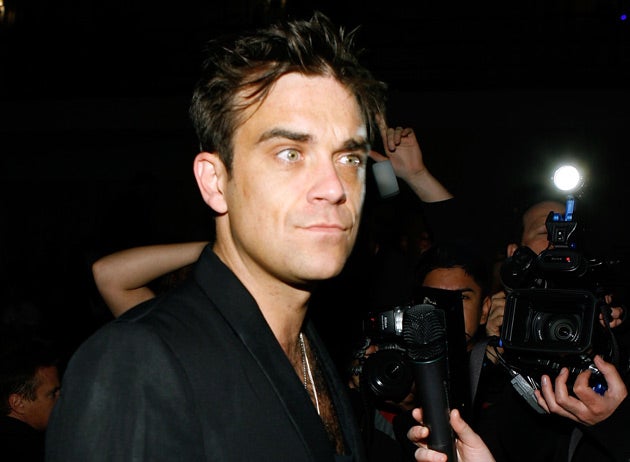
Robbie Williams is one of the artists that believe the public should not be prosecuted for downloading illegal music from the internet
Musicians including Robbie Williams, Annie Lennox, Billy Bragg, Blur's David Rowntree and Radiohead's Ed O'Brien said last night that the public should not be prosecuted for downloading illegal music from the internet.
The Featured Artists Coalition, which consists of 140 of Britain's biggest rock and pop stars, said at its inaugural meeting that companies such as MySpace and YouTube should be required to remunerate the artists when they use their music for advertising.
Bragg told The Independent that most of the artists had voted against supporting any move towards criminally prosecuting ordinary members of the public for illegally downloaded music.
The musicians will express their views to Lord Carter, who suggested that individuals downloading music illegally should be brought to justice.
While Lennox was not able to attend the meeting, she sent a message of support, as did Peter Gabriel, while David Gray, Fran Healy from Travis, Pink Floyd's Nick Mason and Mick Jones from The Clash turned up in support.
Bragg was speaking as a key member of the coalition, which was set up to give a collective voice to artists who want to fight for their rights in the digital world. It is pushing for a fairer deal for musicians at a time when they can use the internet to forge direct links with their fans. "What I said at the meeting was that the record industry in Britain is still going down the road of criminalising our audience for downloading illegal MP3s," he said.
"If we follow the music industry down that road, we will be doing nothing more than being part of a protectionist effort. It's like trying to put toothpaste back in the tube.
"Artists should own their own rights and they should decide when their music should be used for free, or when they should have payment."
The artists wanted to tell Lord Carter "that we want to side with the audience, the consumer".
O'Brien said it was a "defining time for the industry", adding: "A lot of the rights and revenue streams are being carved up, and we need a voice... I think all the major players want to hear what we have to say."

View all comments that have been posted about this article.
Offensive or abusive comments will be removed and your IP logged and may be used to prevent further submission. In submitting a comment to the site, you agree to be bound by the Independent Minds Terms of Service.
- Print Article
- Email Article
-
Click here for copyright permissions
Copyright 2009 Independent News and Media Limited


Comments
If i "download" or "preview" a song i buy it if i like it,this is fast replacing ever diminishing facilities to browse shops for music-may as well listen to the brave new world me thinks!
The white knights of the industry are here to battle the evil of children, young adults, single parents and people with less expendable incomes.
Its a sad time.
Let's see how many great records get made if they are then required to invest in marketing, properly recording and distributing those records from day 1 (not album 7 like most of the above artists are on) - eeermm very few in my view.
There are thousands of bands looking for investors who will help them get their records out there.
This was originally the preserve of the labels, and whilst new models might come along, you can bet your bottom dollar that if I invest 50k in a new band i'm going to want to negotiate owning the master rights, and perhaps, given that everyone is steaiing music, perhaps even a share of all your other rights income as well. All of this in return for my investment. And will that investor be minded to carry on to LP2 for another 50-100k when LP1 bombs....eeerm me thinks not.
Get real musicians - it is easy for the NAMED STARS above to release their own records and control their own rights and earn decent livings from live touring etc. - WHY because they are huge stars that were made huge stars as a result of the investments put into them by their labels. The future without that investment is in my view very very depressing.
Recording practices are becoming cheaper and cheaper by the day, real studios are not nearly as necessary as they used to be (check out Gotye - Like Drawing Blood, the whole thing was recorded by himself in his bedroom over a few months, this is only ONE of many examples). Once you have the recording done, you now have instant and free access to unlimited distribution to whomever chooses to grab it.
Promotion is the only thing missing and that's when social networking and word of mouth come in so damn handy. One person likes your recording, sends a link to 5 friends. Of that 5, 2 people like it and send it to 5 more. Of those 10 half like it and send it to 3 more and you get the drift. All of this is done basically free, likely in a fairly local area (but not constrained to it which is the best bit). Play a live show on the weekend and suddenly you've got 200 people at your show.
All of this has happened to my band in Melbourne in the course of about 6 months. The only money we've spent so far is on our equipment. It helps that our drummer studies sound engineering but sound engineers are all over the place.
We may not ever become the biggest band on the planet but at least we won't end up with $10,000's worth of debt to a record company which is STILL the outcome for about 80% of bands that sign to major record labels.
Pot calling Kettle Black.
It's always a personal decision how one behaves and it says a lot about the individual involved in the decision.
As to the bunch of "stars", in someways they are right, members of the public should not be prosecuted. Members of the public should be persuaded of the moral damage they do to themselves and the lack of personal value this behaviour promotes. People are unlikely to be so cavalier with what is actually someone elses income should the situation start to effect them personally. It's the public's responsibility at the end of the day. Robbie and Co are just out to look good and protect their declining careers. Their actions have to be viewed viewed suspicion and are at best irresponsible.
Also what's wrong with downloading music to see if the artist has any good songs. I don't recall anyone saying that listening to music on the radio is theft.
Whatever.
I take your point about downloading to preview, and if that's all it's used for , then downloading per se is not a problem. The problem begins when the download to preview converts into consumption as is very much the case with films.
1/2 the problem here is that people like you make ridiculous comments without any understanding of the law.
Go back to school and read some of those passages from the books you mention; in fact why don't you just go into Waterstones and steal a book on the music industry - it might give u a better understanding of copyright.
I am sick to death of trying to explain copyright law to ignoramuses.
Downloading, whilst not technically a criminal offence is a civil law matter (a bit like kicking a tenant out of a rented property for damage or non payment of rent). Massive uploading of tracks is arguably secondary infringement of copyright and can be prosecuted CRIMINALLY.
Perhaps the downloaders should be left alone and all the serial uploaders put in prison. Then there would be nothing for the 'innocent' downloader to download. Problem solved.
And as to listening to a song on radio - yet again you just prove your complete ignorance. Radio stations pay a licence to play music so the musicians are getting paid!
Only in the UK - the US and probably other countries they pay no royalties; although the likes of Billy Corgan are trying to change this.
Maybe you should do some research too? The idea of copyright is a fairly recent one, and one used for the right to make physical copies - ie. bootlegging or counterfeit. It's not totally and ideologically caught up with the digital world of the last 30 odd years where a copy can be made without damage (either financially or otherwise) to the original. The usual arguments that people won't buy when they can get it for free don't work either - look at free book authors like Lessig who's paper versions have sold better, or indeed Radiohead with their 'pay what you want' which was phenomenally successful.
People do want to support the artist. They prefer physical copies if they like it. Quite a few quite rightly don't see why they should pay for digital copies, especially if they intend to buy or see the artists if they like them. In fact I can quote many times and people who have bought more music because of being exposed to music via downloading...it's far from being theft. What I think people don't want to support is the music industry - it's arcane, bizarre and overpopulated by stupid people. It's a 19th or 20th century contraption - and most of the money even from online doesn't go to the artist - the protectionism doesn't help but a small % of artists, and actually screws the rest with arcane laws about licensing and clearance which makes the creative process harder - difficult to borrow that blues lick or quote a lyric or build on other's work as in previous decades....Impossible in fact.
So good on you Featured Artists...slightly worrying they are going after Myspace and YouTube, I think those are false targets as I doubt they have piles of money either. Embrace the new medium, don't attack it. If you're going to attack anything destroy the 4 main corporates...they're the real problem.
If third party entities (whether on-line or off line) build their business around music they should pay.
Copyright has been around in one form or another since The Stationers Guild (1403) and with the advent of moveable type printing, started to become enacted in a more formal form during the early 16th Century in England, so I don't know if that is a recent thing in your book. Seems quite a long time ago to me. Copyright is also an evolving area of the law which makes it all the more fascinating.
As to your issues with copyright in the digital arena, well that is a wholly separate philosophical discussion - if there is general consensus to change the principles of copyright, then I am all for it.
I am not sure though there has been consensus that the Radiohead model was a complete success and in any event the only reason that they could try it was because they had been put in that position as a result of huge investment along their career. Although scoring a big hit with Creep in the US - it bombed initially in the UK. On the Bends they started to pick up fans and it was not until OK Computer that they really broke through. I have followed them closely since before the first single came out. And I would hazard a pretty good guess that the people who supported them in the early years were their label, their publishers, possibly their management and income from live work.
FYI - By the way the origin of the word plagiarism comes from the latin Plagium meaning 'to kidnap'!
Yes I knew about the reciprical deals and SoundExchange and all that - not to a deep level; only Ents lawyers and music lawyers really do, because it's so arcane.
Copyright in music is a fairly recent thing; of course the right to copy existed in other arenas first, was quite short (5? 20 years) and then the king or anyone had a right to copy it - none of this 70 years + life! In music it came in at the end of the 19th century, several court cases extended the printed musical work from I think 20 years to more - these kicked in around 1923 in the States, with amendments in the 50's and 1977 or so - until the DMCA and the recent extensions, or attempt to extend mechanical copyright to 75 or 90 years - this is seperate from the Publishing rights and the sheet music rights...it's complex...and reflects it's ad-hoc case-by-case basis that it was created - it's simply crazy that mechanical copyright of a track is 50 years from publishing, but if you try and do anything with that track you get whacked by various rights - sync rights for movies; publishing rights and royalties to the songwriter (long dead usually) and I think the musical score has the original traditional protection of 300 years!!!
Apologies if there are mistakes in this, doing this from memory rather than googling/Wiki...would take years to write this then.
So the system is weird and arcane; loads of different agencies trying to get money from each other, and the artist and the listener loses in the end.
Radiohead - yes I bought their first single in the UK and US when it hit, was a fan way before that single hit in the US. I understand that they had a certain fame but that model has worked for NIN, Saul Williams and others - in fact it was invented by Trent Reznor, he was the first I think. The authors I mentioned aren't all MEGAFAMOUS. It can work - if your work is good, people will pay for it - people like physical things.
I don't know why it is so difficult to treat the Internet the same as promo for radio and TV - record companies give out 100s if not 1000s of CDs to those people (making the whole 'pay us for playing' a bit kind of silly, really - as they sometimes do payola also, so it's all a moneygoround) and give or sell their videos literally to MTV - MTV owns many of the major videos - and songs - as record companies have just given them the rights, or MTV bought them early on. The internet is promo for a good record, people WILL buy it, and people prefer the real thing to the digital. It's transient but costs very little to distribute - people know that, so surprise surprise they resent paying a full CD whack when all the distribution, printing and display costs aren't actually incurred.
Yes I knew about plagiarism meaning to kidnap.
Difficult and rather wide-reaching statement there.
Should they pay if they are helping promote the track and provide free advertising? If they incur costs getting or scouting for the track themselves? Does background music count? If it's played live? If that artist is not signed to a union? If that artist wants their music out their free and a collection agency still comes in holding their hand out, for money they will never see?
What about artists who give away free music? Do they lose rights? Can commercial entities use that? What if they are happy with the free advertisements but the industry stopped them 'for their own benefit'?
Should MTV stop showing videos (it pretty much has) because record industry wants it's product out there but also wants to be paid for such advertising? If the music is asking too much should you start pulling it (see YouTube)?
Is payola wrong? Are record companies bribing or giving away their product to entice chart positions or radio play? Competitions...
It's a far from clear-cut argument.
All these guys have already made a ton of cash selling music. They have no need for anymore.
I wonder if they'd be so keen to shout for free downloads if they were back on the streets lugging their gear around playing gigs for a pittance and struggling to get a record deal.
"....90% of their members earn less than 5k per year in royalties"
Average wage, more like below minimum wage!
On your analysis, should actors retain all rights in their films without being producers and fronting the millions required for the budgets? Should employees retain all their rights in the creations they make for their employers?
Lovely idealism....but the reality of life in the music industry is that the vast majority (90%) earn peanuts from making music, yet the 10% outlined above - who have made their money on the back of their 'employer's' investments, are now complaining. Something doesn't quite sit right here.
As a guitarist and independent label owner, I wholeheartedly endorse the artists' position. My purpose in remaining fervently, stridently indie throughout my musical career has been to prevent the corporate parasites from using my art to pay for their cocaine and camaros whilst separating me from my rights over my own creations.
Music is a cultural phenomenon, not a business. The demise of the labels - which can't happen soon enough - will mark the day when it once again attains its rightful place as a component of a shared human experience, rather than as a commodity.
They ALL download stuff online themselves.
A family friend, who is a police officer told us about when they did a raid on a group of people who were involved with counterfeits and illegal file sharing and he joked that he had lots of films and albums he downloaded illegally online himself. What on earth does that say about how idiotic it is!!
It's an absolute joke!! These record companies and movie boffs make enough money out of us with the stupid extortionate prices they charge. No wonder people download illegally. It's not right to download illegally but It's understandable.
Hardly any new acts are being signed. Studios are closing all the time. Small record shops are going out of business everywhere. New bands have zero chance of getting a record deal, and musicians will never make a living out of it.
Happy now?
The justice is that the downloaders are destroying their own genre. Sad that they're taking a lot of hard working well meaning people with them.