The human iPod: Meet the musical savant
Derek Paravicini was born blind and with serious learning difficulties. But he only needs to hear a tune once to play it. Soon he will make his debut at the Southbank Centre, reports Chris Green
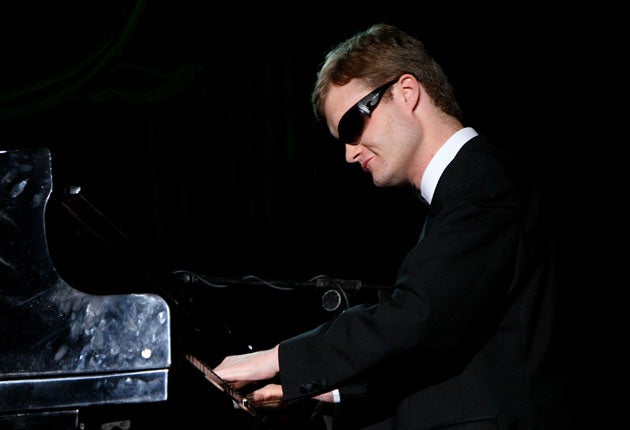
Almost 25 years ago, Adam Ockelford was giving a piano lesson to a young girl at Linden Lodge School for the blind in Wandsworth, south-west London, when a couple and their five-year-old son who were touring the school opened the door to his room.
Moments later, the little blond boy was free of his parents' grip and had sprinted over to the piano. There he pushed Ockelford's unfortunate pupil roughly off her stool, depositing her on the floor. "He was obviously manically determined to play, and began karate-chopping the keys, bashing them with his fists and his elbows," he recalls. "At first I thought he was completely bonkers, but suddenly I realised that not only was he playing "Don't Cry For Me Argentina", he was rampaging up and down the keyboard to fit in extra chords and scales. Then I knew he was a genius, not a madman at all."
That was in 1985. Now, Derek Paravicini is about to give his first full concert accompanied by an orchestra at a series of appearances in Bristol and the Queen Elizabeth Hall in London's Southbank Centre.
Paravicini, now 30, is a musical savant nicknamed the "human iPod". He was born 25 weeks premature, and although oxygen therapy saved his life he incurred brain damage and now suffers from severe learning difficulties and autism. He is blind, unable to read Braille and can barely count, let alone read music, but he possesses an extraordinary gift: he can play anything after hearing it only once. For Ockelford, now a professor of music at Roehampton University, the concerts will mark the next stage in a remarkable relationship that began when Paravicini first burst into his classroom. Since then, he has acted as Paravicini's teacher and mentor, and has even written his biography, In The Key Of Genius.
When the pair met, Paravicini had only played on a toy organ. Ockelford had to place his pupil's hands on top of his own, so he could feel the movements. However, before this could happen he had to solve the basic problem of getting to the keyboard.
"It took quite a few months before he would let me play his piano at all," he says. "It was his territory, and if I tried to play a note on it, he'd hit me and push me out of the way with his head. The only way to teach him was to pick him up, shove him on the other side of the room and quickly play something before he could get back to the piano. It was a good game, because that way he could copy what I played. He didn't talk very much, but music became a sort of proxy language. He realised he could communicate with people through his music."
It took Ockelford 10 painstaking years to teach his pupil how to play correctly, a process he describes as "fascinating". The pair met every day for an hour's lesson, and like any good musician, practice made Paravicini perfect.
His blindness and other disadvantages might have slowed his progress, but Ockelford believes that his pupil's extraordinary memory sets him apart from other classical musicians, who are constrained by the necessity of sticking rigidly to their sheet music.
"A lot of classical soloists who play from memory say it makes them feel freer, and I think that's true for Derek all the time," he says.

Enjoy unlimited access to 100 million ad-free songs and podcasts with Amazon Music
Sign up now for a 30-day free trial. Terms apply.
ADVERTISEMENT. If you sign up to this service we will earn commission. This revenue helps to fund journalism across The Independent.
Enjoy unlimited access to 100 million ad-free songs and podcasts with Amazon Music
Sign up now for a 30-day free trial. Terms apply.
ADVERTISEMENT. If you sign up to this service we will earn commission. This revenue helps to fund journalism across The Independent.
The carefree quality of Paravicini's playing – and his talent for improvisation – makes him ideally suited to jazz and blues, and audiences across Europe and the US have been amazed by his ability.
Roger Huckle, director of Bristol's Emerald Ensemble, the orchestra that will accompany Paravicini on his tour next month, says the pianist's unpredictability might be nerve-wracking for the other players, but it is also undoubtedly his greatest strength. "He has no fear. Most musicians will be very aware if they play a wrong note, but that critical side of it isn't really in Derek's make up. If he does play something wrong he can cover it up within half a second. But having said that, I don't think he really perceives it as making a mistake."
Some aspects of rehearsals have nevertheless proved difficult. As he does not read music and cannot see the conductor's baton, Paravicini has to wait for the orchestra to begin before he knows which section of the piece they are practising.
According to Huckle, the pianist's short-term memory is so poor that he often forgets which pieces of music he is due to play at the concerts, and even with whom he is playing. "I'd like to play that at the Southbank!" he once exclaimed of a piece the ensemble had rehearsed countless times. "He once asked me: 'Roger! Are you coming to hear the concert?' to which I replied 'Yes, I'm playing with you!'", says Huckle. "It's a curious thing that he has this massive memory for music, yet he can't remember what he's going to be playing next week."
This gives the music Paravicini plays a unique freshness, as at every performance audiences will effectively be hearing a totally new improvisation. Indeed, merely listening to the pianist converse is enough to persuade most people of his musicality. Although he often repeats questions – a habit Ockelford says reflects his talent for remembering musical phrases – his voice is always upbeat and lilting. Paravicini's lineage is also notable: he is the great-grandson of the writer William Somerset Maugham, the great-great-grandson of Dr Thomas Barnardo, founder of the children's charity, and also the nephew by marriage of Camilla, the Duchess of Cornwall.
The concerts are likely to raise his profile, but Ockelford is convinced he will not have a problem coping: "He's been in the media for most of his life and has always enjoyed the attention, because he likes interacting with people."
Lost in life: Found in music
David Helfgott Australian pianist who suffers from schizoaffective disorder, his life story inspired the film Shine which turned him into the world's most famous pianist overnight.
John Ogdon In 1973 the English pianist had the first of a series of breakdowns, thought to be caused by mild schizophrenia or manic depression. He died in 1989.
Nick van Bloss The pianist has suffered from Tourette's Syndrome since he was seven, which causes his body to experience 38,000 tics daily. He retired in 1994 aged 26 after the convulsions got worse, but made a triumphant return to the stage at London's Cadogan Hall last month.
Join our commenting forum
Join thought-provoking conversations, follow other Independent readers and see their replies
Comments