Marilyn and Ella: The meeting of the misfits
Bonnie Greer's bold new play about the friendship between Marilyn Monroe and Ella Fitzgerald reveals a bond forged in adversity. Ciar Byrne hears an unlikely story
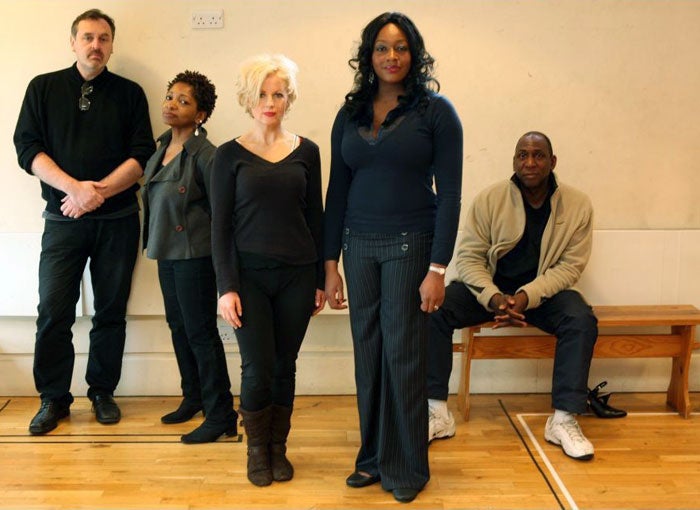
The year was 1955 and, unthinkably, black singers were not allowed to perform in leading nightclubs. It was also the year that Marilyn Monroe, tired of being cast as a helpless sex symbol, took a break from Los Angeles and headed to New York to find herself. Here she immersed herself in jazz, in particular the music of Ella Fitzgerald. In Fitzgerald's melodies, Monroe recognised the creative genius she herself longed to possess.
So when she discovered that, due to the colour bar, Fitzgerald was not permitted to play in her favourite nightclub, the Mocambo in Los Angeles, Monroe approached the manager, Charlie Morrison, and promised to sit in the front row for a week if he let Fitzgerald play. Morrison agreed to break the colour bar and Fitzgerald would never again have to play in a small, second-rate jazz club.
The two women became firm friends and discovered they had many things in common. Until now, their mutual history has not been widely known. But this week, Marilyn and Ella, a play by the black American writer Bonnie Greer about the friendship between Fitzgerald and Monroe, opens at the Theatre Royal, Stratford East.
It was a split second on a documentary on the Biography Channel that first alerted Greer to the story five years ago, when she was finishing off a novel in New York. The documentary, which covered Monroe's time in New York, when, like Greer, she had become involved with the Actors Studio, included the briefest reference to her helping Fitzgerald.
"I was shocked. It was all of a second and immediately I visualised Ella Fitzgerald and Marilyn Monroe, an unlikely pairing," remembers Greer, who went on to research the story: no mean feat, as although Fitzgerald's music is famous, little is known about the woman herself. Even the numerous Monroe biographies said little about the acquaintance. Greer discovered two short lines from Fitzgerald. One said, "I owe Marilyn a debt", and the other, "Marilyn Monroe was ahead of her time and she didn't even know it."
As she discovered more, what she knew about the two women started to fall into place. Greer had always wondered what Arthur Miller saw in Monroe – "other than the obvious – and that didn't make any sense in a guy like Miller". Now, she discovered that Monroe was a left-winger, who was very much concerned with workers' rights, as well as being the first woman aside from Mary Pickford to have her own production company.
"She knew who her audience were: people who parked cars and flipped hamburgers, housewives and guys who worked in the factories – she called them workers and she was a worker," says Greer. "So her interest in Ella Fitzgerald and helping Ella to break the colour bar was all of a piece."
To get inside the mind of Fitzgerald, Greer had only to draw on her own history. One of the first stories she heard as a little girl was that of Emmett Till, a 14-year-old black boy from Chicago, who in 1955 was visiting relatives in the small town of Money, Mississippi, where he made a smart remark to a white woman in a grocery store. Days later, his disfigured body was dragged out of the Tallahatchie River. His mother, Mamie Till, insisted on the lid of his coffin being kept open at his funeral, for all to see the brutality inflicted on him, and the murder was an important catalyst for the nascent American civil rights movement.
It was against this backdrop that Monroe and Fitzgerald struck up a friendship. Greer also drew on the stories her mother and aunts told her about their own lives. "It isn't imagination in that sense; it is putting together all those bits and pieces that would be true of a black woman at that time. One of the things that's important to me is to have a black woman who is not conventionally beautiful worshipped by one of the most beautiful women in the world who can see her inner quality."
Beauty is central to the play. Monroe's looks were iconic, but she was not as naturally blessed as some may think. Uneducated, the product of an unhappy childhood, she was not even a natural blonde. She had to get her nose and teeth fixed to meet the contemporary standard of beauty. Fitzgerald, despite her great talent, longed to be conventionally beautiful. She had a favourite expression – "I stopped traffic" – to describe how stunning she wanted to be. "For me, at the most profound level, it's about beauty: beauty as a curse, beauty as a desire. It's about inner beauty. It's about the beauty of real work, of a gift, they both were gifted," says Greer.
Fitzgerald, according to one female jazz artist, was the person who made it possible for a woman to be a musician in jazz, not just the singer. She had her own band, and is in Greer's estimation a true "genius". Monroe, on the other hand, was "a genius of human understanding – she didn't understand herself, which was a tragedy, but she understood human beings".
The two women had much in common. Both had abusive childhoods, both had pursued the American dream, both spent a lot of time around men, and both desperately wanted, but could not have, children. Fitzgerald adopted her husband's son, but they did not enjoy a close relationship. Monroe suffered from endometriosis and had two miscarriages as well as several abortions.
Instead of having children, they were infantilised themselves. When Fitzgerald divorced her first husband, the judge said to him, "Don't you mistreat that little girl any more", while Monroe was known as "the girl". Above all, both attempted, unsuccessfully, to beat the system: Monroe ended up dead, while Fitzgerald retreated into her music.
Greer's drama started life as a radio play, then, in 2006, she went to see Colin McFarlane's production of Road to Nirvana, a play she had invested in at the King's Head Theatre). She was so impressed by what she saw that she asked him if he would direct her new play at the Edinburgh Festival – which was only four weeks away. There was no time for casting, so McFarlane called up Sally Lindsay, who had just left Coronation Street and jumped at the chance to play Monroe.
The play was an instant success, selling out every night. Assuming that most people in the audience had come to see Lindsay, McFarlane conducted a straw poll and discovered they had in fact come because they were either Marilyn or Ella fans.
Even so, many assumed the play was a work of fantasy. "Most people look at the photograph [on the front of the programme] and say, 'that's a really clever idea, putting Marilyn and Ella together,' and we say, 'no, it's a true story,'" says McFarlane.
The play has been completely rewritten for the Theatre Royal. With actresses Nicola Hughes and Wendy Morgan, McFarlane has worked hard to avoid simply presenting a lookalike or soundalike. Instead, the drama has a filmic quality.
Both actresses are delighted with Greer's interpretation of their characters. "I didn't realise I could go as deep into Ella as I have. Bonnie's allowed that to happen," says Hughes. To get into the part, Hughes has listened to Fitzgerald's music non-stop, as well as watching footage of her singing. When Fitzgerald sang ballads, her natural shyness came across in her body language, while when she was singing uptempo numbers, she let go of her physical inhibitions; so Hughes prefers to watch Ella singing uptempo, while listening to her ballads.
Morgan has similarly watched Monroe's films. She says: "Bonnie's writing is an endless source of information about these kaleidoscopic characters; petals of insight."
Coming from the American South, Greer is almost superstitious about the production. In her soft drawl, she explains, "I'm a Southern American and I just think Ella and Marilyn, they want this to happen."
'Marilyn and Ella' runs at the Theatre Royal, Stratford, London E15 (020-8534 0310) from Friday to 15 March 2008
Join our commenting forum
Join thought-provoking conversations, follow other Independent readers and see their replies
Comments