Protector of the nation's heritage
As director of the National, Sir Nicholas Hytner has overseen a golden decade in British theatre. But unless ministers restore funding and help to attract vital private support for the arts, all the gains will be lost
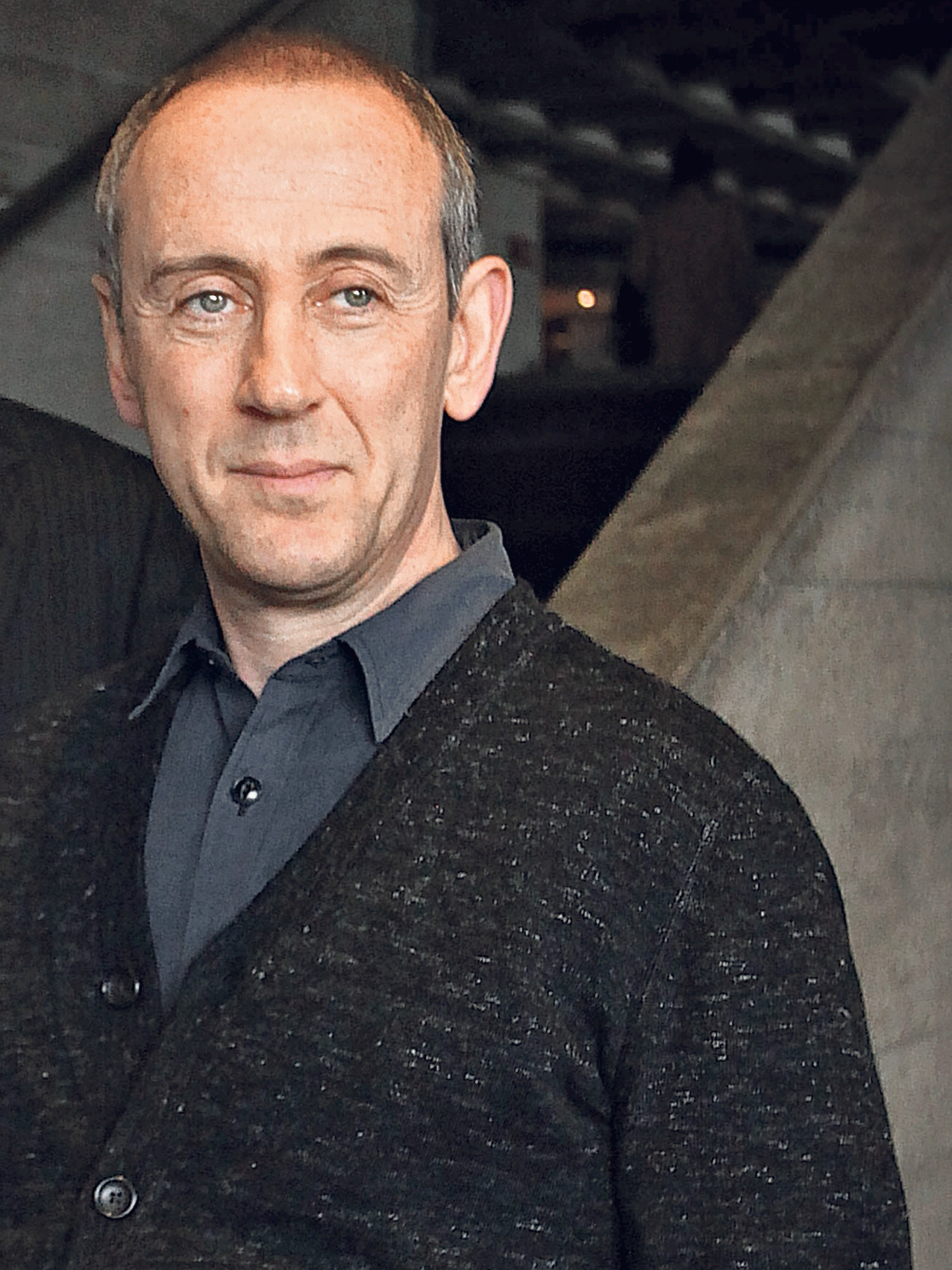
Sir Nicholas Hytner has not yet met the new Culture Secretary, but it is fair to bet that, when their paths do cross there will be a frank exchange of views. While Maria Miller said recently that arts organisations need to become "better askers" for private support, arguing that philanthropy is the future of funding, both in times of recession and otherwise, the director of the National Theatre is firm in his belief that private generosity and public support are two sides of the same, much-needed coin.
"I can tell her," Hytner says, "that organisations like the National Theatre, British Museum and Tate raise lots of money because they are properly funded by the Government in the first place." Such institutions need the bedrock provided by reliable state backing, he argues, in order to sustain successful and innovative fundraising programmes. Cutting the former does not allow private donors to step in, it makes them harder to reach.
Yet cut the Coalition has. Arts funding has decreased since Arts Council budgets were slashed 30 per cent in 2010 and local authority culture budgets have also fallen. The National itself has seen its own subsidy slashed by 15 per cent in real terms over the past four years. Hytner, whose latest collaboration with Alan Bennett, People, opened earlier this month, is fearful that "Government neglect" of the sector could turn into a long-term decline unless something is done and has been proactive in raising awareness of the issues facing smaller organisations.
"It is fair to say that Jeremy Hunt talked the talk, but did not do anything particularly useful. It will be interesting to see what he does at Health," he says. "Immediately after the election, he promised us a golden age for the arts by acting to unlock philanthropy. The only real action the Government has since taken on philanthropy was the proposal, swiftly withdrawn, to remove a substantial proportion of tax relief from charitable giving."
Hytner would, unsurprisingly, like to see the National's subsidy restored, but this is not just about lobbying for his own institution. He points to the real financial problems faced by many regional arts institutions that face the threat of closure, arguing that a "straightforward solution is to fund them properly", and says that the skills and talent that the UK was able to display so proudly to the world during this summer's Olympic ceremonies are a legacy of previous Government support.
To emphasise his point, Hytner recounts how Danny Boyle, who directed Frankenstein at the National last year, told him that he and Stephen Daldry, who oversaw all four ceremonies, "are really keen to remind Government how many of the people involved in the Opening ceremony learned most of what they know in subsidised theatre". Last week, he organised an event to allow artistic and executive directors of regional theatres a platform to express their achievements and outline the threats to their future in the current climate.
The National, in fact, is in considerably less urgent need of subsidy than many other areas of the arts, having generated more than £70m in revenues during the past financial year and played to full capacity over a summer in which many other London tourist attractions suffered the "Olympic ghost town" effect. That success is down in part to Hytner's leadership; Dame Helen Mirren has described him as overseeing a "golden era" in British theatre. But it also owes a considerable amount to exactly the kind of private funding, secured by an institution that at the time had a backstop of public support, that he sees as pivotal.
Asked what is the most influential thing he has done in his almost decade-long reign, Hytner points not to a production or a season but, surprisingly, to a sponsorship deal. The Travelex season, now in its 10th year, has become a fixture for theatregoers in the capital, offering tickets to see works on the National's largest stage, in the Olivier Theatre, for £12 each. The scheme has transformed the finances of the theatre, but also the type of plays it is able to stage and the audience that comes to see them.
It began early in 2003, when Hytner, about to take over at the National, had a meeting with Lloyd Dorfman after the latter made a chance comment about arts funding at a dinner party.
At that point, the theatre was struggling to fill its seats, particularly over the summer – a run of The Seagull starring Judi Dench in 1994 played to an auditorium that was just 63 per cent full; The Winter's Tale that Hytner directed in 2001 ran at 61 per cent – which was having a knock-on effect on its ability to take risks with less well-known works.
It was a happy encounter. Hytner had an ambition to make theatre more affordable, and Dorfman had a plan to do just that. Yet the partnership almost didn't happen. Just as Hytner officially took up his post at the National, the Iraq war and the international uncertainty that came with it brought the deal to a shuddering halt as Travelex froze hires, wages and indeed sponsorship. Seven weeks later, with the National facing its inaugural cut-price ticket season without a sponsor, Hytner made a desperate last call. "Nick told me that I was the last call before the programmes went to print," Dorfman said. "That he understood about the war, but as it seemed to be ending would I reconsider."
Reconsider he did, and since 2003 Travelex has invested several million pounds – it won't say exactly how much – in the deal, which has now been extended to 2015. Around 1.3 million cut-price tickets have been sold so far, and with those cheaper seats came a whole new audience.
The theatre's surveys show that every year 22 per cent of Travelex ticket buyers are doing so for the first time, and that the audiences are younger and more likely to take risks on a production they don't know. Armed with such knowledge, and financially bolstered by sell-out performances, the National has been able to foster new talent. The Olivier has staged 13 new plays since the Travelex deal, bringing through writers like Mike Bartlett and Richard Bean, writer of mega-hit One Man, Two Guvnors.
"We've been able to do more new stuff," Hytner said. "The classical stuff has been fuller and we have done more of it." The partnership has had a knock-on effect right across London, he added. "The sponsorship has been the single most influential thing we've done. It kept the pressure on the subsidised theatres but also the West End has had to respond as well. The fact this theatre was able to take such definite action on ticket prices has spread over London." Other institutions including the Donmar have introduced cut-price tickets, as has Michael Grandage with his West End season, while the English National Opera has recently introduced a scheme to encourage more young people to attend.
Meanwhile, Mr Dorfman, a life-long theatre fan and self-confessed frustrated performer, has donated £10m to the NT Future campaign to fund a £70m redevelopment of the theatre's South Bank site. In recognition, the smallest of the three auditoriums, the Cottesloe, will be renamed the Dorfman when it reopens – a move that Hytner said has the blessing of the Cottesloe family: "They were totally fine, they understood."
That reopening could be one of Hytner's last acts at the National. The director, who is 56, has said he is likely to leave after the works have been completed in the next few years, but believes he has at least two more big jobs in him.
"When I leave, whenever that is, I will miss it like crazy," he said. "I don't look on this as remotely approaching a last episode. I'm now approaching 10 years, I think I could do another 10 years somewhere else, and probably another 10 years somewhere else after that. I want to remain in theatre."
Nor is he about to stop being a thorn in the side of this Government, as long as it continues, as he sees it, to neglect the arts. While he is in no rush to meet Ms Miller – "I think it is up to her" – his current target is Education Secretary Michael Gove, and his planned English Baccalaureate, which fails to include arts as a core subject.
"It does seem really shortsighted and really unfair on the large number of children who don't have access to the country's cultural provisions through their parents," Hytner says.
While the revamped National will have more focus on education – "It cannot replace what could be going on in schools, but we [arts organisations] can do an awful lot" – he remains convinced that the Government has a key role to play in the future of Britain's artistic sector, however tough the economic climate.
"We're really good at the arts, and in the grand scheme of things, they don't cost very much," Hytner concludes. "We're able for very little money to bring a huge amount of people a lot of satisfaction and present to the rest of the world a positive image of this country, which some of the more costly industries have failed to do."
Join our commenting forum
Join thought-provoking conversations, follow other Independent readers and see their replies
Comments
Bookmark popover
Removed from bookmarks