After the Tardis: Russell T Davies
Before saying goodbye to his incredibly successful revamp of 'Doctor Who', Russell T Davies has one last story to tell: that of the writer himself
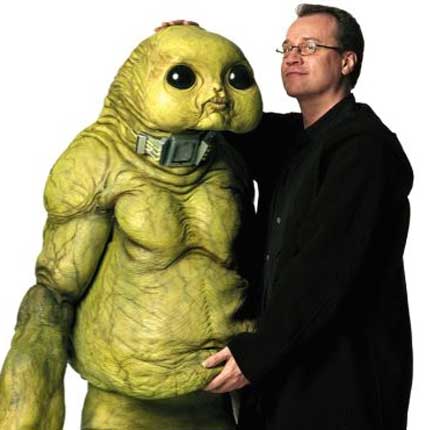
The resurrection of Doctor Who has been one of the BBC's greatest success stories. The creative force behind its renaissance, Russell T Davies, took the tired, unloved show and turned it into must-see, big-budget, prime-time TV.
Celebrities such as Kylie Minogue clamour to make cameo appearances, and leaked plot lines are feverishly discussed in the media, the latest is that former History Boy Russell Tovey, is next to play The Doctor. The 45-year-old Davies, best known until he was taken on to do Doctor Who for writing Queer as Folk, a drama about gay men, went from being a slightly risqué, cultish figure to a senior statesman of family television.
And then, in May this year, Davies quit. He would not be doing a series five, handing the Doctor Who baton instead to fellow Doctor Who scriptwriter Steven Moffat.
To mark the end of his time on Doctor Who – although he will still be in creative control of the spin-off Torchwood and the Doctor Who Christmas specials – Davies has co-authored a book about the creative process of writing Doctor Who scripts, called Doctor Who: The Writer's Tale.
We meet in the central courtyard at BBC's Television Centre, where Davies is smoking cigarettes and drinking coffee. I am, probably disproportionately, impressed that Davies queued up at the nearest coffee stall and bought me a coffee with his own money; this kind of gallantry from an interviewee is unheard of.
The book is a very heavy, glossy thing detailing a year in the life of Doctor Who, seen through the eyes of Davies as he emails the co-author of the book, Benjamin Cook. The book is interspersed with actual scripts from series four and illustrated with Davies' own lively and accomplished cartoons. It's a strange concept. There have been books of scripts before and TV series accompanying books before, but you'd have to be a figure as grand and accomplished as Davies for this project to work – even then he acknowledges that there is a sniff of vanity about the whole thing.
But it doesn't really matter; the fans will adore it. Davies has engaged with the book totally and there is full disclosure from him about everything: leaks to the papers about plot lines and cameos, despair at schedules, good-natured freak-outs about deadlines and even his disappointment at how he (as a gay man) is sometimes sketched by the press. "I'm portrayed as giggling, primping and lipsticked," he says.
Which he is not, by the way. Standing fully six feet and six inches tall, Davies is a broad, booming Welsh lad and when he laughs he goes "HA HA HA HA", which makes people turn around and wonder why they, too, are not having as much fun. But he does not giggle. And he isn't wearing lipstick. There is, yes, a slight luvvieness to his manner now and again but no more than anyone else who works in TV, straight or gay.
He works all the time. The times of the emails he sends in the book – 1.30am, 2am, 7am – prove that he is never off duty. He has not had a summer holiday this year but, actually, he doesn't really see the point. "I am a workaholic, I suppose," he says. "I don't know what I would do on holiday. After about a day I'd get twitchy and want to do some writing."

Watch Apple TV+ free for 7 day
New subscribers only. £9.99/mo. after free trial. Plan auto-renews until cancelled.
ADVERTISEMENT. If you sign up to this service we will earn commission. This revenue helps to fund journalism across The Independent.
Watch Apple TV+ free for 7 day
New subscribers only. £9.99/mo. after free trial. Plan auto-renews until cancelled.
ADVERTISEMENT. If you sign up to this service we will earn commission. This revenue helps to fund journalism across The Independent.
He left Oxford University in 1984 and ended up at the BBC, working behind the camera on Playschool and then went to work on other children's programmes such as Why Don't You?. Blithely ignoring the unspoken rule in TV that once you've picked an age group, you're stuck with it, Davies moved into adult programming, creating the controversial but hugely popular series for Channel 4, Queer as Folk.
"When you work in children's television everyone says to you, 'Oh, you'll never work in adult drama.' When I worked in Children's there was a woman who went from Playschool to working on Casualty and she was spoken of in hushed tones like she was a sort of legend!"
When the news broke that Davies was to head up the revamp of Doctor Who, The Sun's headline was, tastefully, "Doctor Queer". And then the first series of Doctor Who aired, captivating the entire British under-13 audience, as well as most of their parents. The massive interest in the show has led to constant plot line leaks to the press. Is that annoying?
"It's part of the game," he says. "But yes it is annoying, I suppose. What you want is for people not to know the ending, because that's the whole point of storytelling. At the end of the last series, with the regeneration question, it went mental for us because people didn't know what was going to happen and they all watched to find out. We got two million extra viewers just because of that.
"Our problem is that about a hundred people know about what's going to happen on the show: we have to book locations and talk to the council and say, 'Well, we're going to have a big explosion on the street and there are going to be Daleks everywhere. Is that OK?' In the end, the day that no one gave a toss would be a sad one."
The rewards that have come Davies's way have been magnificent: in 2001 he won the Writer of the Year award at the British Comedy Awards and a Royal Television Society award in 2003. To cap it all he was awarded an OBE, which he finds funny.
"How middle aged is an OBE? I haven't had the actual thing yet, I think I've fallen off the end of a list somewhere. Then I had this booklet telling me when I can wear it. I could have it on my cuff maybe? God... I complain about people saying I'm camp and then I talk about wearing my medal on my cuff! People keep asking me if I've had it yet. I think they send you a date and then you go up to the palace like Kylie and get it."
Ah, yes – Kylie! It must have been fun to have famous people desperate to be on your show. "There's such goodwill towards Doctor Who, which makes it much easier for us. It's not like someone really famous will come on and have to play a murdered prostitute, like in Prime Suspect. They have fun and it's seen by kids and that's what really registers with people and means they're up for it."
There's also the unspoken fact that Doctor Who has got a pretty big budget, although, Davies says, there wasn't so much money that they could throw it at him when he decided to leave. "To be honest," he laughs, "I thought that when I went in to tell Peter Fincham that I wasn't going to do series five, he'd throw money at me, and he didn't!
"And that's quite right, too," Davies continues more soberly, "because it's a public service and it would be a waste of money."
A waste of money? Russell T Davies? Never.
Join our commenting forum
Join thought-provoking conversations, follow other Independent readers and see their replies
Comments
Bookmark popover
Removed from bookmarks