TV & Radio

Partly Sunny with Showers 9° London Hi 12°C / Lo 6°C

BBC archives - Gone but not forgotten

The BBC is archiving online some of the great TV shows in their history. But what about the ones they wiped – and the ones they should have wiped? Andrew Roberts reports
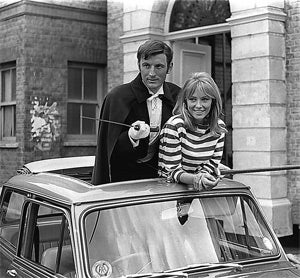
Golden years: Gerald Harper and Juliet Harmer in Adam Adamant Lives.

Getty

Golden years: Gerald Harper and Juliet Harmer in Adam Adamant Lives.

The BBC is trumpeting its BBC Online Archive, but it does continue to raise awkward questions concerning the amount of material that does not survive. Some of the wiped programmes such as Peter Cook and Dudley Moore's Not Only... But Also and early Dr Who episodes are already notorious but somewhat less outcry appears to have greeted the news that only two editions of ITV's The Saturday Banana are believed to exist. For any reader of a certain age who spent their formative years in the Southern Television region, The Saturday Banana is a vague but disquieting memory of a partially networked children's magazine show that always seemed to have Bill Oddie supervising zany stunts in the studio car park. A rare tape of the programme reveals that this is indeed the case, along with the unforgettable sight of a 25ft-high banana statue dominating the grounds of Southern Television.

Programmes such as The Saturday Banana rarely feature in lists of great shows that are "Missing, Believed Wiped". The National Film Archive holds no editions of a 1965 football drama United, and almost an entire BBC soap opera of the late 1960s, The Newcomers, has vanished together with Accident – a 1970s drama series based on the concept of disparate characters meeting in a mass car crash. By the standards of the day they may have been regarded as competent, and attracted reasonable viewing figures, but they are also prime example of the days when popular meant highly dispensable. Why, runs the popular argument, should any broadcasting company have paid to store the likes of Compact, an early 1960s BBC soap opera that was critically loathed in its heyday or any other material of little or no repeat value?

One obvious reason is that sheer historical importance demands their inclusion. The massively popular ITV police show No Hiding Place ran for 400 episodes between 1961 and 1967, only 10% of which survived a mass culling of the Associated Redifusion archives. The world it depicted may have been dated even then, with gentlemanly Superintendents arriving in their Humber Super Snipes to arrest cockney ne'er-do-wells, but its viewing figures show that this image of the police was easily as popular as the BBC's far more hard-hitting and critically acclaimed Z-Cars. Indeed, the fact that BBC1 was still making Dixon of Dock Green at the same time as Euston Films were shooting The Sweeney speaks volumes for the public's mixed view of the police circa 1976 – even if poor old Station Sergeant, George Dixon, was now aged 81 and having to read his cue cards from his prop desk.

Another reason for the retention of such programmes is as a counterbalance to the more corrosive effects of nostalgia. The Challenge TV station used to re-run editions of 321 during the evening, leaving the sensitive viewer in stunned horror at what passed for ITV Saturday night entertainment in the 1980s; namely a mobile dustbin, Ted Rogers and Frank Thornton dressed as a giant owl. Earlier ITV quiz-shows, one of the most notorious outward manifestations of the nascent consumer society, were rarely recorded and those that taped were usually wiped. In some respects this is a relief, sparing the world from as much Hughie Greene as was possible, but in terms of British popular history the few existing editions of ITV's Double Your Money show are invaluable reminders of the reality of the Macmillan era; nervous couples in badly cut clothes being patronised by a large and very sinister Canadian quiz-master in exchange for nylon stockings.

Popular television could, and did, contain as many memorable moments as a more critically acclaimed show; little of the BBC's Dee Time survives but the limited existing footage does have Sammy Davis Jnr giving a live performance. The few recorded episodes of Crackerjack showcase Eammon Andrews hosting the show with all of the ease and verve of a man who looked as though he was about to be arrested at any moment, but they also contain musical gems from the original line-up of The Shadows to Don Maclean and Peter Glaze's cover of David Bowie's "Golden Years".

Occasionally, there are gems to be found in the programmes that escaped the wrath of the archive wiping police – the opening credits of the 1966 ITV series The Ratcatchers are just too groovy for mere words, while Gerald Harper's delightful performance as the BBC's Edwardian superhero Adam Adamant makes it a real tragedy that half of the programmes were wiped – but often the quality of the repeats of no importance to the viewer, for the real reason in their watching is to recapture a particular time in their lives.

To re-watch a former favourite can be a grave error as your memories are all too often more elaborate than the harshly lit and slow-paced reality. To see The Goodies at the age of seven was almost as good as television comedy could be; to watch the show as an adult is all too often to experience bitter disappointment. But those who recall such gems as BBC TV's 1970s drama The Brothers, the over-dramatic acting and the glamorous setting of a haulage yard is an essential part of the experience.

Today, in an era of digital television, the idea of wiping a programme is a truly arcane concept. Shows such as The Suite Life of Zack and Cody and Zoey 101, American children's sitcoms that were surprisingly not mentioned in Dante's Inferno, seemingly plague satellite TV stations morning, noon and night. It indeed is a cruel world when such entertainments survive and Dud and Pete were wiped, where the ennobling sound of the Great British Public baying at a middle-aged spinster can be sent around the world in an instant, while Bob Dylan's BBC TV debut remains lost. So, if even your offspring force you to watch Zack and Cody – a "comedy" that bears an eerie similarity to Village of the Damned – it is the price we pay for ensuring that future historians can learn of the depths to which television in the early 21st century could sink. And to prevent any more of the medium's heritage from vanishing into the ether.

Post a Comment

View all comments that have been posted about this article.

Offensive or abusive comments will be removed and your IP logged and may be used to prevent further submission. In submitting a comment to the site, you agree to be bound by the Independent Minds Terms of Service.

Comments

BBC archives - Gone but not forgotten
[info]famulla wrote:
Friday, 28 August 2009 at 03:06 am (UTC)
Andew Mind Your Language etc with the BBC were gerat WERE great but then BBC was ....
I thank you
Firozali A Mulla
Retired and now forgotten
[info]welshmaninmilan wrote:
Friday, 28 August 2009 at 08:05 am (UTC)
Having allowed myself a frisson of excitement at the thought of reliving some of the TV programmes of my childhood, I find that the BBC are only allowing residents in Britain to actually see the archive. Apparently, it is to protect the BBC license payers from free-loading foreigners, who are potential buyers of BBC programming from the 50s and 60s - not!

I would just like to remind the BBC that I was a license payer for the best part of 40 years, before heading off for foreign shores, away from the violence endemic in Britain these days, to enjoy my twilight years - seemingly away from the wonders of "Muffin the Mule", or "Woodentops" to refresh my fading memories.

"Annoyed", of Costa Brava...
Re: Retired and now forgotten
[info]drg40 wrote:
Friday, 28 August 2009 at 10:31 am (UTC)
Ah, you're not allowed to see it but Rupert Murdoch is, and make a nice load of moolah in the process. As you know in Spain you can buy Sky boxes set up to receive UK/BBC programmes in any TV shop worthy of the name, all the RM's benefit. You can even watch BBC sport in most of the pubs and clubs, thanks to RM.
But does "Lord" Mandelson and the BBC creeps take on the blatant copyright infringement of their great white hope?
No, he wants to prove what a big boy he is by taking on the average Joe from the might of his seat on the red banches.
As to the sordid Beeb, the other night I had the priviledge of being told that I could not see a Beeb programme I could hear being played in the nearby club.
Charlatans.
A sad loss.
[info]gruffuddglyn wrote:
Friday, 28 August 2009 at 08:19 am (UTC)
The biggest crime about Pete and Dud in Not Only... But Also being wiped is that the BBC did so even though Pete and Dud offered to pay for the tapes to be preserved and to pay for new tapes - the Beeb said no and just wiped it anyway.
Doomwatch (www.doomwatch.org)
[info]snhbuk1 wrote:
Friday, 28 August 2009 at 03:38 pm (UTC)
Unfortunately, Doomwatch was produced just early enough to be a victim of the BBC archive purges in the early 1970’s.

Many classic television episodes no longer reside in the broadcasters archives. They were either junked or the tapes were simply used again in order to reduce costs and storage space for the broadcasters. The BBC and ITV erased countless hours of its black and white output throughout the 70’s as they saw no further commercial use for such material with the advent of colour TV. Doomwatch however, was recorded in colour, but like many shows (Doctor Who) was still affected.

In total 38 Doomwatch episodes were recorded and all but one aired between 1970 and 1972.

Producer Terence Dudley became so keen on his vision of the series that he clashed with Kit Pedler and Gerry Davis, who left mid-way through season two, with Kit Pedler publicly attacking the third season on BBCtv. This perhaps contributed to the decision to end the series after its third run, with the season cut back by one episode leaving a completed script unproduced, while a completed episode, “Sex and Violence”, was pulled from the schedules and left unshown. Ironically, "Sex and Violence" is one of the few third season episodes that still exist, though it still remains unshown, despite being scheduled for transmission by UK Gold during the early 1990’s.

Five episodes are missing from season one, and nine from season three (season two is thankfully complete largely thanks to returns from Canadian broadcaster CBC).

From season one, the PAL 625 master tapes of "The Plastic Eaters", "Project Sahara", "Re-Entry Forbidden", "The Devil's Sweets", "The Red Sky", "The Battery People", "Waiting for a Knighthood", "Hair Trigger" and the unbroadcast "Sex and Violence" were preserved intact, along with the final season two episode "Public Enemy" with black-and-white overseas 16mm telerecordings of the whole of season two also retained.

From the third season, episodes "Waiting for a Knighthood", "Hair Trigger" and the aforementioned "Sex and Violence" were preserved on PAL 625 master tapes.

In addition, Canada's CBC purchased the first season episodes "Tomorrow The Rat" and "Train and De-Train" in 1971, along with the entirety of season two, and these NTSC 525 line recordings were returned to the BBC in the early 1980s. The CBC had screened all the episodes they had except "Train and De-Train", second season opener "You Killed Toby Wren" (which opens with a recap of the final scenes of the missing first season finale "Survival Code") and "Public Enemy".

Since then, rather astonishingly, no episodes of Doomwatch have been among the gems turned up by episode hunts, though there is reason to hope that more of season one may exist, as at least one of the crew was given a black and white film print of a favourite episode. Unfortunately, the episode writer Gerry Davis chose was "The Red Sky", which is intact in colour, but it suggests more prints were made, and that other production staff might still have them somewhere.

Even if you think you may have or know anybody that was taping the series and has duplicate episodes, we would still like to hear from you. We are hoping that much like Doctor Who, someone may have audio tapes of the transmitted episodes, where these don't exist in the BBC archive. We are also looking for help with reviews, story submissions and memories from those who watched the series and those that produced it. All submissions are welcome. If anyone knows about the overseas broadcast details of Doomwatch, we would love to hear from you! It is the 40th Anniversary next year and it would be a perfect time for people to search for and come forward with new missing material. So check if your having a house clearance, or next time you are rummaging around in your parents attics, for those old rusty film cans. Don’t throw them away! They are out there somewhere, maybe in a dark corner stuck in a garage or even a garden shed! This is a serious search, so please only contact us if you have found any film cans or audio recordings of Doomwatch at info@doomwatch.org
Missing Television Programmes
[info]snhbuk1 wrote:
Friday, 28 August 2009 at 04:00 pm (UTC)
There are many lost gems out there just waiting to be rediscovered. If you think you may have one of them, you can check them out on the database provided at www.lostshows.com

News of recent finds on classic TV shows can be found at www.wipednews.com and www.kaleidoscope.org.uk

If you are looking for a site to discuss anything else you may have found, please visit www.missing-episodes.com and view their comprehensive forum.

WE WOULD KINDLY ASK VISITORS NOT TO TELEPHONE OR CONTACT UK OR FOREIGN TELEVISION STATIONS, AS THERE ARE ORGANISED AND OFFICIAL GROUPS THAT EXIST THAT ALREADY DO THIS.
In defence of archive television
[info]thehistorywoman wrote:
Saturday, 29 August 2009 at 06:00 am (UTC)
This article is fairly standard of the way that British television archives are treated by the media. The assumption that the archives are mainly only of interest to historians wanting to see footage of miniskirts or someone wanting to ban the bomb. And the idea put regularly put forward that most of these old shows should only be kept to show how poor they are to misguided nostalgists. Nonsense.

To me, the 50s to the 80s are packed full of under-appreciated television greats that are not just of historical interest, they are of massive creative merit. High quality plays on five nights a week, discussions and documentaries where experts were allowed to discuss their chosen subject in depth, beautifully crafted childrens programmes, always entertaining rock music shows, groundbreaking and intelligent comedy, drama that achieved greatness with weekly regularity. And yes, I have seen lots of this stuff recently.

It's often assumed that to the defend old British television, you must be defending every single show. Not true, Television up until the Murdoch influence took hold was a mixture of the bad, the okay and the sublime, now it's just the bad and the okay. The fact that some of it was dross, doesn't stop it being a great era for broadcasting though. The same way the existence of William McGonnagal doesn't do in the reputation of Victorian poetry.

Most of the time when these old shows are bad, its because they weren't much cop at the time either. Can someone point to any critical raves for 3-2-1 when it was originally on? I don't seem to remember it sweeping the Baftas. What rose tinted spectacles are being removed exactly? And The Saturday Banana wasn't meant to be one of the all time greats of broadcasting. It was meant to entertain kids on a saturday morning. Who exactly would sit down to watch it expecting to match a Dennis Potter play? I'm bored of archive TV being attacked with these hopeless strawmen.

Sometimes the assumed negatives of archive television are in fact positives. One of the joys for me is the slower pacing of a lot of these shows. It betrays a more respectful attitude to the audience and their own programme. MTV editing isn't everything. Rushing content often makes for a less satisfying and rich experience. The pre-multichannel era when the BBC didn't feel compelled to fight with satellite or grab your attention in increasing desperate ways is something I miss. Edge of Darkness is a good example of something goes at a snails pace and is all the better for it.

I collect and watch shows from these eras, and it staggers me how such a treasure of sublime creativity is so often ignored or unfairly patronised into irrelevance. But it seems if every old show isn't a masterpiece, none are. Such a myopic dismissal of an incredible heritage.


hello bbc
[info]djclapham wrote:
Sunday, 11 October 2009 at 10:11 am (UTC)
hello bbc will you be showing all old programmes that used to be on bbc1 when anagloune is switched off show them on the new channels BBC4 BBC3 BBC2 or if you come up with UK.BBC ITV GOLD for digital channel Quest is showing ironside and that from daniel clapham from bamber bridge

Article Archive

Day In a Page

Sun | Mon | Tue | Wed | Thu | Fri | Sat

Select date