Pop Idol for prodigies
The reality talent-show is coming to classical music, complete with precocious host. Michael Church is not impressed by the lack of harmony
Since music doesn't have "subject matter" the way plays and paintings do, television has trouble grappling with it. When it can't produce a sex angle, a suicide, or a "lost masterpiece" (and if a work has lain for centuries in the vaults, it must by definition be a masterpiece), television falls back on glamour, or on that perennial standby, the prodigy. Programmes about prodigies are often toe-curling, but, judging from its first two episodes, The World's Greatest Musical Prodigies (which is on Channel 4 from 8 June) is in a class of its own. Never have these hapless, vulnerable creatures been subjected to a treatment so degrading.
The series trawls America and China to find "tomorrow's classical stars", and as the voice-over opines, who better to lead the search than 16-year-old Alex Prior, "one of the most promising young composers Britain has ever produced". We are told his 40 compositions include symphonies and concertos, plus a ballet which has been performed (gasp) "at the Kremlin". The instrumentalists he selects will "help" with the composition of his new concerto, which they will perform at the Sage Gateshead under his baton. He will be assisted in his search by "prodigy expert" Giselle Brodsky, and by octogenarian violinist Ida Haendel, but his decision will be final. Rings a bell? Like The Apprentice's Sir Alan Sugar and the host of every television talent show you ever saw, his word can change your life.
We meet the players, their parents, and their teachers. All the hopefuls – apart from an obedient little Chinese one – are indeed prodigiously gifted. Their parents range from the eminently sane to the smotheringly obsessive – into which category Prior's Russian mother Elena, who is constantly clucking at his side, by her own admission, falls. Brodsky remarks en passant that she sometimes turns down gifted pupils because of their disabling parents, and it's a fair bet she would have done so with Prior and his mum.
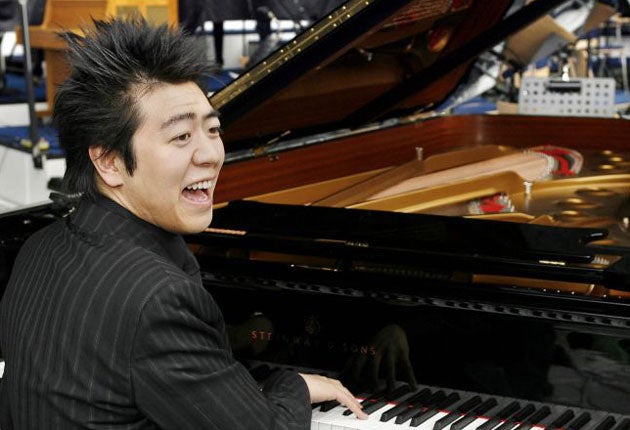
To get us in the mood for China, we are shown clips of Lang Lang doing his stuff, with a voice-over explaining how "cool and popular" he has made the piano for his young compatriots. This is the inevitable reach-me-down cliché, delivered without qualification, but the truth is that celebrity has irretrievably corrupted the remarkable talent which Lang Lang had when he first hit the headlines. Moreover, we know from his autobiography that the treatment he received from his fanatically ambitious father would have been regarded as child abuse, had they been living in the West.
When the father of a 13-year-old Chinese contestant joylessly explains to Prior that he has sacrificed everything, including his job as a taxi driver, to propel his son into the limelight, Lang Lang's miserable tale looks like repeating itself.
The young musicians play, the emperor and his aides deliberate, and much good sense is talked, though not by Prior, who quickly emerges as ignorant, opinionated, and quite astoundingly pig-headed.
"You have the right to disagree," he says grandly to his advisors, reminding them that he is "a very clever person", and lecturing them on the meaning of music. His own compositions are designed "to make the listener a better person" – he wants to "purify and enrich" his audience. No wonder Brodsky and Haendel are itching to box his ears; no wonder he put backs up at his high-flying London school, to a point where his parents had to remove him for his own protection.
But since he's the Sir Alan Sugar of the moment – "tell me why I should choose you" he says brightly to his assembled players in Shanghai – he gets built up hugely. His verdicts are delivered with the sort of theatrical pause ITV talk-show host Jeremy Kyle employs when revealing the results of DNA tests, and Prior's judgments are brutal and arbitrary.
"You don't communicate," he tells the most outstanding of the cellists, while explaining to his shocked advisers that his reason for not selecting another player is that "he is not charming". The best pianist is dismissed as being "too bossy". His final choices reflect malleability rather than excellence.

Watch Apple TV+ free for 7 day
New subscribers only. £9.99/mo. after free trial. Plan auto-renews until cancelled.
ADVERTISEMENT. If you sign up to this service we will earn commission. This revenue helps to fund journalism across The Independent.
Watch Apple TV+ free for 7 day
New subscribers only. £9.99/mo. after free trial. Plan auto-renews until cancelled.
ADVERTISEMENT. If you sign up to this service we will earn commission. This revenue helps to fund journalism across The Independent.
The cameras eagerly collude in all of this. When Prior coolly informs a harpist (who has flown hundreds of miles for her audition) that he hasn't chosen her because he has now decided he doesn't want to write for the harp, the cameras dwell slaveringly on her tears, as they do on the downcast faces of the others he smilingly rejects; the high-fives and victory hugs of the winners are similarly dwelt on. We are constantly told what an "ordeal" it is for Prior to say no, but, despite his protestations, he shows every sign of enjoying the process. When a voice-over looks forward to the moment when Prior meets "the supreme challenge of living up to his own expectations" as his concerto is unveiled, we know he will rise effortlessly to that challenge.
But if the format is formulaic, it's also predicated on a very dubious premise: that Prior is a major composer in embryo. At this point I must confess that, as the author of an article about him in this newspaper four years ago, I have helped fuel his fame.
I first encountered him at a composition class at Dartington summer school, where, attended by his mother Elena, he roundly ticked off a lecturer for avant-gardism, and marched out. At their London home, which is stuffed with Tsarist memorabilia, Elena told me he was, "the last big hope of the Stanislavski family, and Tchaikovsky and Tolstoy were connected to it by marriage. My son has much to live up to". He wasn't interested in technique: "It was always the passion in music he was interested in. He was never prepared to just play somebody else's music – he always had to improvise."
And music of a sort was indeed flowing out of him: grand emotional gestures, with very basic scoring. He eagerly showed me his new oratorio on the computer: commemorating the 600th anniversary of a battle between Russians and Tatars – very much a child's effort, but nothing if not ambitious. After this meeting, he went off to study at the St Petersburg conservatoire, the youngest entrant, claims Channel 4, since Prokofiev.
Recently I chanced to hear a 20-minute piece Prior had composed for a young pianist's debut disc: a clumsily bombastic thing which it would have been kinder to bin. The concerto we will see his chosen pianists and string-players deliver has already been premiered in reality, with the most positive review describing it as "the kind of over-the-top music a 16-year-old should be writing" (tell that to the 16-year-old Mozart, or Mendelssohn, or even Thomas Adès). So far, the only incontrovertibly prodigious thing about Prior is ironclad self-belief.
But we shouldn't be beastly to him, because he too is a victim of this circus. It's cruel to feed a child's delusions of grandeur, when what he desperately needs is a reality-check. But, unfortunately, "reality" television has other priorities.
'The World's Greatest Musical Prodigies' begins on Monday at 9pm on Channel 4
Join our commenting forum
Join thought-provoking conversations, follow other Independent readers and see their replies
Comments
Bookmark popover
Removed from bookmarks