Spooks: A drama that sees the future
The uncanny premonitions of its writers remain the key to the success of the BBC's MI5 series Spooks, says James Rampton
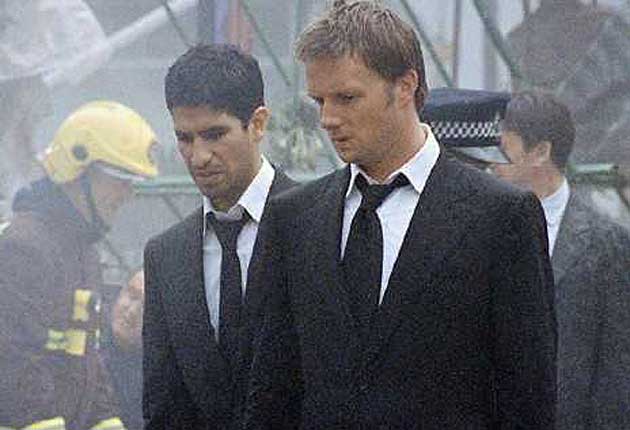
Call it sixth sense. The makers of Spooks, BBC1's hit MI5 drama, which begins its eighth series on Wednesday, seem to have an uncanny knack of knowing what's about to happen in the news.
"The obvious example is 7/7," says Spooks regular Peter Firth. "In June 2005, we filmed a train station being bombed by terrorists – a month before the same terrible event happened in real life. At one point, the episode wasn't going to be shown because it was too near the mark. In the end, the episode went out in a very heavily edited version."
Disturbing as the parallels may be between fact and fiction, they only serve to underline the extent to which the creators of Spooks have their fingers on the current-affairs pulse. They have also written episodes about the threat posed by a recrudescent Russia, the global financial crisis and London being locked down for a state visit by a US President before those events took place in real life.
The writers' ability to predict the tide in the affairs of men is one of the reasons why Spooks defies conventional TV wisdom and is stronger in its eighth series than it was in its first. In a most unusual move, last year Bafta nominated the seventh season of Spooks for its Best Drama Series award. So long after a show has begun, that is virtually unheard of.
The actor Richard Armitage, who plays the brooding agent Lucas, finds the interplay between real life and drama, "chilling. I was reading episodes of Spooks and at the same time ripping out press cuttings to create parallels between fiction and reality. You could have filleted the headlines and woven them straight into the drama. Are the Spooks team writing the newspapers as well? "
In the new series, the MI5 section, now led by the indomitable Ros (Hermione Norris), are sent footage of their erstwhile boss Harry – who was kidnapped by the Russians at the end of the last season – lying in a pool of blood. Despite all the evidence, Ros will not accept that he is dead and takes her team "off line" to try and locate Harry. As the series pans out, the team uncover a global conspiracy of terrifying dimensions.
In his dressing room at the decidedly insalubrious industrial warehouse in South London which doubles as Spooks' "Grid", Armitage comments that, "the writers very cleverly use what's happening in the real world as a springboard for their imagination. So at first their scripts might feel far-fetched, but when you analyse them, they are entirely possible. The writers manage to make the incredible credible. It's pretty scary when you look at how this series is unfolding. If what the writers have envisaged is really the case, then we're in deep trouble!"
The writers' foresight is no fluke. They have been immersed in the news since the first script conference in October of last year. "They're very clever people who are very politically aware," reckons Chris Fry, the producer of Spooks, which has, over the past eight seasons, won Bafta, RTS and TRIC awards and been sold to 45 countries. "They are reading papers and books all the time in an effort to predict what will be relevant when the series is broadcast. The ideal thing is when an episode goes out and the following morning viewers open their newspapers and say, 'my God, I saw that story last night in Spooks.'
'Spooks' starts at 9pm on BBC1 on Wednesday
Vision on: How the show predicts real life
Financial meltdown
Last year, the ‘Spooks’ production team shot an episode about the cataclysmic effect of a financial meltdown caused by irresponsible bankers, foreshadowing what took place in reality later that year.

Watch Apple TV+ free for 7 day
New subscribers only. £9.99/mo. after free trial. Plan auto-renews until cancelled.
ADVERTISEMENT. If you sign up to this service we will earn commission. This revenue helps to fund journalism across The Independent.
Watch Apple TV+ free for 7 day
New subscribers only. £9.99/mo. after free trial. Plan auto-renews until cancelled.
ADVERTISEMENT. If you sign up to this service we will earn commission. This revenue helps to fund journalism across The Independent.
A presidential lockdown
In 2003, in the second series, Matthew Macfadyen and Megan Dodds had to deal with the chaos caused after London was locked down for a state visit by a US President, months before those events occurred in real life when George W Bush arrived in Britain.
Race riots
The first series in 2002 contained an episode about race riots. Jane Featherstone, the executive producer of ‘Spooks’, recalls that, “at the time it was broadcast, the 10 O’Clock News followed with a story about race riots. There were a number of times when items in the news seemed frighteningly to mirror what had just happened on the screen.”
Join our commenting forum
Join thought-provoking conversations, follow other Independent readers and see their replies
Comments
Bookmark popover
Removed from bookmarks