Stopping the credits crunch
Why do broadcasters ruin the final scenes of dramas with pointless plugs? Give us some credits, says Nick Hasted
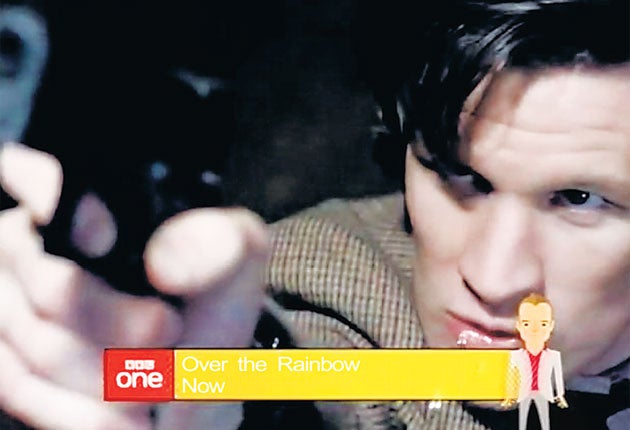
The mental scars incurred when an animated Graham Norton tripped across the bottom of the TV screen to advertise Over the Rainbow during the final seconds of a dramatic Doctor Who episode are starting to fade. The thousands of viewers who jammed messageboards straight afterwards means that the insane innovation of promoting a programme while the actors in the current show are still speaking has been retired, for now. But that's just one invidious extreme of a more general plague: the schedulers' obsession with making us watch the next programme, with no thought for the content and effect of what we're actually absorbed in.
Another Doctor Who episode had a particularly poignant ending, including the death of a major character. More than a few children, drawn deep into events, were no doubt left sobbing. Luckily, the BBC was ready to teach them that life moves on as, the second the credits rolled, the show shrank into a spare corner of the screen as the Eurovision Song Contest was breathlessly promoted. The jolt was like waking from a dream. When the announcer eventually finished, it was hard to remember what you had been unexpectedly made to feel early on a Saturday evening, at such effort from the programme-makers.
"Our members hate it," says acting union Equity's Martin Brown. "They hate it that the credits are squeezed up into the corner of the screen so that on most normal-sized screens you can't read them. They hate it that they're then scrolled so fast that you can't read them. The reason they hate it is not for the reason that Lorraine Heggessey, former BBC1 controller, once gave, which is that nobody reads the credits but somebody's mum. The credits on a good piece of work are their CV. And they want members of the public to know who they are, because they're giving something very personal, a performance.
"We have a major campaign running called Stop the Credits Crunch. Our members wrote to Ofcom, Channel 4, the BBC and the ITV networks to complain about this in March, saying this is serious, you can't just ignore it, and we had a productive meeting with the BBC last week. The broadcasters tell us that the changeover from one programme to another is where they struggle to keep audiences, and that they have to have advertisements for upcoming programmes flashing as soon as the previous programme has finished – and even while the drama is continuing. We are concerned with the integrity of the artistic product, and what that holds for it. We think it trivialises the work that's been done, and we think it isn't only performers who are concerned about this. Every time we've run a campaign, members of the public say how infuriated they are."
Equity's campaign would be satisfied by readable credits. But pick your own moment when a TV drama has gripped you the most in recent years, and the trend's deeper damage becomes apparent. The last episode of Life on Mars in 2007, in which John Simm's hero jumps off a building to an unknown fate, was so elegantly ambiguous and moving, public goodwill allowed the writers three series of Ashes to Ashes to explain it. The orchestral swell of Bowie's "Changes" over the credits was crucial to the effect. Naturally, as Simm leapt, the continuity announcer was already clearing his throat. Late-night viewers of The Wire on BBC2 last year committed themselves to between three and five hour-long episodes a week, as all five series of a contender for the greatest TV drama were screened. The bleak twists which ended each episode, as Baltimore's child drug-dealers were picked off, was nearly matched in tension by never knowing from one night to the next if Tom Waits's "Down in the Hole" would be allowed to play over the credits, or replaced by information on the snooker highlights. Oasis's "Don't Look Back in Anger" at the devastating end of Our Friends in the North, the last carefully anti-climactic minute of The Sopranos – these are all moments in which viewers have invested months, even years. They deserve the period of closure and reflection you give a great book when you put it down, not a reminder that Weatherview's up next, followed by a signed version of Cash in the Attic.
Valuing or even noticing the content of programmes is no longer a priority, in the hard-sell chaos that surrounds and encroaches on them. On the commercial terrestrial channels and Sky, things are even worse. There is talk at ITV of product placement during shows, and it is champing at its frayed leash to extend its current four-minute, deafening ad breaks. Those ads now cut into movies not at a natural dramatic break, but on a crude timer, actors sometimes being cut off almost mid-scene. Cute five-second films for a surfeit of sponsors ignore the tone of the programme they're sponsoring.
The time in the late 1970s when Federico Fellini came close to legally preventing Italian TV from showing adverts during his films, because this broke their artistic integrity, now belongs to a different world. The long-established US practice of running ads and programmes with no discernible break in the flow of product is nearer our current reality. This is partly an infection from the numbing universe of satellite and cable TV. Here, news channels roll on a barely shifting loop, symbolised by the info-strap scrolling infinitely along the screen's bottom. The endless repetition of programmes on non-news channels has followed suit. For a couple of years, you could watch the Arnold Schwarzenegger vehicle True Lies every few days on ITV2. Having got away with this, ITV sneaked the feature cartoon Ice Age on to prime-time two Saturdays in a row, just as Channel 4 recently trialled screening the same movies on successive weekends. This turns programmes into interchangeable, half-watched mush.
As if in proof, BBC4 insisted over the weekend on the need to have its insignia distractingly omnipresent in the corner of the screen, despite public criticism. Without it, they feared no one would know what channel or programme they were watching. Theultimate nightmare of this invaded and trivialised screen can be seen on Indian TV's coverage of cricket's Indian Premier League. You can barely see the matches, boxed in on all sides by ads and info-straps which are nakedly the point of transmission. Even the strokes and wickets of the athletes have sponsors' names attached by the commentators.
The BBC's obsession with loudly advertising itself has corrupted its remit to use the licence fee to show TV free of such nonsense. The Wire and Total Wipeout are different. Not everything is product. Programmes, and viewers, need time to breathe.
Join our commenting forum
Join thought-provoking conversations, follow other Independent readers and see their replies
Comments