Why the BBC dominates TV drama
The recession has hit commercial television broadcasters so hard that we could witness the demise of drama on ITV and Channel 4. The BBC's dominance of the genre is unhealthy, says Gerard Gilbert
So Lord Carter has made the radical suggestion that the licence fee might be used to fund projects beyond the BBC – to finance public-service broadcasting on commercial channels, such as ITV's regional news programmes. The government will report back in September – his lordship emphasising that his political masters will remain "open to other ideas and proposals". So here's one: why not include ITV and Channel 4 drama within the definition of public-service broadcasting – because at the moment the BBC is heading towards a virtual monopoly of drama production.
Certainly drama, the most financially draining of all forms of television, is in trouble on both ITV and Channel 4. Michael Grade, the recently departed executive chairman of ITV, announced in March that its flagship drama output would be hacked back by as much as 40 per cent, while Channel 4 is having to lop at least £60 million a year from its on-screen budget. For ITV that will mean far less of its expensive 9pm dramas, while Channel 4's once vigorous 10pm drama slate – Shameless apart – has all but disappeared already.
The situation has become so dire that one our most successful home-grown TV actors, James Nesbitt, has hired a US agent and is reluctantly turning to Hollywood in search of work because of the financial crisis now squeezing British TV drama. "I was challenged here, I enjoyed what I was doing," Nesbitt recently told Radio Times. "But the British TV industry is in a desperate state – not creatively but financially. There's so little happening here."
I was recently on the set of an upcoming ITV drama series with a press officer whose own life was reflecting in microcosm that the macro-economic realities being faced by broadcasters reliant on an advertising revenue that has shrunk by 20 per cent in the past year. Along with several other colleagues, she has taken voluntary redundancy, after surviving a cull only last summer. ITV has cut close to a third of its 5,500 workforce in the past few years, shelving long-running favourites such as Heartbeat, The Royal and Wire in the Blood, reducing The Bill to one episode a week, and axing lavish new projects like an adaptation of E M Forster's A Passage to India, which was expected to star Matthew Macfadyen and Sally Hawkins.
The one glimmer of hope for non-BBC drama would seem to be Sky1, whose recently acquired taste for home-grown drama has seen a broadcaster best known for importing American shows like Lost, 24 and The Simpsons turn to "best-loved British authors" for a string of ambitious projects that have included Terry Pratchett's Hogfather, Skellig with Tim Roth, and now a lavish and rather good four-part adaptation of cockney crime author Martina Cole's The Take, starring Tom Hardy and Brian Cox.
Sky1's head of drama, Elaine Pyke, tells me that the challenge for her is to make the channel a destination for drama. "It's very tough out there, but I do believe there is a hunger for another source of drama." In the Sky1 pipeline are an ambitious six-part adaptation of Chris Ryan's gung-ho SAS-adventure, Strike Back in Anger, which starts filming in South Africa in July; and a second Martina Cole adaptation, The Runaway, set in 1960s and 1970s Soho.
"I want to have that scale on everything," says Pyke. "It's what makes us stand out and makes us punch above our weight – and if we can go for that really high quality in every production eventually I hope we will be known for that."
The telling phrase here is "punch above our weight", because Pyke knows that even if Sky continues its commitment to big, costly home-grown drama (not necessarily a given in these uncertain times), the channel will still not be able to fill the void left by a diminished ITV and Channel 4. "We haven't got the number of hours. What we have we're maximising as much as possible. I would like to be up there with HBO. We're not really HBO genre, but the way that channel has been built up over key drama pieces is something that's really exciting.
"The production companies I talk to are having a very tough time and that's not good for British drama. The anxiety is that everyone feels they can take less risks. I hope the riskier stuff will still come through, but it seems to be only the BBC in a strong position at the moment."

Watch Apple TV+ free for 7 day
New subscribers only. £9.99/mo. after free trial. Plan auto-renews until cancelled.
ADVERTISEMENT. If you sign up to this service we will earn commission. This revenue helps to fund journalism across The Independent.
Watch Apple TV+ free for 7 day
New subscribers only. £9.99/mo. after free trial. Plan auto-renews until cancelled.
ADVERTISEMENT. If you sign up to this service we will earn commission. This revenue helps to fund journalism across The Independent.
Indeed it is. In fact, the BBC, slowly but surely, seems to be becoming the only show in town. Could we really be heading back to a time before the advent of commercial television, to an era before the ITV screened its first advert for soap powder and Michael Grade's "Uncle Lew" lit up the world of popular drama with shows like The Saint, Danger Man and The Prisoner? That's unlikely, but BBC drama arguably hasn't been in such a dominant position in half a century. Ben Stephenson, the BBC's head of drama, worries that this might be the case.
"I absolutely, categorically don't want the BBC to be the main stamping ground for drama," he told me recently over lunch. "I want us to make brilliant drama. But to be honest I want ITV and Channel 4 and Sky to make brilliant drama too."
And the people creating the much of the best TV drama are the plethora of independent production companies that have emerged since Margaret Thatcher years opened up Auntie to market forces. So-called "super-indies" such as Company Pictures, makers of Skins and Shameless and Kudos (Spooks and Ashes to Ashes) and responsible for roughly half of the BBC's non-soap and non-costume drama output.
"They are a huge massive part of what BBC drama is all about," says Stephenson. "If you look at the last few years they've really helped rejuvenate BBC drama – in-house with the period drama and new series like Survivors, Lark Rise to Candleford and Doctor Who, and the indies with Spooks, Life on Mars and Hustle. Channel 4 doesn't have an in-house department, so they are completely reliant on the indie community, as is Sky."
But Stephenson fears for the smaller and often more innovative production companies. "Some of those indies are the most important; they're the most idiosyncratic, they have the boldest voices and come at things in a different angle."
Either way, the situation is approaching where the BBC becomes such a dominant patron that there is only one port of call. And the ultimate patron is the man I'm sitting having lunch with, a self-confessed 32-year-old "geek" who seems to have both an encyclopaedic knowledge of television past and present – not to mention drama in the wider sense – and a genuine and lively passion for his remit. Not that his department is without its own problems.
"We have had quite a substantial hit this year, which is the licence-fee settlement. We're tens of millions of pounds down – or enough for 10 drama series," says Stephenson. "It would have happened with or without the credit crunch.
"So we do have our issues to deal with, but at the end of the day you want people to be getting on with the nuts and bolts of making shows rather than worrying about their bottom line and whether they can afford to keep their staff on. Above all else I want drama to thrive, whatever channel it's on." And if financial strictures mean it doesn't thrive elsewhere? "Then the BBC will have to be its own competition."
FIVE BIG NEW DRAMAS FROM THE BBC
Freefall
Dominic Savage has created the BBC's big recession drama, a semi-improvised saga exploring the fallout from the credit crunch. Aidan Gillen ('The Wire', 'Queer as Folk') heads the cast as a banker with too many dodgy bundles of debt. Also stars Dominic Cooper and Rosamund Pike. Broadcast in August
Day of the Triffids
John Wyndham's sci-fi classic updated by 'ER' writer Patrick Harbinson, with a stellar cast that includes Dougray Scott, Eddie Izzard, Vanessa Redgrave and Joely Richardson. But can they make the killer plants scary? Broadcast in autumn
Desperate Romantics
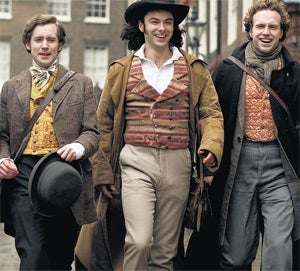
The tangled lives and loves of the Pre-Raphaelite Brotherhood as Peter Bowker ('Occupation') dramatises Franny Moyle's engrossing biography of the ground-breaking Victorian artists. Rafe Spall and Tom Hollander wear the facial hair. Broadcast in July
Defying Gravity
Aptly enough, the BBC is only one of several partners in this 13-part co-production about an international space mission. Set a short while into the future, Ron Livingston from 'Sex and the City' stars, and it's exec-produced by Michael Edelstein from 'Desperate Housewives'. Broadcast in August
Emma
Costume drama is what the BBC has always done best, but they will hope that Jane Austen-fatigue hasn't set in as Romola Garai (above) of 'Atonement', takes the title role in Austen's comic masterpiece – serialised for the first time since the 1970s. Broadcast in autumn
Join our commenting forum
Join thought-provoking conversations, follow other Independent readers and see their replies
Comments
Bookmark popover
Removed from bookmarks