BBC bosses almost lost faith in 'disgusting' Monty Python

For free real time breaking news alerts sent straight to your inbox sign up to our breaking news emails
Sign up to our free breaking news emails
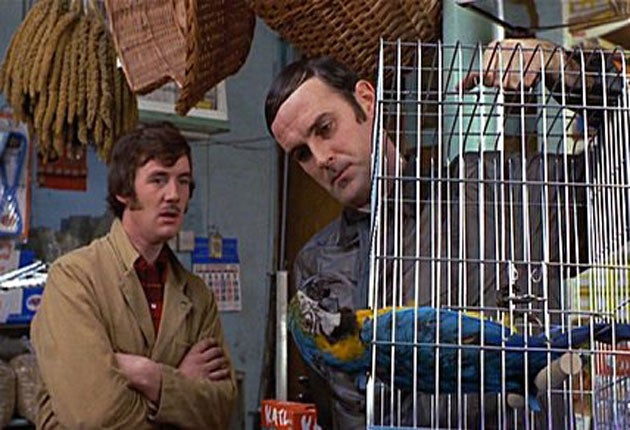
One of the BBC's most enduring comedy programmes, Monty Python's Flying Circus, almost met the same fate as the famous Norwegian blue parrot whose lifeless state was immortalised in a sketch featuring John Cleese and Michael Palin.
Audience ratings for the first show, broadcast 40 years ago, were the lowest for any light entertainment show and the BBC management soon lost patience with the Python's "disgusting and nihilistic" humour, according to documents from the time relayed to The Independent.
The future for John Cleese and the other five Pythons looked particularly bleak after a BBC management meeting in December 1970. "This edition had contained two really awful sketches; the death sequence had been in appaling taste, while the treatment of the national anthem had simply not been amusing," says a BBC memo released after a request under the Freedom of Information Act.
Aubrey Singer, the head of the BBC's features group, told the meeting that he had found parts of the programme "disgusting" while the controller of BBC1 complained the show had "gone over the edge of what was acceptable".
In echoes of many controversies to come, the most recent embroiling Jonathan Ross and Russell Brand, the managing director of television complained that "the producer had failed to refer it when he should have done so." Stephen Heast, head of arts features, accused the Pythons of being "nihilistic and cruel". Bob Reid, the head of science features,said they "wallowed in the sadism of their humour". Even the legendary Bill Cotton, head of the BBC's light entertainment group, conceded the "team seemed to have some sort of death wish". It was left to Desmond Wilcox, then editor of Man Alive, to defend the programme, asking what was wrong with "cruel humour".
Audience research figures for the first programme broadcast on Sunday October 5 1969 indicated only three per cent of the UK population had watched the show, compared to 22 per cent for Dad's Army. The audience reactive index, judged by a panel of BBC experts, was also the lowest for a light entertainment programme that week. But by the end of the first series the public had begun to appreciate what Python was all about and the producers were inundated with scripts and ideas for sketches.
The British public's growing understanding of Python comedy was also being reflected in BBC management thinking. In another senior managers' meeting in 1970, the managing director of television confessed he had enjoyed the whole show and the Controller of BBC1 had thought the Marx and Lenin quiz sketch to be "hilarious".
On November 27 1969 Michael Mills, the head of comedy and light entertainment, wrote congratulating John Cleese on the success of the series offering him a part in a second series. "The shows seem to be getting better and better and this a view shared by most people who see it," said Mills.
But it is clear that Cleese was unsure of his future contribution. "Barry (Took) told me you had reservations about doing another 13 shows quite as soon as this," wrote Mills. "I do hope you will be able to take part both as a writer and performer because the show would lose a great deal if you are not one of them. Could you let me know ... as early as possible?" But by end of third series Cleese had lost enthusiasm and decided to leave. The rest of the group carried on for one more "half" series before calling a halt to the programme in 1974.

Watch Apple TV+ free for 7 days
New subscribers only. £8.99/mo. after free trial. Plan auto-renews until cancelled
Watch Apple TV+ free for 7 days
New subscribers only. £8.99/mo. after free trial. Plan auto-renews until cancelled
The documents also reveal details on the costs of the Python series. Each of the Pythons was paid £160 for a single episode as well as supplementary payments of £10 a day during filming. Barry Cryer was paid 25 guineas (£26) to warm up the audience before the recordings of the programmes.
In a memo written on 26th September 1969, the series producer, John Howard Davies, said he had overspent by £755 on episode one due to filming and design costs. Behind the chaos was meticulous BBC planning. A ubiquitous 3-tonne props van carrying three men accompanied the cast wherever they went.
Subscribe to Independent Premium to bookmark this article
Want to bookmark your favourite articles and stories to read or reference later? Start your Independent Premium subscription today.
Join our commenting forum
Join thought-provoking conversations, follow other Independent readers and see their replies