9/11 State of Emergency / Sat Channel 4<br/>David Jason: the Battle of Britain / Sun ITV1<br/>Albert's Memorial / Sun ITV1
Light shed on the darkest of days
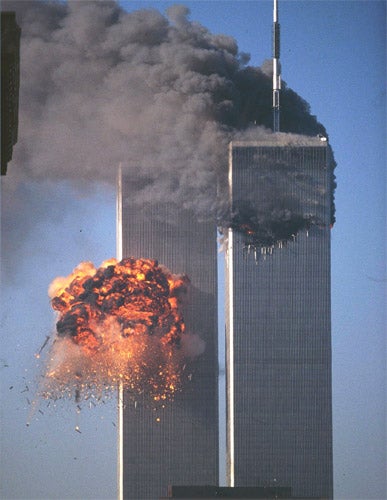
Anyone making a serious documentary about 9/11 has to strive to stop it turning into a thriller. Everyone is pretty much bound to fail – that event being so potent a blend of enormity and unsuspecting innocence that even the bereaved have acquired a kind of possessive excitement about its details. To have been at the heart of those events – rather than merely an appalled onlooker – is to have enlarged status and the boast of 9/11: State of Emergency was that it had got some of the biggest status witnesses of all. So Donald Rumsfeld pitched up to recall the moment – midway through one of the most redundant CIA security briefings in American history – when American Airlines Flight 77 screamed across the Pentagon lawn and buried itself in the building. And Condoleezza Rice – eyes shining at her intimacy with the momentous – was also here, describing the chaos that followed the strikes. "Despite all of the sophisticated command and control... at that moment much of it didn't function very well," she remembered, "and people instead did whatever they could to communicate messages... frankly, we then had to make it up." Given the fatuous avidity with which the conspiracy theorists seize on the tiniest encouragement you might have wished her to choose her words more carefully, but her account of the powers in the land reduced to calling each other on their own unencrypted cellphones struck me as plausibly chaotic.
The programme's implicit boast was only half-fulfilled. There were unquestionably figures at the heart of the drama here, and they told us things we haven't heard elsewhere. Particularly striking was Condoleezza Rice's decision to put America's armed forces on to Defcon 3, the first time this had happened since the Cuban Missile Crisis. Having ordered this, she suddenly remembered Lesson One in Deterrence Theory – that such gestures can start a feedback loop, with the Russians responding and tension ratcheting up until an unstoppable escalation is set in train. Anxious to put Putin's mind at ease, she put in a call to the Kremlin and found he'd anticipated her. He'd seen what was going on, he said, had lowered Russia's alert status and cancelled a large military exercise. "You don't have to worry about us," he reassured her. "For one moment, I had this moment of reflection," said Rice, "I thought, 'The Cold War's really over'."
Outside of that though you didn't learn much more about the panic at the highest levels of the American government, and nothing at all about what that double-dyed villain Rumsfeld got up to after he'd left the Pentagon lawns, where news footage captured him helping with the evacuation of the wounded. Instead, you got mid-level fluster, as the military looked frantically for an enemy it might actually be able to shoot at and the man running the Federal Aviation Administration took the unprecedented decision to ground every aircraft in American airspace. And you got ground-level courage, from people who'd suddenly found themselves pitched into a disaster movie. Kelly Reyher, a systems analyst working in the South Tower stepped into an elevator just seconds before the second plane hit. Fighting his way out of it again, seconds later, he found himself facing the decapitated body of a dead colleague, and a 70-storey walk down to safety, ignoring the advice of a steady stream of people going upwards to their deaths. The testimonies of those involved was cut together with archive footage and pretty expertly produced reconstruction, the authenticity of which was a professional triumph but a source of some minor editorial anxiety, given the scale of what happened. I wasn't convinced that we really needed to see the arterial blood spray from a murdered passenger on the first flight hijacked, given that there could be no living authority for the accuracy of that detail. It wasn't trying quite hard enough not to be a thriller at that point.
Last night on ITV1 was virtually given over in its entirety to David Jason, who turned up first as the host of a programme about the Battle of Britain and then, after an hour's interval, as a London cabbie in the drama Albert's Memorial, in which two Second World War veterans drive a dead friend across Europe to be buried in a German field. David Jason: the Battle of Britain naturally spent time with veteran pilots but also honoured "the many behind the Few", talking to the ground crew, aircraft observers and fighter command plotters who helped ensure that – unlike those F16s some 60 years later – the fighters could actually find their targets. Albert's Memorial looked initially like an old geezer's comic road movie, enlivened with that invaluable prop for farce – a dead body. Then it darkened into something quite sombre with the revelation that the unresolved secret all three men had carried with them since the war involved their failure to save a young woman from a violent death at the hands of Russian soldiers. And then it squandered the respect it had earned for its daring by adding a preposterous and entirely wishful supernatural ending, with the revelation that the enigmatic hitchhiker the two men had picked up while crossing the Channel was in fact the dead girl's spirit, returned to absolve them of their guilt. I had been planning to make a mild note of protest at the plot's dependence on coincidence, but in the light of that later twist it seems a bit pointless.
Join our commenting forum
Join thought-provoking conversations, follow other Independent readers and see their replies
Comments