Last Night's Television: Right to Die? Sky Real Lives
A dignified departure
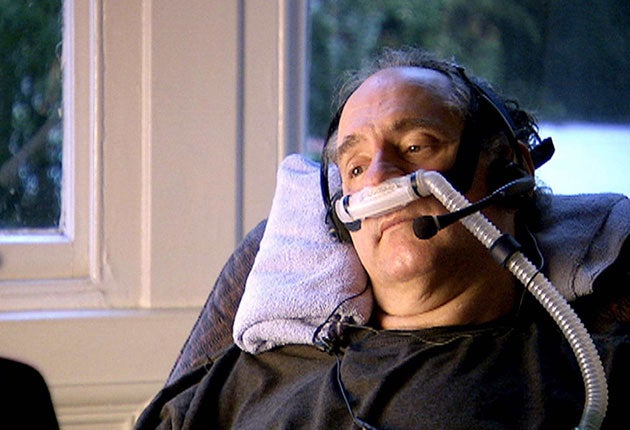
"Rather surprisingly, I find that I feel much the way I imagine immigrants to America must have felt in the 19th century. I cannot stay where I have been and I embark on a journey to a destination of which I have only heard the vaguest rumours." Writing to his friends and family about his travel plans, Craig Ewert didn't labour another element of the analogy. Like almost all of those immigrants, he knew with certainty that there would be no return trip, because he was planning to commit suicide with the help of the Swiss organisation Dignitas. And John Zaritsky's film Right to Die? – the subject of a considerable amount of knee-jerk affront and moral flutter yesterday – was going to record the process.
The first thing to say about a film that will have been heard about by vastly more people than actually saw it – since it was transmitted on a new cable channel, Sky Real Lives – was that the reports that it featured the moment of Ewert's death were a little wide of the mark. You saw him falling asleep after he'd taken the medication that had been prescribed to kill, and you saw him pronounced dead, but the camera cut away in between, as if reluctant to linger in prurience for the precise moment. The second would be that it was far more nuanced and troubling than some of the press coverage might have led you to expect. Ewert, a college lecturer who was suffering from motor neurone disease, was the central subject, but Zaritsky had also filmed the Coumbias, a delightful Greek-Canadian couple whose request to go on Dignitas's books was eventually turned down.
"Why don't I go healthy and happy?" George Coumbias asked, worried that his heart condition was steadily slicing the pleasures out of his life. "No golf, no tennis, no sex... so it remains good food and good wine... I wonder when they are going to tell me, 'You are not allowed to do that?'" His healthy wife, utterly devoted to him, declared that her oft-stated reluctance to live without him was not mere rhetoric and that she planned to die too, arm in arm. But their pleasure in each other's company, and George's ebullience in adversity made it all but unthinkable that they should be approved for oblivion. For those who believe that life and death is an individual choice – not something to be constrained by other people's religion or other people's fear – they were a tough test case.
Craig Ewert was a different matter entirely, a man bowed by his disease and sucking at his breath in a way that looked like hard labour. He spoke with a dry forensic clarity about the options that faced him and struck you as a man who was far more frightened of dying than of death itself, worried that his disease would advance to the point where his ability to choose would disappear. "I've got two choices," he said, his speech measured out by shallow breaths. "I go through with it or I say, 'You know what? I'm too scared right now. I don't want to do it.' If I go through with it, I die as I must at some point. If I don't go through with it, my choice is essentially to suffer, and to inflict suffering on my family and then die! Possibly in a way that is considerably more painful and stressful than this way." More pointedly, he addressed the standard religious objection to human decisions about the ending of a life. "The Christians never say, 'We have to stop organ transplants. We have to stop helping premature babies.' No, then it's all right to play God."
The craft of Zaritsky's film was always going to struggle for attention over its subject matter, but it was there, in the way that the camera kept looking past Craig's shoulder to see life continuing in the local park and in the time- lapse sequences that entered the film when the couple finally went to Switzerland, which seemed to capture some of the blurred unreality of booking in for your own death. It didn't veil the final minutes either, the wince as Ewert swallowed the drug that would kill him, the fact that the end wasn't the idyll of calm resolution you might have conjured up. He was scared and it showed. "I've learnt something new," he said with willed perkiness after asking a question about the device that would turn off his life support, "Every day you learn something new... even in the last day." And then he exited, seen only in stills from that point on as if to press home the finality of his departure. "Safe journey and a good sleep," his wife said, as he lay back and closed his eyes. It might sound like faint praise – but it's meant as forthright defence – to say that this was a decent film.
Join our commenting forum
Join thought-provoking conversations, follow other Independent readers and see their replies
Comments