Last Night's TV - Twenty Twelve, BBC4; The Secret War on Terror, BBC2
At the top of their Games
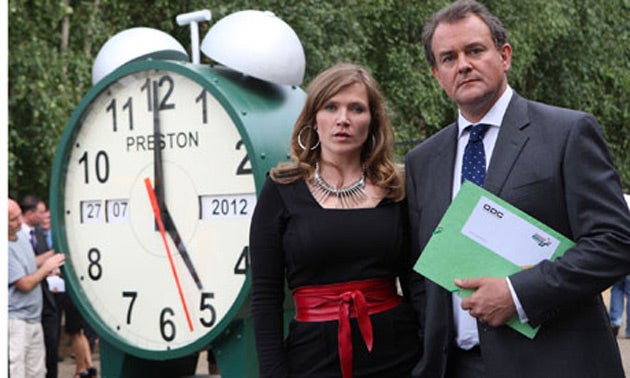
One of the pleasures of being British lies in our willingness to sit squarely on whoopee cushions of our own making and positioning, of which the latest example is Twenty Twelve, a six-part spoof documentary poking relentless fun at the preparations for next year's Olympic Games. There is surely no other country in the world that would laugh at itself in this way, even persuading the vast project's principal mover-and-shaker, in our case the Rt Hon Lord Coe KBE, to participate in the joke.
In last night's opener, Seb Coe's contribution was restricted to a few references and an appearance in a trailer for next week's episode. But by then I was hooked anyway, by the mischief in John Morton's script and the beautifully nuanced performances of, in particular, Hugh Bonneville and Jessica Hynes.
Bonneville plays Ian Fletcher, head of the (fictional) Olympic Deliverance Commission. Hynes is Siobhan Sharp, whose firm, Perfect Curve, has somehow landed the public relations contract. The best spoof documentaries rarely veer too far away from plausibility. That was the beauty of The Office, and Twenty Twelve nails it too. Siobhan's gabbled PR-speak masks a cluelessness that is frighteningly convincing. "Matthew Pinsent? I don't know who that is," she snapped dismissively into her mobile. It's all too painfully, horribly likely.
Bonneville's Fletcher, meanwhile, has a veneer of competence, albeit diminished by his daily fumblings with his folding bike. It was a smart idea, too, to give him a nagging, as-yet-unseen wife, and if you don't think it strains credibility for a powerful administrator in the testosterone-fuelled world of sport to find himself in thrall to a domineering wife then you haven't read No Angel, Tom Bower's biography of Formula 1 supremo Bernie Ecclestone.
No, Twenty Twelve was pitch perfect throughout, with the possible exception of head of contracts Nick Jowett (Vincent Franklin), who seemed too obviously inspired by Mackenzie Crook's immortal Gareth in The Office. That said, I enjoyed Jowett's tribulations with the new traffic-light phasing software, not least because like pretty much everything in the first episode, it didn't take a Bob Beamon-style leap of the imagination to picture it happening for real. Indeed, I can still recall a conversation I had with a London cabbie shortly after London was awarded the Games. He predicted extensive roadworks starting a couple of days before the opening ceremony. It is that same pervasive British cynicism that brought us Twenty Twelve and should deliver it a healthy audience.
As for Lord Coe and those people actually engaged in delivering the Olympics, the sad fact of 21st-century life is that the word terrorism looms just as large as traffic, and in The Secret War on Terror the indefatigable Peter Taylor asked whether the world has been made safer by the West's efforts to suppress al-Qa'ida.
Intriguingly, the question seemed to boil down to one of morality, even philosophy. Is there any justification for what the CIA euphemistically calls "enhanced interrogation techniques", meaning torture, as routinely practised at Guantanamo Bay? Waterboarding, once practicised by the Spanish Inquisition, has yielded information that has saved innocent lives: does that make it defensible?
Taylor thinks not, and found some illustrious contributors to agree with him, up to and including the former director-general of MI5, Baroness Manningham-Buller, giving a rare TV interview and recalling her "shock" at the discovery that the mastermind of 9/11, Khalid Sheik Mohammed, had been waterboarded 183 times in a month by his American captors. It was, she reckoned, a huge propaganda coup for al-Qa'ida that the West with its "much-vaunted principles" should resort to such practices. General Musharraf, on the other hand, asked bluntly whether the ends justify the means, replied "to an extent, yes". Taylor didn't push the former president of Pakistan on the definition of "an extent". After all, how long is a piece of string, or perhaps in this case a piece of piano wire? "Unusual circumstances demand unusual measures," added Musharraf. It is the explanation offered by tyrants and torturers through the ages, although, despite British protestations to the contrary, he didn't recall being asked to curb his unusual measures by Her Majesty's Government.
From General Hayden, the former head of the CIA, Taylor got a more gnomic response, perhaps inspired by the memorable circumlocutions of Hayden's old boss, Donald Rumsfeld. "My view is that I don't have a view," said the general, regarding the propriety of techniques used in what the CIA, very hot on euphemisms, also calls "the Programme". Rumsfeld, with his known knowns and unknown unknowns, would have approved.

Watch Apple TV+ free for 7 day
New subscribers only. £8.99/mo. after free trial. Plan auto-renews until cancelled.
ADVERTISEMENT. If you sign up to this service we will earn commission. This revenue helps to fund journalism across The Independent.
Watch Apple TV+ free for 7 day
New subscribers only. £8.99/mo. after free trial. Plan auto-renews until cancelled.
ADVERTISEMENT. If you sign up to this service we will earn commission. This revenue helps to fund journalism across The Independent.
Taylor's own modus operandi, meanwhile, are not above criticism. He has an agenda, and fashions his documentary to fit it, finding an eloquent critic of US-sponsored torture, in the admirable form of lawyer Clive Stafford Smith, but not a similarly eloquent apologist. That I happen to agree with his agenda doesn't mean that I can't spot a glaring lack of objectivity, but then who can be objective about human-rights abuses? And hats off to him for assembling a truly stellar collection of talking heads. It was a mild surprise, in fact, not to find him sitting in an Afghan cave with Osama bin Laden.
Join our commenting forum
Join thought-provoking conversations, follow other Independent readers and see their replies
Comments