Chopsticks: The cutlery conundrum
Some 45 billion chopsticks are used and chucked away in China each year. Campaigners want to change that, but face huge economic and cultural obstacles
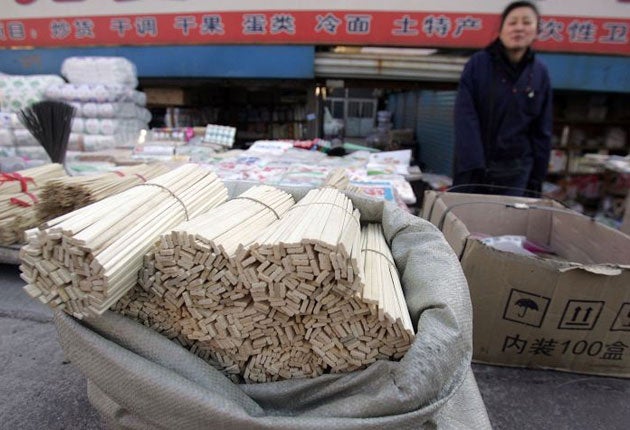
For the humble chopstick, life is predictable. Start off as a tree, one of the 25 million felled each year for the purpose. Spend a brief few weeks, newly-whittled, encased in paper. Then wind up on someone's plate, where you are expertly used to shovel noodles, or rice, or meat into a mouth. Then that's it. It's time to face the great landfill in the sky.
Millions of chopsticks meet their end like this. In fact, billions – 45 billion a year in China alone, taking with them some 100 acres of birch, poplar and bamboo forest a day. It is one reason why attempts are under way to turn the Chinese off their disposable cutlery and on to the longer-lasting kind.
In 2006, the Government introduced a 5% tax on all disposable wooden chopsticks following petitions from schoolchildren and citizens' group. Since then, efforts to curb the wooden sticks' use have increased. A BYOC (Bring Your Own Chopsticks) movement has been actively petitioning for sustainable options for some time. Described by the China Post as a collection of "young yuppies", they carry around their own implements when dining out. Occasionally, claims the Post, restaurant owners take it upon themselves to reward the yuppies' efforts with a complimentary bowl of soup. Greenpeace launched a campaign with the slogan "say no to disposable chopsticks." In 2008, activists dressed as orang-utans invaded corporate cafeterias – Microsoft, Intel and IBM among them – to discourage diners from going disposable.
Then, earlier this year, the Chinese Ministry of Commerce joined with five other government departments to warn that companies using disposables could soon face legal restrictions. They claimed to "aim at decreasing the use of the throwaway utensil". "Production, circulation and recycling of disposable chopsticks should be more strictly supervised," they explained. It's a stark about-face for the Chinese government. Prior to the measure, they had actively encouraged disposables' use. They were, reasoned authorities, more hygienic that their reusable cousins.
The debate over throwaway instruments, while raging in China, is by no means limited to chopsticks. In the UK, disposable cutlery is thought to be used for an average of three minutes before being discarded. Plastics – including convenience cutlery, crockery and cups – account for 7 per cent of office waste (the overwhelming bulk, unsurprisingly, is paper). That's before the countless millions of knives, forks and spoons churned out by fast food restaurants, cafes and supermarkets are taken into account. Recent years have seen the rise of the Carry Your Own Cutlery (CYOC) movement, while websites such as Recyclethis.co.uk offer readers advice on how to reuse their plastic implements.
Increasingly, retailers are under pressure to offer – if not reusable – then at least recyclable options. Starbucks recently pledged to introduce renewable materials during its next round of store upgrades and has committed to using entirely recyclable cups by 2015. Pret a Manger, meanwhile, has pledged to go "landfill-free" by 2012. Not everyone has been so quick to change. McDonald's, while using recycled paper in much of its packaging, defends its choice of plastic cutlery on the grounds that washing up would waste energy.
How effective China's measures will be remains to be seen. The BYOC has been slow in picking up active support, and the government's waste warning, while a step in an environmentally-friendly direction, is more bark than bite. Legislation is looming, though as yet there are few concrete incentives for diners to trade in their disposables. Wooden chopsticks cost restaurant owners a fraction of what the more durable alternatives do, since the cost of sterilisation is high. What's more, the alternative melamine-resin chopsticks have a notoriously high formaldehyde content, which is neither great news for the environment nor diners' health.
Polls by news outlets have found broad support for reusable items. Some 84.2 per cent of participants told a recent Sina.com poll that they would swap for more durable options. Still, analysts point out that the authorities' interest is divided. Environmentally, cutting down on chopsticks makes sense. Economically – in the short term at least – it doesn't. More than 300,000 people are employed by the wooden chopstick industry, across 300 factories. Exports of their wares bring in $200m a year. In 2009, it was claimed that 300 restaurants in Beijing had ceased to provide disposable chopsticks. In a country of some 1.3 billion diners, there's a long way left to go.
Join our commenting forum
Join thought-provoking conversations, follow other Independent readers and see their replies
Comments
Bookmark popover
Removed from bookmarks