All roads lead to Copenhagen as 100 world leaders head to summit
Saudi Arabia casts shadow over conference with bid to exploit leaked climate change emails
Hopes of reaching an international deal on curbing global warming were boosted yesterday by the announcement that more than half the world's leaders would attend the Copenhagen summit starting on Monday.
A stream of acceptances has taken the number going to the conference to more than 100 – and more could decide over the weekend to attend.
"The presence of so many leaders doesn't guarantee success but it makes failure harder. They won't want to come away without an agreement," a British source close to the negotiations told The Independent.
The Danish government, which issued 191 invitations to heads of state and government, announced that more than 100 had accepted. They will attend on the last two days of the talks on 17 and 18 December.
Early sessions at the United Nations summit will be conducted by officials from participating governments, but parallel contacts between leaders will take place at the same time.
Britain says the high levels of participation and engagement by heads of state in the Copenhagen negotiations contrasts with the stalled international trade talks in which few world leaders participated.
Divisions between – and within – nations on the size of the problem and the cost of tackling it mean that the chances of negotiating a binding international treaty on climate change at Copenhagen look remote.
However, cautious optimism that an agreement can be struck has grown as most of the world's biggest economies have said they were prepared to commit themselves to targets on carbon emissions. The United States, China, India, Brazil and Indonesia have all put offers on the table, with an announcement expected shortly from Mexico.
Opposition to cutting emissions has come from Saudi Arabia, which has seized on leaked emails from the University of East Anglia's Climatic Research Unit that appeared to cast doubt on the evidence of man-made global warming. But negotiators believe the Saudi stance is designed to protect its oil industry and the kingdom will eventually be forced into line by the weight of world opinion.
Gordon Brown insisted that an agreement to close a "five-billion-tonne gap" in carbon emissions cuts was in reach. He explained that existing pledges would reduce projected emissions in 2020 from 54 billion tonnes to 49 billion but the international community needed to go further and agree on 44 billion.
The Prime Minister was the first to announce his participation in the Copenhagen negotiations.
Those joining him include French President Nicolas Sarkozy, German Chancellor Angela Merkel, Chinese Premier Wen Jiabao and Japanese Prime Minister Yukio Hatoyama. The Indian Prime Minister, Manmohan Singh, has not disclosed whether he will attend.
President Barack Obama has said he will attend the negotiations next Wednesday, well before they come to a conclusion, but hopes are rising he could return the following week.
Preparations for the United Nations climate change conference, designed to agree a replacement for the 1997 Kyoto protocol, began two years ago.
As well as an emissions deal, industrialised nations will have to reach agreement on how much cash to give to developing countries to help them develop carbon-capture technology. There are divisions on the issue within the European Union, let alone between the world's major economies.
The scale of the task ahead in the hugely complex negotiations was underlined by Erik Solheim, the Norwegian Environment Minister.
He said: "These are the most difficult talks ever embarked upon by humanity. The effects will be felt by the rice farmer in Sichuan in China, by Google headquarters in Seattle, or by the oil worker in Norway."
A British official agreed: "This is a live process. We think there is an emissions deal to be done but equally it could all fail. It will be history in the making."
Mr Brown said the world was "only halfway there" in reaching agreement on cutting emissions and on finance for the poorest countries.
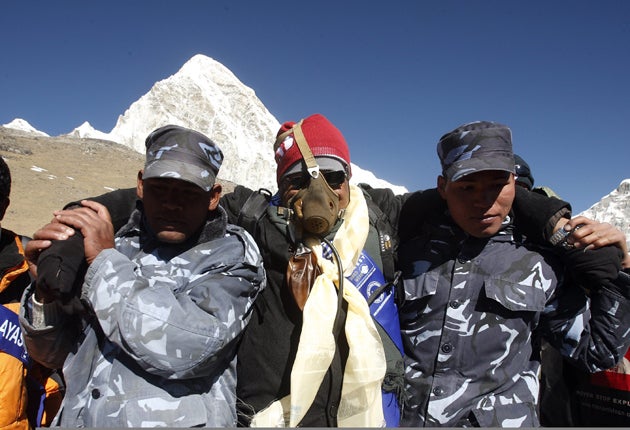
High-level meeting: Nepal's cabinet on Everest
In oxygen masks and woolly hats, Nepal's ministers yesterday held the highest cabinet meeting ever at the base camp of Mount Everest. At 17,200 feet up, they were a long way from the Maldives' cabinet, which met underwater in October. But the point was the same: to highlight the impact of global warming. "The Himalayas are getting hot," said Environment Minister Thakur Prasad Sharma. It went without a hitch – almost. Minister Without Portfolio Lal Karn, had to removed by helicopter after he developed altitude sickness.
Join our commenting forum
Join thought-provoking conversations, follow other Independent readers and see their replies
Comments
Bookmark popover
Removed from bookmarks