China stands accused of wrecking global deal
Nations stunned by tactics of world's largest polluter. Michael McCarthy, Environment Editor in Copenhagen, and Jonathan Owen in London report
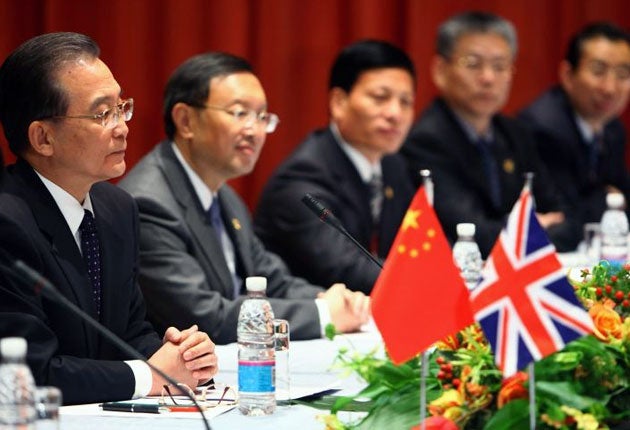
China "systematically wrecked" the Copenhagen climate summit because it feared being presented with a legally binding target to cut the country's soaring carbon emissions, a senior official from an EU country, present during the negotiations, told The Independent on Sunday yesterday.
The accusation, backed up by a separate eye-witness account from the heart of the talks of obstructive Chinese behaviour, reflected widespread anger among many delegations about the nation's actions at the conference.
The concluding agreement about tackling global climate change was widely criticised yesterday for being too weak, and was seen as a dashing the hopes of many concerned about the warming threat. The lack of teeth in the "Copenhagen accord" – which, it is accepted on all sides, is inadequate for fighting climate change – was widely blamed by environmentalists on President Barack Obama for not making bigger US commitments to cut carbon emissions.
Yet the key element of the agreement, a timetable for making its commitments legally binding by this time next year, was taken out at the last minute at the insistence of the Chinese, who otherwise would have refused to agree to the deal.
Also removed, at Chinese insistence, was a statement of a global goal to cut carbon emissions by 50 per cent by 2050, and for the developed world to cut its emissions by 80 per cent by the same date. The latter is regarded as essential if the world is to stay below the danger threshold of a two-degree Centigrade temperature rise.
The "50-50" and "50-80" goals have already been accepted by the G20 group of nations and world leaders who were negotiating the agreement, including Gordon Brown, Angela Merkel of Germany, Nicolas Sarkozy of France and Kevin Rudd of Australia. They were said to be amazed at the Chinese demands, especially over the developed nations' goal. The European official said: "China thinks that by 2050 it will be a developed country and they do not want to constrain their growth."
China, with its rapidly expanding economy, has now overtaken the US as the world's biggest CO2 emitter, and although at the meeting it agreed for first time to a target to constrain its emissions growth in an international instrument, it is desperate not to have that made legally binding, the official said. He added: "This conference has been systematically wrecked by the Chinese government, which has adopted tactics that were inexplicable at first as we had been led to believe they wanted an agreement."
Even more pointed allegations about Chinese behaviour came last night from another source at the heart of the negotiations.
The source was present as heads of state and government drafted the final document, and gave the IoS an astonishing eyewitness account. He said: "There were 25 heads of state in the room; this was about six o'clock on Friday night. To my right there was President Obama in the corner, with Gordon Brown on one side, the Ethiopian President on the other, the President of Mexico, the Prime Minister of Papua New Guinea...
"If China had not been in that room you would have had a deal which would have had everyone popping champagne corks. But this was the first sign that China is emerging as a superpower, which is not interested in global government, is not interested in multilateral governance that affects its own sovereignty or growth. You could tell this lack of engagement through the process; they play a much cleverer game than anyone else. They were running rings around the Americans.
"It's always easier to block than to try and get something. The Americans will probably be given some of the blame because that's the conventional narrative all the pressure groups have – that the rich countries are bad, they didn't give enough money or they would not create enough mitigation targets."
The source went on: "But the truth is, I was in that meeting and the 'Annex 1', rich countries had mitigation targets of 80 per cent by 2050 which everyone supported, and it was taken out by the Chinese. The deal was watered down because the Chinese wouldn't accept any targets of any sort, for anybody. Not themselves or anybody else. Legally binding stuff was taken out by the Chinese as well and there was a lot of anger in the room. It was controlled but it was very, very clear what the feelings were.
"The Chinese were happy as they'd win either way. If the process collapsed they'd win because they don't have to do anything and they know the rich countries will get the blame.
"If the deal doesn't collapse because everyone is so desperate to accommodate them that they water it down to something completely meaningless, they get their way again. Either way they win. I think all the other world leaders knew that by that stage and were just furious that they couldn't do anything about it.
"It was extraordinary to see, and incredibly worrying for what it bodes for the future of our planet in this century. China is not going to get less powerful, and if this is the way that it's going to behave, then we have problems."
Ed Miliband, the Secretary of State for Energy and Climate Change who led the negotiations for Britain, said last night: "It's disappointing that the Chinese insisted we should not commit to a global 50 per cent emissions cut, and it's disappointing that they didn't support a legally binding treaty. I think both of these are necessary."
Additional reporting by Rebecca Buchan and Claire Cooper
Eyewitness: Amid the confusion and chaos, we waited in vain for the hand of history on our shoulders
It was colourful, chaotic and confusing. But the sense most people will probably walk away with after nearly two weeks of talks in Copenhagen is one of intense disappointment and deflation.
Close to 50,000 people attended, and most of them – be they environment ministers, NGOs, journalists or green campaigners – arrived at the Bella Center at the start with a justified feeling of optimism. The conference did, after all, mark the culmination of years of work. "Can you feel the hand of history on your shoulder?" some of the thousands who gathered in the vast media room joked to one another.
On Tuesday, the excitement was palpable. Arnold Schwarzenegger swept past with his entourage. John Prescott arrived, bounding from one interview to the next. Al Gore was everywhere, giving speeches and getting standing ovations. This is it, I thought: this is history being made.
But as the days wore on, the mood became more pessimistic. At the beginning of the conference, the huge hall of NGO and campaign stalls was crammed full of people, desperate to attract your attention. By the end, it was like a ghost town – most of them had been banned from entry. It was through this hall that I joined a walkout by protesters on Wednesday; less than an hour afterwards they had been beaten into submission by Danish police. Only the hardy vegan group remained.
On Thursday and Friday, the leaders of rich and poor nations descended and the main plenary hall became a sea of rhetoric. The conference became a mess of hastily arranged and cancelled press conferences. After the confusion came an uneasy lull, before Barack Obama's dramatic announcement promised to resurrect a deal. But it was not what anyone had hoped for.
Walking through the centre yesterday, I was struck by a sense that the whole thing had been a waste of time – with a carbon footprint of about 121,500 tons of C02. The hand of history was nowhere to be seen.
Chris Green in Copenhagen
Join our commenting forum
Join thought-provoking conversations, follow other Independent readers and see their replies
Comments
Bookmark popover
Removed from bookmarks