How the blurring of the seasons is a harbinger of climate calamity
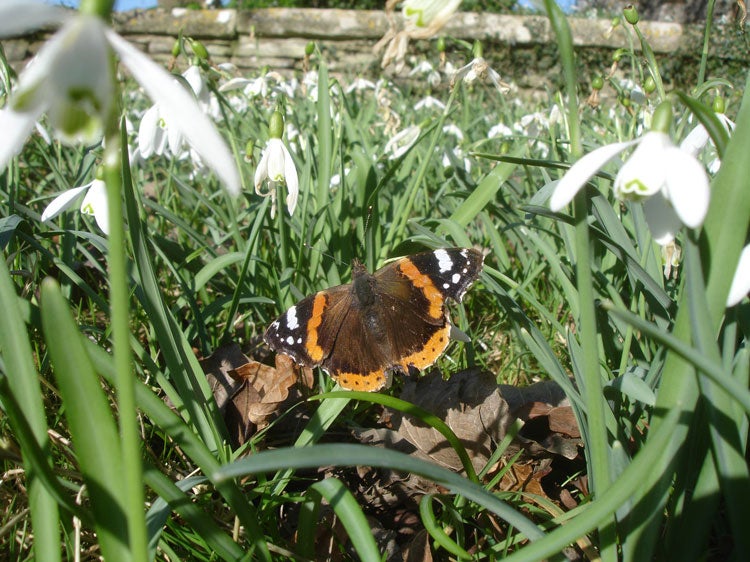
Spring, which officially starts today, is starting to dissolve as a distinct season as climate change takes hold.
According to documented observations throughout 2007 and 2008, events in the natural world that used to be key spring indicators, from the blooming of flowers to the appearance of insects, are now increasingly happening in what used to be thought of as mid-winter, as Britain's temperatures steadily rise.
Although many people may see the changes as quaint or charming – butterflies certainly brighten up a January day – they are actually among the first concrete signs that the world is indeed set on a global warming course which is likely to prove disastrous if not checked.
In fact, the blurring of the seasons in Britain is now as serious a piece of evidence of climate change as the rapidly increasing melting of ice across the globe, in glaciers and in the land-based and marine ice sheets of the Arctic and the Antarctic.
The phenomenon shows that a whole range of organisms is already responding actively to the greatest environmental change in human history, in a way that people – and especially politicians – are not.
Last month, that shift produced its most remarkable image yet – a photograph, taken in Dorset, of a red admiral, an archetypal British summer butterfly, feeding on a snowdrop, an archetypal British winter flower.
Although that is not an event likely to cause alarm among the public, it was quite inconceivable until very recently. It is undeniable confirmation that a profound alteration in the environment, the consequences of which are likely to prove catastrophic, is already under way.
It is happening so quickly, and without people realising its true significance, because, in Britain, the major effects of climate change are initially being felt as less cold winters, rather than as hotter summers.
That has produced a startling rise in winter temperatures in recent years, clearly visible when current monthly means are compared to the average for 1961 to 1990.
To take the figures for last winter from the Central England Temperature Record, the world's oldest, which dates back to 1659: January 2007 was 3.2C warmer than the 1961-90 average, February was 2.0C warmer, March was 1.5C warmer, and April was 3.3C warmer. So far this year, January has been 2.8C above the 1961-90 average for the month, and February, 1.6C
Those are substantial rises. Although there is always natural variation in temperatures, recent winters taken together show a remarkable warming trend.
It has meant that many of what used to be thought of as the traditional signs of spring are happening very much earlier, causing primroses, for example, spring flowers par excellence, to bloom in some parts of the country as early as November. Other traditional spring plants, such as dog's mercury and the lesser celandine (a favourite of Wordsworth's) can be seen in January rather than March.
And in what is perhaps an even more vivid change, dandelions and daisies, which used to come into flower in spring on lawns (where they were permitted), now flower in many places all winter long.
Insects are responding similarly. A number of butterflies that overwinter as hibernating adults can now be seen in January rather than March or April, including the peacock and the comma, and especially the red admiral.
This last species used to be a spring migrant from the Continent but, in the recent warmer winters, it has begun to overwinter here.
Bumblebees have similarly become visible in mid-winter, and frogspawn, usually laid about March, can be seen in December in the South-west and south Wales.
The changes and many others have been monitored in detail because in Britain there has been a renewal of the old discipline of phenology, or the study of the timings of natural events, which was favoured by the Victorians but largely abandoned by the 1950s.
It has been revived by an environmental statistician, Dr Tim Sparks from the Monks Wood wildlife research centre near Huntingdon, part of the Government's Centre for Ecology and Hydrology (CEH).
Dr Sparks set up the UK Phenology Network, which has been taken over by the Woodland Trust, a charity which runs it in partnership with CEH as Nature's Calendar, with 40,000 people from all over Britain contributing records.
"We do have problems now recording some of what used to be signs of spring," Dr Sparks said last night. "For example, we used to record the first grass cutting of the year. But in many places now grass grows all year round and so it has to be cut all year round."
Until 1947, said Dr Sparks, the Royal Meteorological Society used to produce an annual Phenological Report, the front-page logo of which was a song thrush singing against a background of hazel catkins.
"A major sign of spring used to be the first time a song thrush was heard singing," he said. "But now song thrushes can be heard all through the winter, and hazel catkins can be found in December to January, rather than in January to February."
The shift was largely a phenomenon of southern Britain, he said, and traditional spring signs were still likely to be seen in Scotland. In southern England, oak leaves are sprouting 26 days before they did in 1950, while swallows, house sparrows, great tits and robins are laying their eggs a week earlier on average.
Poppies are a fortnight ahead of where they used to be, and stinging nettles 10 days ahead. Last April, the earliest-ever emergence dates were recorded for 11 species of butterfly: the speckled wood, for instance, was seen in January, seven weeks earlier than ever before.
The irony of course, is that the first days of spring 2008 are likely to be startlingly cold. But not withstanding the predicted Easter snap, there can be no doubt that spring has already sprung.
Join our commenting forum
Join thought-provoking conversations, follow other Independent readers and see their replies
Comments
Bookmark popover
Removed from bookmarks