Hudson Bay polar bears 'could soon be extinct'
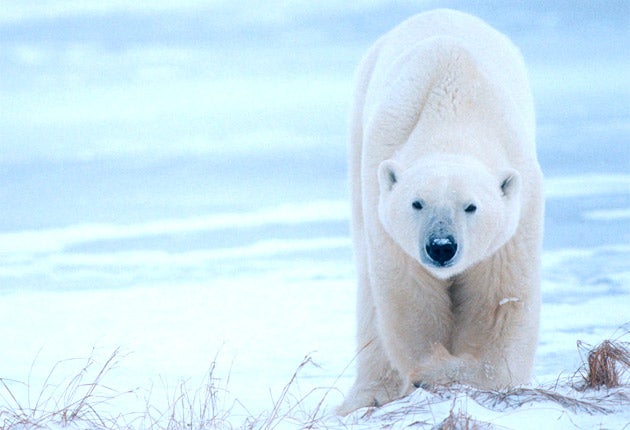
Polar bears in the Hudson Bay area of Canada are likely to die out in the next three decades, possibly sooner, as global warming melts more Arctic ice and thus reduces their hunting opportunities, according to Canadian biologists.
The animals in western Hudson Bay, one of 19 discrete sub-populations of the species around the Arctic, are losing fat and body mass as their time on the floating sea ice gets shorter and shorter, according to the researchers from the University of Alberta.
The sea ice is where the bears hunt ringed and bearded seals, their main prey, and they have to build up enough fat in the winter, when the ice is at its greatest, to get through the summer, when the ice retreats from the shoreline and the bears can find no food.
But the ice has been melting earlier in the spring and forming later in the autumn, so that the bears are now spending on average three more weeks on land per year, without food, than they did three decades ago, the researchers say. As a consequence, their body weight in that time has dropped by 60lb, females have lost 10 per cent of their body length, and the west Hudson Bay population has declined from 1,200 animals to 900.
If the decline in the sea ice continues – as predictions of global warming suggest it will – it is feared that the bears could die out in 25 to 30 years, or perhaps in as few as 10, if there are a succession of years with very low sea ice cover. The Hudson Bay group of bears is the second-most southerly population and might be expected to feel the effects of climate change early. The Arctic sea ice as a whole reached its lowest-ever recorded extent in September, 2007. In the last two years it has recovered, but it is once again declining rapidly this year.
The dependency of the bears on the ice has long been known, and the animals have become an iconic species in terms of being used to promote awareness of global warming. But predictions of how long they may survive have until now been little more than educated guesses.
The significance of the new study is that it is based on a mathematical model which matches the weight and energy-storing capacity of the bears, which are known – the west Hudson Bay animals are the most closely observed of all polar bear populations – against the annual ice shrinkage and the time they have to spend on land without food.
Carried out by Professors Andrew Derocher and Mark Lewis, with graduate student Peter Molnar, it has been published in the journal Biological Conservation, and Professor Derocher talks about it at length in the current issue of Environment 360, the online environmental journal of Yale University in the US.
"We understand very well things like how fat a bear has to be to produce a certain number of cubs, and we know a lot about how much energy these bears are burning during the period of time over the summer that they're forced ashore when the sea ice melts," Professor Derocher says. "And from there it's fairly easy to run various scenarios of sea ice change to look at when, basically, the bears' fat stores run out – and when that happens the bears, of course, subsequently die."
He adds: "There's been a gradual decline in [the bears'] body condition that dates to the 1980s and we can now correlate that very nicely with the loss of sea ice in this ecosystem. And one of the things we found was that the changes that could come in this population could happen very dramatically, and a lot of the change could come within a single year, if you just ended up with an earlier melt of sea ice."
Join our commenting forum
Join thought-provoking conversations, follow other Independent readers and see their replies
Comments
Bookmark popover
Removed from bookmarks