Satellite blasts off on mission to map the Earth's melting ice
CryoSat-2 to determine the effects of polar climate change
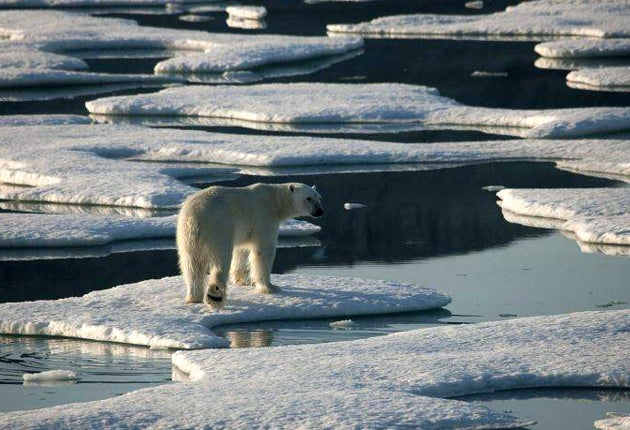
A hi-tech European satellite designed to measure how fast the Earth's polar ice caps are melting was successfully launched into orbit yesterday, nearly five years after the first attempt at such a mission ended in spectacular failure.
CryoSat-2, which was designed and built in France and Germany but masterminded by British scientists, blasted off on a Russian launcher rocket from the Baikonur Cosmodrome in Kazakhstan shortly before 3pm yesterday afternoon. Some time later, a tracking station in Africa picked up the satellite's signal, confirming that it had gone into orbit.
It was a far cry from the last attempt in October 2005, when the original £100m CryoSat was lost after an apparently successful launch, when the Russian rocket failed to separate from its third stage, and the whole assembly, including its satellite, plunged into the Arctic Ocean – the very waters whose icy secrets CryoSat had been designed to uncover.
Yesterday there was jubilation among the scientists of the European Space Agency (ESA) who tracked the launch from the European Space Operations Centre in Darmstadt, Germany.
"If anything, this mission is even more important now than a decade ago when we first proposed it, as changes in the Earth's polar ice sheets are accelerating," said Professor Duncan Wingham of University College London, CryoSat's principal investigator and the man behind the whole enterprise.
CryoSat-2 is part of the ESA's Earth Explorers programme, involving seven spacecraft which will carry out innovative research about issues of pressing environmental concern. The melting ice of the poles and Greenland is considered one of the most pressing of all, with implications for ocean circulation patterns, the global climate and sea levels.
If the land-based Greenland ice sheet were to melt completely, it would mean a global sea-level rise of 21 feet, while if all of the Earth's polar ice and glaciers were to melt, sea levels could rise by more than 10 times that amount.
Scientists have been observing significant changes in the polar regions in recent years which are generally ascribed to the warming climate, and in September 2007 the extent of summer ice cover in the Arctic Ocean reached a record low level.
However, too little is known about how thick the ice is, although surveys of sea-ice thickness undertaken by submarines suggest ice draft – the amount of water the floating Arctic ice displaces – may have reduced by about 40 per cent since the 1960s and 1970s.
The 1500lb satellite is designed to pinpoint the effects of climate change on Arctic, Greenland and Antarctic ice volumes, using sophisticated radar technology. Satellites have long been used to track ice extent, but calculating the waterborne ice thickness means the satellite has to gauge the difference between the top of the ice surface and the top of the water, which allows the overall volume then to be calculated.
The melting of the ice also changes the sea's salinity, which can affect long-range ocean currents. If the Gulf Stream became weaker, the British Isles and north-west Europe would experience more severe winters, even though the world as a whole would be warming.
Join our commenting forum
Join thought-provoking conversations, follow other Independent readers and see their replies
Comments
Bookmark popover
Removed from bookmarks