The Big Question: Will it really be possible to meet the G8's climate change targets?
Why are we asking this now?
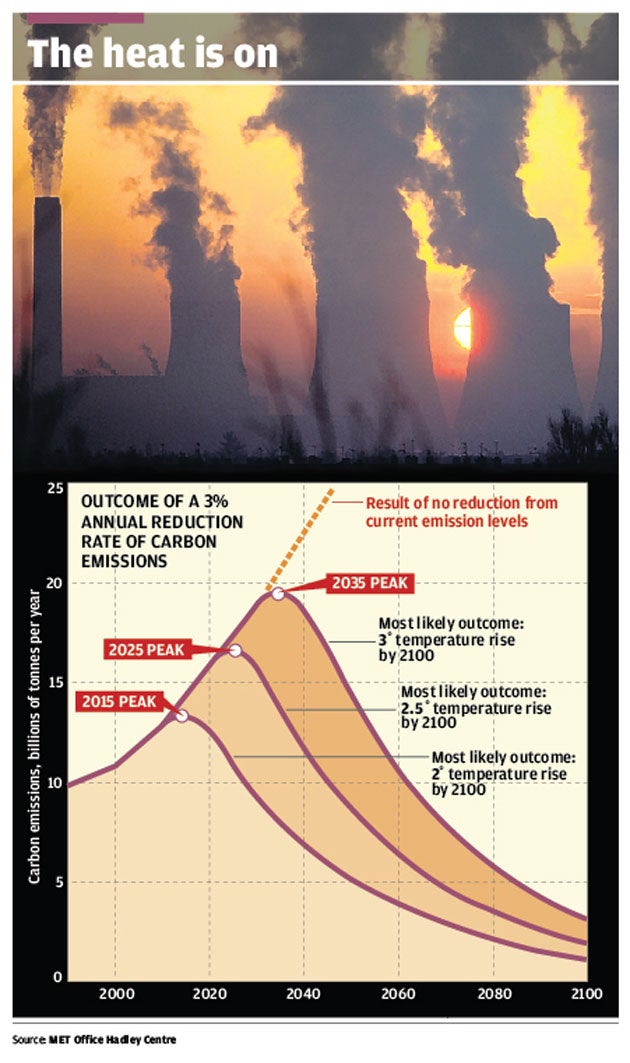
Because the leaders of the rich countries, at their meeting in Italy, have just made a great headline-grabbing pledge to cut their emissions of carbon dioxide, in the fight against climate change, by 80 per cent by 2050.
Why shouldn't that be realistic?
Because it is not at all clear what "80 per cent" means; it sounds like a terrific reduction, but 80 per cent of what? It might be taken to mean cutting emissions back to 80 per cent of what they are today, or what they were in 2000, say; while what UN climate scientists and environmental campaigners think is necessary, is to cut them back to 80 per cent of what they were in 1990, and that's a much tougher call (though it should be said that Britain has pledged to do this). Have a close look at the wording of the G8 communiqué issued after the agreement.
So what is the key part of the communiqué?
The leaders say in paragraph 65: "We also support a goal of developed countries reducing emissions of greenhouse gases in aggregate by 80 per cent or more by 2050 compared to 1990 or more recent years [our italics]." Those last four words, put in to keep all parties happy, especially the more reluctant ones, and make sure agreement was reached, in effect render the commitment so imprecise as to be meaningless.
How so?
Since 1990 global CO2 emissions, especially in the US, have soared, and the difference between a cut on a 2009 baseline and a cut on a 1990 baseline is enormous – hundreds of millions of tonnes of CO2. To be fair, the communiqué also says that for countries making reductions, "efforts need to be comparable". Yet at the moment the G8 does indeed have a big headline-grabbing target, but nobody knows what it really is.
Is there anything else that's unrealistic about it?
Yes. There are no interim targets, no steps marked out along the way. It's the easiest thing in the world for politicians to get together and promise to do something 41 years from now; none of them will be around to take the blame if it doesn't happen (there's a good acronym for it – Nimtoo, or Not In My Time Of Office). Pledging to reach a certain stage along the way by a certain date not very far in the future, on the other hand, is much more demanding and much more of a hostage to fortune, and perhaps it is no surprise that the G8 leaders have shied away from it.
So what are they saying they will do?
They promise to undertake "robust mid-term reductions", but they don't say what or when. This has not only attracted criticism from the environmental lobby, but more importantly, it is also being seen as a lack of good faith by the developing countries led by China and India, whose own emissions are growing enormously, but who will only agree to cut them if they are convinced that the developed world is showing the way.
But can targets ever be precise?
Yes: the European Union has agreed to cut its emissions by 20 per cent by 2020, rising to 30 per cent if a global deal is secured at the major climate conference in Copenhagen in December, while Britain has agreed an interim target by 2020 of 34 per cent, which may rise to 42 per cent after a deal; this is currently the most ambitious climate target of any country in the world. But not so the G8.
So are the G8's climate pronouncements just so much hot air?
No, they're not; they mark a welcome step forward. The wealthy countries have come together to recognise the desirability of holding global warming to two degrees Celsius above the pre-industrial level – this is the first time that this has been done, and was never possible, for example, while George W Bush was US President.
Barack Obama has made the difference, and the mood music is changing, which is a hopeful sign that a serious agreement may eventually be possible. The agreement to cut emissions "by 80 per cent" is also an important part of that mood music: it's just important to be clear-eyed about exactly what it means.
How would we go about an 80 per cent C02 reduction once it was properly agreed?
This will be the greatest common enterprise on which humanity has ever embarked. To bring it about you might instinctively think windfarms, or solar panels, or electric cars, and they're all on the way and important, but the basic tool is really a more abstract one: the price of carbon, as determined by markets such as that of the European Union's Emissions Trading Scheme (ETS).
Why is that so important?
Nicholas Stern, in his groundbreaking report on the economics of climate change, said that global warming represented the greatest market failure in history: the true cost of emitting carbon dioxide was not remotely reflected in its price. As the governments in the ETS (and later, we hope, the US and elsewhere) squeeze the amount of CO2 companies are allowed to emit each year, the rising price of permits will drive the efforts to do without it, throughout society; it will drive the necessary behaviour changes by consumers, from transport, to heating choice, to diet (Oxfam points out, for example, how large is the carbon footprint of a steak compared to the same amount of calories produced from vegetarian sources).
Behaviour change is one of the two ways forward, yet despite the fervent hopes of "deep greens", it will need state or market intervention to make most people change their ways. The ultimate (and fair) way of doing it would be to give everyone the same personal "carbon allowance" which they can use as they wish; this is a long way off in practical terms, but as global warming gets worse, it may yet appear on the agenda.
What's the other way forward?
Technological fixes. Nuclear power and the coming technology of carbon capture and storage may – stress the "may" – mean we can carry on with our electricity-based lifestyle while slashing our emissions, as renewable energy on its own is unlikely to be sufficient. Electric motors and hydrogen fuel cells may allow us to maintain private car mobility, carbon-free, on the roads.
Aviation is a lot more difficult: the aviation industry sees biofuels as its get-out-of-jail card, but their expansion shows every sign of drastically pushing up food prices, never mind wrecking the rainforest. Getting aviation emissions down may ultimately mean restricting people's ability to fly, a very difficult job for any politician to undertake. It is becoming obvious that technological fixes are much preferred by politicians to asking people to change their behaviour; it is dawning on them that no one ever got elected by asking voters to make do with less.
Is an 80 per cent cut in emissions just pie in the sky?
Yes...
* It's not realistic until we know precisely what it means – an 80 per cent cut of what baseline?
*It's hardly realistic if there are no interim targets. Without those, action is easily deferred
* Emissions are growing so fast that such a huge cut becomes harder every year
No...
* The world already has the technology to do it; all that is needed is the political will
* New low-carbon technologies will increasingly come on stream, easing the task for us all
* The pressure to cut emissions will increase as the impacts of global warming become more severe
Join our commenting forum
Join thought-provoking conversations, follow other Independent readers and see their replies
Comments
Bookmark popover
Removed from bookmarks