Why Canada is the best haven from climate change
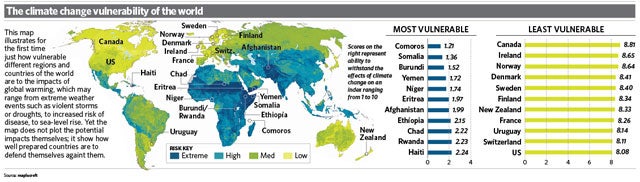
A group of islands with the potential to develop into a tourist paradise has been named as the country least equipped to withstand the effects of climate change.
The Comoros Islands in the Indian Ocean, between Mozambique and Madagascar, are a small nation of sparkling blue lagoons and picture-postcard beaches. But the country is politically unstable and a report published today says it is the world's most vulnerable country to the future impacts of global warming such as increased storms, rising sea levels and agricultural failure.
At the other end of the scale, Canada is the best place to move to if you want to be a climate change survivor in the decades ahead (although Britain is also a good place to be as a warming atmosphere takes hold).
The best-to-worst rankings are revealed in the first-ever climate change vulnerability index, produced by Maplecroft, a British consultancy which specialises in the mapping of risk. Its study, The Climate Change Risk Report, looks in great detail at global warming risks in 168 countries.
Africa is the most vulnerable region, and eight of the 10 most vulnerable countries are African, with the Comoros Islands followed by Somalia and Burundi in second and third places. Only five non-African countries are in the 20 most vulnerable. They are Yemen, Afghanistan, Haiti, Pakistan and Nepal.
As might be expected, developed nations score best. Canada is top, followed by Ireland, Norway, Denmark and Sweden. The United Kingdom is in 12th position, just behind the US. The surprise in the top 20 is Uruguay, which is listed ninth, and the only well-placed nation not to be in the club of countries which are rich, or Western (and usually both).
The originality of the new study is that it does not predict global warming's impacts, from increased droughts to rising sea levels, which has been done for the past two decades by the UN's Intergovernmental Panel on Climate Change.
Instead, it looks at how countries are fitted to meet them. "We're not saying anything about the changing climate," said Andy Thow, one of the report's authors. "We're saying, what's the situation on the ground in terms of vulnerability? If there were an impact, how vulnerable would the country be?"
Vulnerability is examined by the study across six different sectors – the economy; natural resources and ecosystems; poverty, development and health; agriculture; population, settlement and infrastructure; and institutions, governance and social capital. Eventually a figure is arrived at on the scale of one to 10, with one being the most vulnerable, and 10 the most secure. The Comoros score is 1.21; Canada's score is 8.81. (The UK scores 8.06.)
"The simple reason that Comoros is most vulnerable overall is that it scores poorly across all parts of the index," Dr Thow said.
"The combination of all these factors is worse than for any other country. It scores particularly poorly in the agriculture and natural resources and ecosystems components.
This reflects a situation in which pressure on natural resources is extremely high and there is very limited capacity to adapt to the impacts of changes in climate. That capacity is limited by factors such as poor land quality, low crop production and yields and water stress, combined with a growing population.
"Canada, on the other hand, is extremely well equipped to adapt to changes in climate. It scores well across all aspects of the index. This is because of the low pressure on natural resources resulting from a low population density and large land area, combined with high agricultural capacity, a healthy economy, few development and health challenges and excellent public institutions."
But Dr Thow pointed out that while Maplecroft's work showed Canada was well placed to manage the impacts of climate change on people and society, its wildlife was likely to be seriously affected by the expected magnitude of changes to climate in the Arctic region.
The Comoros also scores lowest in the world (jointly with Chad) on the report's index of emissions of carbon dioxide, which means that the country likely to suffer most from global warming has done the least to cause it.
Worst hit
75% Proportion of the world's 20 most vulnerable nations to climate change that can be found in Africa
The report is available at climate@maplecroft.com
Join our commenting forum
Join thought-provoking conversations, follow other Independent readers and see their replies
Comments
Bookmark popover
Removed from bookmarks