Billions fewer plastic bags handed out
Shops' cutbacks could stave off government plan to charge for carriers
Shops gave out 3.5 billion fewer plastic bags last year under a voluntary scheme which has, for now, headed off the threat of a government ban on free carrier bags. Figures from Wrap, the Government's anti-waste body, show that the number of plastic bags dispensed fell from 13.4 billion in 2007 to 9.9 billion last year, a drop of 26 per cent.
Wrap said that when taking into account increased recycled content in the bags, the use of virgin materials in the bags had been slashed by 40 per cent, well above the 25 per cent target set in 2007. Supermarkets have now agreed a target of reducing the number of bags by 50 per cent – from 2006 levels – by May. But the Department for the Environment, Food and Rural Affairs (Defra), while welcoming the new figures, warned that it would retain the option of introducing a charge for bags if stores failed to honour their commitments.
Environmental campaigners lambaste plastic bags as one of the worst excesses of consumerism. The bags waste resources and end up in landfill, scattered across the countryside or swirling round the seas, where they choke and kill marine life, particularly turtles. Several countries have banned the bags, including Rwanda, Bhutan, Taiwan, Papua New Guinea, Zanzibar and Botswana.
In the UK, 21 leading supermarkets and high street chains agreed in February 2007 to cut bag waste by 25 per cent. Britain's biggest retailer, Tesco, introduced loyalty points for customers reusing bags, helping slash the number of bags by two billion, and other stores such as Sainsbury's have moved bags from the bagging area, putting the onus on customers to request them. As a result, shoppers have become more used to reusing carrier bags or buying sturdier, long-lasting alternatives such as jute bags. "Consumers deserve congratulations for these results as they clearly show we are moving away from using bags once to re-using bags often," said Liz Goodwin, Wrap's chief executive. "They are also a credit to retailers who have worked hard to find innovative ways of helping us reuse our bags."
The British Retail Consortium urged customers to help stores by remembering to take stronger "bags for life" on shopping trips and, when they had to take them, reusing lighter carriers on five or six shopping trips before returning them for recycling.
The Environment minister, Jane Kennedy, said the "great progress" made showed that the national reliance on carrier bags was diminishing: "It also puts retailers well on the way to meeting the ambitious 50 per cent reduction in the number of carrier bags that they have pledged to reach by the end of May this year."
Later, Defra confirmed that it had not abandoned the threat of a ban on free plastic bags. "The powers are there in the Climate Change Act to introduce a charge, but, particularly in the current climate, we don't believe introducing a charge would be the right option," a spokeswoman said. "It would be a significant burden for retailers. But that's not to say we have abandoned the possibility of introducing a charge; at the moment, the voluntary approach seems to be working."
Cotton and jute: The alternatives to plastic
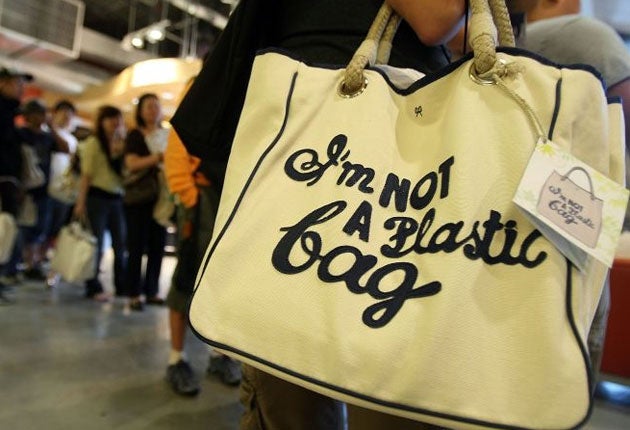
Cotton and jute bags have become fashionable as shoppers seek to replace plastic carriers with more eco-friendly alternatives. Sales of jute bags alone increased from around 100,000 in 2006 to 7.4 million last year, according to Wrap. The most famous "eco-bag" is the Anya Hindmarch "I'm not a plastic bag" bag, constructed from reusable cotton. Superdrug's £2.99 cotton shopper, released for the 30th anniversary of the Prince's Trust, caught the headlines when Kate Moss was pictured carrying one, while Tesco and Sainsbury's have also released green bags. Stronger "bags for life", intended to be re-used several times, are sold by supermarkets, while many swisher stores are dispensing paper bags with the implication that they are more eco-friendly.
So which bag is the least harmful? "A very difficult question to answer," replied Richard Swannell, Wrap's director of retail programmes. "The best thing you can do to help the environment is to re-use your bag. If you buy a bag for life and then don't re-use it that is a disaster for the environment."
9.9bn
The number of plastic bags dispensed last year, down from 13.4bn in 2007.
Join our commenting forum
Join thought-provoking conversations, follow other Independent readers and see their replies
Comments
Bookmark popover
Removed from bookmarks