Clean coal is future for energy supplies
Greenhouse gas emissions from new power stations will be collected and permanently stored deep underground
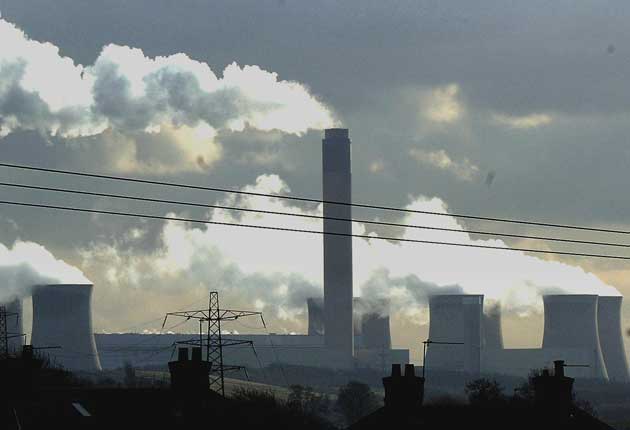
Any new coal-fired power stations built in Britain will have to be fitted with cutting-edge technology to capture their carbon emissions, the Government announced yesterday in a revolution in energy policy.
The announcement, by the Energy and Climate Change Secretary Ed Miliband, outlined the first practical programme in the world to deploy carbon capture and storage, or CCS – the technological "fix" on which the world's chances of fighting climate change may come to depend.
CCS, which takes power stations' carbon dioxide waste gas, liquefies it and stores it permanently deep underground, instead of letting it escape into the atmosphere where it helps drive global warming, would henceforth be a requisite for any new British coal-fired power plant, Mr Miliband said.
As the technology is in its infancy and still unproven, new generating stations would have to be built from scratch with demonstration plants attempting to capture emissions from about 300 megawatts of capacity, or about a quarter of a typical big plant's output. But after 2020, as long as the technology had been proven, CCS would have to be retro-fitted to all new stations to cover the whole of their emissions, Mr Miliband said.
It is likely that four new coal-fired plants, accompanied by CCS facilities, will be built in Britain, as the Chancellor, Alistair Darling, announced in his Budget on Wednesday that government funding for "up to four" CCS demonstration plants would be made available. Their enormous cost (probably well over £1bn each) will be met by a levy on electricity prices, which by 2020 will add about 2 per cent to the average household electricity bill.
The new power stations are likely to be built on east coast estuaries such as the Thames, the Humber, the Tees and the Firth of Forth, where access is easiest to the future permanent storage areas for their CO2 – depleted oil and gas fields deep under the bed of the North Sea. Norwegian operations have already shown that waste gases can be pumped down into such geological formations and safely stored.
Yesterday's announcement was generally given a cautious welcome by environmentalists.
"At last Ed Miliband is demonstrating welcome signs of climate leadership in the face of resistance from Whitehall officials and cabinet colleagues," said John Sauven, executive director of Greenpeace. "He is the first minister in 12 years to throw down the gauntlet to the energy companies and demand they start taking climate change seriously."
However, Mr Sauven warned that for every tonne of carbon captured and buried from new coal plants before the 2020s, the Government was allowing three tonnes to be released into the atmosphere.
At a stroke, the new policy takes much of the heat out of what for two years has been the thorniest environmental problem in British politics: whether or not to let a new generation of coal-fired power stations go ahead, led by the massive plant proposed by the German-owned electricity giant E.ON for Kingsnorth in Kent.
Green campaigners feared that the Government was at one stage close to sanctioning Kingsnorth (and thus other coal-fired plants which would follow) without regard to abating the huge volumes of CO2 which would consequently be emitted. The site of the plant became the focus of widespread environmental protests.
But allowing Kingsnorth to go ahead with its emissions "unabated" is now off the agenda, and the plant will only be built if E.ON wins the design competition for the first CCS demonstration plant, in which it is involved with two other utilities – which will not be for at least 18 months.
"The era of new unabated coal has come to an end," Mr Miliband said yesterday, claiming that the Government's plan was "the most environmentally ambitious of any country in the world, and puts us in a world leadership position on CCS and coal".
He said: "There is no alternative to CCS if we are serious about fighting climate change and retaining a diverse mix of energy sources for our economy."
Join our commenting forum
Join thought-provoking conversations, follow other Independent readers and see their replies
Comments
Bookmark popover
Removed from bookmarks