Green cleaning: There's the scrub
Can cleaning products ever be good for the environment? Not according to the man behind the biggest green brand – but some are more eco than others
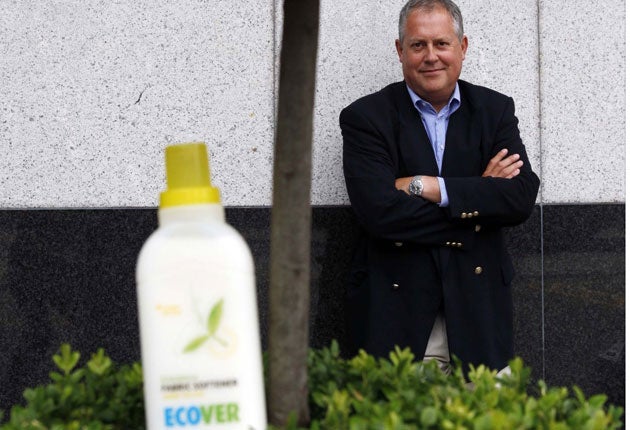
Our products harm the environment. They are not environmentally friendly. We never say they are environmentally friendly." Who is saying this? BP's Tony Hayward, perhaps?
Actually these are the words of Mick Bremans, chief executive of Ecover, the biggest-selling brand of "ecological" cleaning and laundry products in Britain. Despite celebrating 30 years in the business of selling greener, cleaner household products, Bremans' team at Ecover has not yet discovered a dishwasher tab or laundry liquid that is what the consumer with a conscience is looking for – environmentally friendly.
In fact, Bremans is making the point that no product, be it a lavatory cleaner, a hybrid car or a locally sourced punnet of strawberries, is technically environmentally friendly. Everything we make takes its toll on the planet in production and leaves its mark when disposed of. Instead, Ecover describes its products as "ecological", to communicate that they are kinder to the environment than comparable products.
This might mean, as in the case of the Power Cleaner, that it is made from plant and mineral-based ingredients, biodegrades quickly and completely and has minimum impact on aquatic life. The same goes for the All Purpose Cleaner. "The last thing a loved-up butterfly needs is the smell of your laundry," explains the label on its Fabric Softener. "Artificial fragrances from cleaning products confuse breeding insects – so we use only natural fragrances, that disappear quickly." The Washing Tablets claim to have "minimum impact on aquatic life", so the fish are as safe as the butterflies.
This last claim, though, recently earned Ecover a mention in a Which? report on the green claims of household products, called "Are You Being Greenwashed?" Greenwashing, a term which has been around as long as Ecover, is the practise of making false or deceptive claims about a product or policy which suggest it is better for the environment than it actually is.
The terms thrown around by bona fide green companies and greenwashers alike include "plant-based", "eco-friendly", "biodegradable", "natural" and "ecological". These certainly sound better for the planet than "bleach", say, or "a blend of toxic chemicals which irritate skin, damage clothes and kill aquatic life". But it is tricky for consumers, however clued up they are, to determine which claims are genuine.
Which? looked at 14 everyday products – laundry tablets, loo cleaners, nappies and wipes. Apparently 80 per cent of us are already wise to potential greenwashing, and the report concluded we were right to be suspicious. While it found that all the products investigated made some justifiable claims, almost half were not supported with convincing evidence. In the case of Ecover's loo cleaner and washing tablets, the report found there was not enough evidence to suggest they had a significantly different impact on aquatic life than the market leader.
Is this splitting hairs? Consumers don't like being taken for a ride, particularly when they're paying for the privilege, and eco brands tend to be a little more expensive than their standard competitors. But Bremans found the report frustrating. "It said there wouldn't be much difference between our product and conventional products once they had been through a water treatment plant. Well no, it would be incredibly unbelievable if there was a lot of difference, because that would mean the treatment plants for which the taxpayers were paying didn't work."
Adam Lowry is the founder of Method, a California-based green cleaning company which isgrowing in Britain, whose products look so good you'll want to show them off instead of hiding them under the kitchen sink. Lowry agrees that the Which? report did not address the subject satisfactorily. "The picture is more complex than was reflected. One example was eco loo cleaners. It says they all go through a waste treatment facility once they leave your home, so a degradability claim is not relevant. In fact, non-green lavatory bowl cleaners use bleach, which doesn't biodegrade but it does break down, to chlorine, which then combines with other organic material to form persistent toxic chemicals."
Tesco has agreed to change the label on its Tesco Naturally loo cleaner since the report. Ecover, explains Bremans, believes in the integrity of its labels, and will not change anything as a result of the findings. Ecover's labels are often changed though, as a result of an evolving product design or legislation. Ecover wants to go above and beyond the Defra-backed EU Ecolabel, which sets out seven criteria for household products and has created a set of 13 criteria for all its products which will be externally audited. This process will look at the sourcing of ingredients: their sustainability, proximity to Ecover's factories in Belgium and France and the chemical processes used to make them. This last bit is important, as a claim made by many manufacturers is that their products are "natural" or produced "naturally", whereas Ecover and Method believe that a more accurate description is that the ingredients they use are "plant-based" or "plant-derived". "People talk about a natural surfactant (a vital ingredient in cleaning products), but it doesn't grow on trees. There is always a chemical process when you are making it," says Bremans.
The premium usually paid for an eco product pays for research and development into manufacturing. Recently, Ecover has been working on surfactants and has patented one made out of vegetable oil that doesn't need chemical processing.
Ecover's other criteria include how a product is used – performance and impact on skin and health – and where it goes during and after use – are the product and packaging biodegradable, for example? "I'm not criticising the EU eco label as an initiative," says Bremans, "but it doesn't go far enough. It still allows phosphates, which makes it weaker than most of the legislation already applied to conventional products in some countries."
Phosphates, which enhance performance, are a common ingredient in cleaning products. They are legal in Britain and under EU law, but Belgium, France, Finland, Holland and Denmark have banned their use and seen improvements in water quality. This argument about phosphates spurred the creation of Ecover in 1980, when the Belgian environmentalist Frans Bogaert realised that phosphate-free cleaning products had the potential to reverse the process of eutrophication – a growth in algae which blocks oxygen and light so aquatic life cannot survive – in water systems. He developed a washing powder and dishwashing liquid, initially available in health shops.
Those early products have little in common with today's, but their legacy, which is not entirely positive, lives on. "The myth about green products not performing well persists," says Bremans. "That was the case in the beginning but not now. Then, the company wanted to create a green product more than a washing product.
"The first wave of consumer interest for green products was at the end of the 1980s, but consumers were disappointed by the quality of the product. Afterwards we made the switch from saying we want to make green products that clean to saying we want to make laundry products that are as environmental and as ecological as possible." It was the sale to Jørgen Philip-Sørensen, who died earlier this year, which propelled Ecover's growth into a global cleaning business.
Ecover's wide availability – it's found in all the major supermarkets – does not equate to a large share of the market. Bremans says one Ecover product might capture 1 per cent of sales, another 5 per cent. But innovations in green cleaning do have the power to move the market, especially if conventional manufacturers see the potential to save money by introducing certain sustainable practices. In the US, for example, when Method launched its triple-concentrated laundry detergent in 2004, which used one third the standard amount of liquid per wash, Wal-Mart quickly saw how much smaller bottles could save it in terms of waste, shelf space and money, and began pressurising other brands to develop a more concentrated detergent. Most managed to halve the volume of their detergent which has led to massive resource savings, though it should be noted that Wal-Mart's heavy-handed approach to supplier product development is not always to the benefit of the environment. Method has just launched an eight-times-concentrated laundry liquid, which should be a lot harder to copy, says Lowry. "But it will show consumers there is a better way to get things done."
As for greenwashing, well, Method probably wouldn't pass muster with Bremans, because it describes its products as environmentally friendly. Yet every one is certified by the cradle to cradle assessment, a highly respected formula which submits industrial manufacturing systems to a rigorous appraisal, ensuring they protect and enrich ecosystems rather than destroy them.
Green products must live up to their claims. Perhaps more so than conventional items, because of all the cynicism associated with greenwashing and its larger potential for damaging the sector. But Bremans suggested it would have been more useful for Which? to compare eco products with their non-eco counterparts, to reveal the different environmental impacts of the two.
The limitation of brands like Ecover and Method might just lie with their determination to spend more on product development than marketing, rather than relying on the generous marketing budgets of their mainstream competitors. This type of approach is ultimately reassuring, but if consumers are aren't aware of it, they may struggle to make informed choices in the supermarket.
Join our commenting forum
Join thought-provoking conversations, follow other Independent readers and see their replies
Comments
Bookmark popover
Removed from bookmarks