Green Living

Rain (AM and PM) 6° London Hi 9°C / Lo 7°C

Kitchen bin war: tackling the food waste mountain

A Government campaign will see the end of confusing 'best before' labels, reduced packaging, and five new plants to convert waste into energy
By Rachel Shields

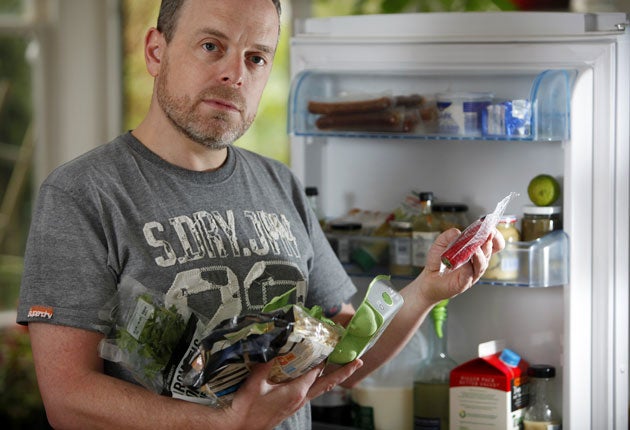
Edmund Luxmoore hates waste and never pays any attention to 'best before' dates

jason alden

Edmund Luxmoore hates waste and never pays any attention to 'best before' dates

An ambitious "War on Waste" campaign to tackle Britain's mountains of food-based rubbish with a range of radical new measures is to be launched tomorrow.

The programme will scrap "best before" labels on food, create new food packaging sizes, build more "on-the-go" recycling points and unveil five flagship anaerobic digestion plants, to harness the power of leftover food and pump energy back into the national grid. The government hopes that its plans will reduce the 100 million tons of waste the country produced last year, which included 20 million tons of food waste and 10.7 million tons of packaging waste.

On Tuesday, Hilary Benn, Secretary of State for the Environment, will announce plans to dispense with "best before" labels, in an attempt to reduce the estimated 370,000 tons of food that is thrown away despite being perfectly edible. The latest government research into food labelling showed that the British are very cautious when it comes to eating anything that has passed its "best before" date: 53 per cent of consumers never eat fruit or vegetables that has exceeded the date; 56 per cent would not eat bread or cake; and 21 per cent never even "take a risk" with food close to its date.

"One of the things we found in our research is that confusion over date labelling is one of the major reasons for throwing food away. Often people don't realise the difference between 'best before' and 'use by'," said Richard Swannell, director of retail and organics at Wrap, the Government waste watchdog. It is working with the Food Standards Agency (FSA) and leading retailers to get rid of the "sell until", "display until" and "best before" tags, which confuse customers, causing them to throw away edible food.

"It is an issue that we want to address, but there has to be a balance, as we have to protect consumer safety," said an FSA spokesman. "Not eating out-of-date food is one of the simplest ways of preventing food poisoning."

Ahead of the launch, Mr Benn said: "It's time for a new war on waste. It's not just about recycling more – and we are making progress there – it's about rethinking the way we use resources in the first place.

"We need to make better use of everything we produce, from food to packaging, and the plans I'm setting out over the next few days will help us to achieve that. We all have a part to play, from businesses and retailers to consumers."

The minister added: "Too many of us are putting things in the bin simply because we're not sure, we're confused by the label, or we're just playing safe. This means we're throwing away thousands of tons of food every year completely unnecessarily. I want to improve labels so that when we buy a loaf of bread or a packet of cold meat, we know exactly how long it's safe to eat."

On Tuesday, the Government will also unveil plans for dealing with packaging, including increased glass collection from pubs, clubs and restaurants, a huge expansion of "on-the-go" recycling points for aluminium cans, and new packaging sizes for supermarkets.

In addition to tackling food waste and packaging, the Government will reveal plans to use the waste we do produce as fuel. Tomorrow Mr Benn will announce the location of five new anaerobic digestion plants, built with the help of £10m in state funding. The facilities compost waste in the absence of oxygen, producing a biogas that can be used to generate electricity and heat.

Mr Benn said: "We need to rethink the way we deal with waste – to see it as a resource, not a problem."

The UK produces 100 tons of organic waste a year. If processed anaerobically this would produce enough energy to power two million homes, or Birmingham five times over. Anaerobic digestion plants are widely used across Europe, and are already being used by high street retailers such as Sainsbury's and Marks & Spencer to tackle their food waste.

Michael Warhurst, senior waste and resources campaigner for Friends of the Earth, said: "This should be happening across the country, instead of councils still putting money into building incinerators. They are the technology of the past – this is the future."

Don't read the label: 'If it looks old, cook it for longer'

Edmund Luxmoore, 39, from London, hates waste and never pays any attention to "best before" dates:

"I get most of my vegetables from the supermarket near my house, picking up bits and pieces throughout the week. I get the heavy stuff delivered. We plan meals, making lots of lists. I like to cook and we make curries and lots of other dishes.

"I'm a vegetarian, and I suppose if I was eating meat I would be more wary about eating off food, but a dodgy potato probably isn't going to do much, is it? The proof of the pudding is in the eating. Just look at it and see if it's OK: if it looks a little bit old, cook it for longer.

"I totally understand the difference between the 'best before' and the 'use by' dates. I've certainly got friends who will bin just about anything. Money used to be a factor in not wasting stuff in the days when I had a lower income but now it's just a personal choice. I intensely dislike waste – I think that is a family tradition. My dad used to make us stop the car by the side of the road to pick up plastic bags and clean up the countryside!"

Cautious eater: 'I don't want to poison my mother'

Julie Andrew, 48, from Wakefield, is nervous about eating food that is even approaching its "best before" date:

"I must admit that I'm a bit wasteful. I throw things away when they are near the date. If it's in the fridge and it passes the best-before date I throw it out, even if it's just one day over. I always check both the 'best before' and 'use by' dates in the supermarket and know the difference, but when I get home I just throw things in the bin if they pass any date on the packaging. I do end up throwing out a lot – day-old yoghurts or the end of Flora pots. If I have meat and it looks at all suspicious, I put it straight in the bin.

"With ready meals I worry about the date too and if I've had them in the freezer too long I chuck them out. I had food poisoning once and since then I've been more careful. I try to not be as wasteful because I know there are starving people out there, but I just like to know the food we eat is OK. I live with my mother, who's in her 70s, and I don't want to poison her."

Post a Comment

View all comments that have been posted about this article.

Offensive or abusive comments will be removed and your IP logged and may be used to prevent further submission. In submitting a comment to the site, you agree to be bound by the Independent Minds Terms of Service.

Comments

Sell by dates
[info]oomigoolies wrote:
Sunday, 7 June 2009 at 07:17 am (UTC)
"It is working with the Food Standards Agency (FSA) and leading retailers to get rid of the "sell until", "display until" and "best before" tags, which confuse customers, causing them to throw away edible food."

Confuse customers? It's the retailers who have to throw away vast amounts of food because they are "out of date". I work in food retail - the enormous wastage of perfectly edible food is disgusting.
a badge of shame
[info]jaffgyp wrote:
Sunday, 7 June 2009 at 07:44 am (UTC)
there is a great free badge of shame to show upwho is wasting food - just watch out for which of the neighbourhood black bags put out for rubbish collection are attacked by the gulls and other scavenging birds : we have just one defaulter, the gruesome contents of whose bags are routinely spread out along the road (once including a large frozen duck); no other bags are touched but he doesn't get the message... any suggestions on how to reform him without causing offence?
Wot no Blame?
[info]fourpie wrote:
Sunday, 7 June 2009 at 08:18 am (UTC)
What no blame attributed to the EU for this situation?

My eyes were opened when the MD of Lea & Perrins Worcestershire Sauce said he was bound by law to date his product, yet top chefs totally ignore the use by dates and actually keep various ages of sauce for the different flavours they bring to the food. Use of a 25 year old bottle was quoted of one chef.
food waste
[info]juliaklloyd wrote:
Sunday, 7 June 2009 at 08:56 am (UTC)
Edmund Luxmore is a shining example of common sense - if we were all as matter-of-fact as he is there would be thousands of tons less waste! And he's right that vegetable products are much less likely to be a problem. My rule about bread is that if it has no green mould then it's ok to eat!
Re: food waste
[info]jaffgyp wrote:
Sunday, 7 June 2009 at 09:02 am (UTC)
i don't think that much of today's bought bread is capable of supporting any life, not even green mould?
Re: food waste
[info]juliaklloyd wrote:
Sunday, 7 June 2009 at 09:11 am (UTC)
You're probably right, but I had a bread machine for Christmas, and haven't bought any bread since! I suppose it's the fear of litigation that makes food producers over-cautious with their labelling...
Re: food waste
[info]jaffgyp wrote:
Sunday, 7 June 2009 at 02:40 pm (UTC)
a diversion- i've had to eat some truly dreadful, solid and dense, or light and chemical, home-machine-made bread; does your machine do a better job, and are you allowed to name the brand on these public e-waves?!
Re: food waste
[info]juliaklloyd wrote:
Sunday, 7 June 2009 at 08:22 pm (UTC)
I'm sure I can - it's a Kenwood, and I've discovered that half and half granary flour and wholemeal makes a good loaf...
Re: food waste
[info]jaffgyp wrote:
Monday, 8 June 2009 at 07:17 am (UTC)
thanks!
Stores could do more...
[info]jollytall wrote:
Sunday, 7 June 2009 at 09:23 am (UTC)
Twice at two different local stores, fruit and veges were being chucked into a bag, some looked perfectly okay to me so I asked if I could take the bags but was politely told that it was against company policy...
Spectacular waste, Fylde Coast style
[info]thorntongate wrote:
Sunday, 7 June 2009 at 12:26 pm (UTC)
You should visit one of the biggest cafes on the Fylde Coast to see examples of spectacular waste.

The owner prides himself on the size of his meals, and the levels of waste created are simply obscene.

Furthermore, at close of the day, ALL food on show in the chiller display cabinets is treated as waste.

The idea that the Salvation Army - or similar - could use the food that is chucked never cross his mind.

He could run his own 'flagship anaerobic digestion plant'; it would light up half Lancashire!

Hooray for the government
[info]kuma2000 wrote:
Sunday, 7 June 2009 at 09:07 pm (UTC)
Fighting food poisoning with their new campaign costing millions of taxpayers pounds. More duck houses please. Whilst it is nice to see a "war on waste" this is clearly designed to help the supermarkets sell off past it food a lot easier. Wake up people, this is wrapping a dodgy deal in green paper to make it more palatable to a gullible public.
Wasted food
[info]clogexpat wrote:
Monday, 8 June 2009 at 07:39 am (UTC)
We're a family of 6 (9 during the holidays) and we waste very little. It's simple really - plan your meals, buy what you need and be sensible. If you can get veg from a grocer or market because it lasts much longer. Similarly meat from a butcher, or at least avoid the packages stuff in the supermarkets because it's full of water. School lunches necessarily have a lot of packaging, but not the rest. And don't buy crap - the children seem to be thriving on proper freshly-cooked food, which doesn't take long to prepare. We're not puritans though, and of course, oven chips and pizza are always on hand becasue sometimes you just need to throw something in. On average, we have two bin-bags of rubbish a week, and most of that is packaging.

We started planning a few years ago just to get organised, but the unintentional benefit was a saving of abou 25% on our food bill, with a commensurate reduction in what we throw out. It only takes a few minutes a week to do this. If, in an ideal world, more people planned a bit more I'm sure that the effect on supermarkets to organise themselves a bit better would help reduce the overall waste. Every little helps! (a phrase I hate even though it's true)
Bin a Bargain!
[info]ironspiderzero wrote:
Monday, 8 June 2009 at 10:19 am (UTC)
I have often bought and frozen meat that's been reduced due to the 'Sell By' date and have never had a problem when eventually using it. Vegetables from supermarkets are more of a risk, as I've encountered produce that's already moldy or otherwise unusable well before the posted 'Use By'. Otherwise I waste very little food - mainly a drop of milk and the tail-end of a loaf of bread. Living on my own I try and judge if I'm likely to waste something before I buy it - knowing how and when to use a product is one way of avoiding wastage; so I agree with Edmund on both planning meals and realising that how we deal with food is a personal choice. Simplified guidance on packaging might help but I doubt it's a cure for food waste.
[info]chriscour wrote:
Monday, 8 June 2009 at 11:30 am (UTC)
100 tonnes of organic waste a year? How about 100 million tonnes? Pretty basic journalism, I would have thought. Doesn't anybody read this stuff before it's printed>
best before dates/food waste
[info]carorice wrote:
Monday, 8 June 2009 at 05:50 pm (UTC)
Best before dates, use before etc. well quite frankly I have opened up fod that is WELL WITHIN any DATE ON THE PACK and found the meat/chicken/prepared meal to have GONE WAY OFF human consumption. Maybe the supermarkets/food manufacturers should be more responsible also. Instead the focus is thrown onto the end user - customer, to have some kind of guild complex/responsibility for not throwing away food before dates, or worse still, eat it anyway because it would be bad for the environment otherwise. How about we remember why ANY date is on the product in the first place, to protect our health, stop us gettting food poisoning, or worse, maybe elderly and frail dying......Please make the providers of the food in the first place a little more responsible. Food does not always even last as long as its use by date. Even when the customer has been careful how it has been transported home immediately, put in a correctly temperate fridge (NOT overfilled) yest still the food goes off.

Just like we are all supposed to start sharing baths to save electricity, rather than tell manufacturing, production factories etc tomake better use of the electricity they use, or the water companies to care for the water, we should start NOT flushing toilets. Doesnt this all seem to be going back somewhat to before even SANITATION, soon we shall all be going down with dysentry, as if we were not a civilised western world. All because of government objectives to tell us to take risks where we should not be doing.

I sincerely hope that we are not going to go back to a situation where food manufacturers take chances with our health, like the situation over the chickens a couple of years back.
[info]amyjomarsh wrote:
Tuesday, 9 June 2009 at 05:26 pm (UTC)
The nose, (if in good working order) is an excellent judge of food, if the odor of the food in question offends the nose, throwing the food out would be prudent irrespective of any printed dates.
waste not want not
[info]franchise999 wrote:
Tuesday, 16 June 2009 at 01:17 pm (UTC)
I try to waste as little as possible in my kitchen, between the pet sheep, 15 chickens, dog, cata and compost pile pretty much everything gets put somewhere! One key area to tackle this problem straight on would be to go direct to Food Franchises that have huge networks of outlets and persuade them to do something about all this waste

Matthew

Lea & Perrins
[info]calendulacat wrote:
Friday, 19 June 2009 at 05:25 pm (UTC)
I read somewhere (Elizabeth David?) that L&P found a batch of sauce that had been aging for years - it had been considered a failure upon first tasting. The find turned out to be the sauce we know today & the longer it sits, the better it gets.

Buy loose produce, patronize farmer's markets, eat 'in season', avoid industrial packaging & the contents within. Try to convince supermarkets to donate food to soup kitchens etc. Buy only what you need. Learn how to prepare dishes using lots of different vegetables - & mostly stop wasting food!

Article Archive

Day In a Page

Sun | Mon | Tue | Wed | Thu | Fri | Sat

Select date