New life for old idea that could dissolve our nuclear waste

Sign up to the Independent Climate email for the latest advice on saving the planet
Get our free Climate email
A nuclear programme that was abandoned two decades ago has emerged as a possible 11th-hour solution to Britain's plutonium-waste headache, which the Government has to decide on within weeks.
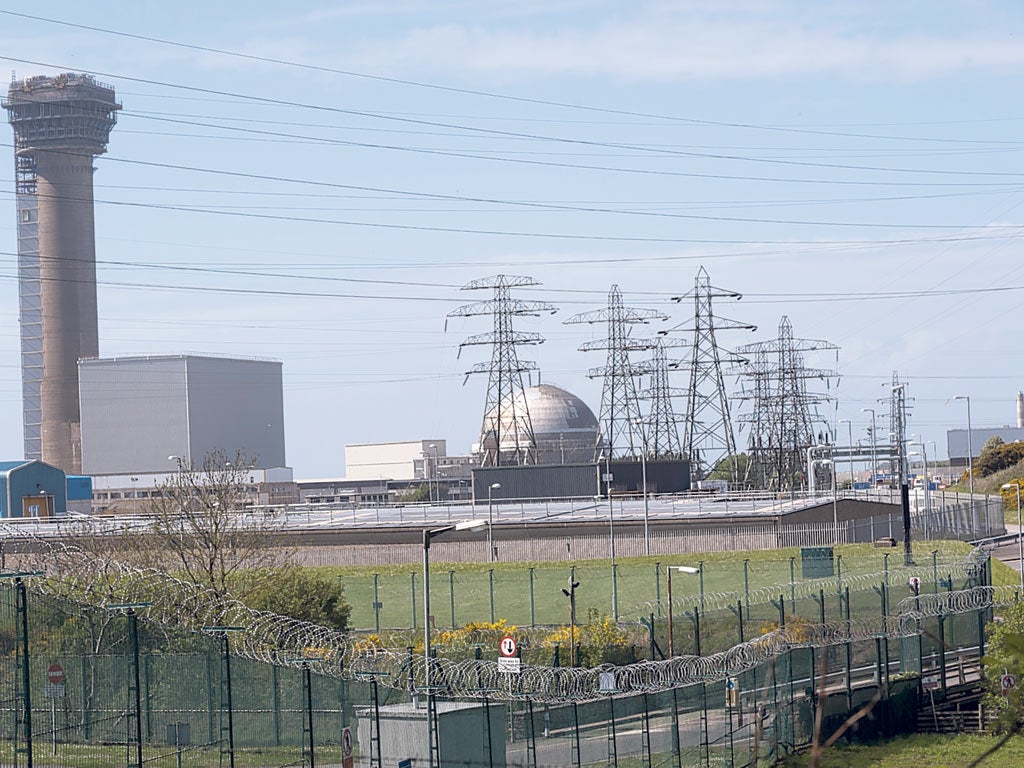
Government officials are looking again at the possibility of using nuclear "fast reactors", which were dropped by Britain in 1994, to dispose of more than 100 tonnes of waste plutonium stored at Sellafield in Cumbria.
The Nuclear Decommissioning Authority (NDA) and senior advisers within the Department for Energy and Climate Change (Decc) have asked for technical and financial details of an American-designed fast reactor that can burn up the plutonium waste as nuclear fuel.
Within weeks of the Government's expected response to a public consultation on plutonium waste, led by energy minister Chris Huhne, officials appear to be having second thoughts about their preferred solution to the problem, the building of a second plutonium-uranium oxides fuel plant at Sellafield.
Previously, Decc and the NDA have said that the plutonium waste stockpile should be first converted into mixed oxide (Mox) fuel by a new £3bn plant at Sellafield, then burned in conventional "thermal" reactors being considered as part of the UK's nuclear re-building programme.
As recently as last February, the NDA said that is has "screened out" the option of using a new generation of fast reactors to deal with the waste stockpile on the grounds that a commerical fast reactor will not be ready for decades.
But both the NDA and the chief scientist at Decc, Professor David MacKay, are understood to be investigating the possible disposal of plutonium using a nuclear fast reactor designed by the US Department of Energy and built by General Electric and Hitachi.
The NDA has asked General Electric to come up with a detailed proposal, including costings, of how to licence and build a nuclear fast reactor on the Sellafield site to burn the plutonium stockpile without the need to first convert it to Mox fuel.
If the Government decides on the fast-reactor route it will represent a radical departure from its stated policy of first converting the plutonium into Mox fuel before burning it in conventional pressurised-water reactors.
Some industry insiders believe that Britain, which has the largest civilian stockpile of plutonium in the world, is in a unique position to take the bold decision of building a next-generation fast reactor now rather than leaving it for 30 or 40 years.
General Electric's fast reactor, called Prism, comes out of the US energy department's integral fast reactor programme, itself abandoned by President Bill Clinton in 1994, just before Britain abandoned is own fast-reactor programme at Dounreay in Scotland. Nuclear scientists believe Clinton's decision was purely political and not based on a rational analysis of the technical merits of the fast reactor, which is said to be inherently safer than conventional thermal reactors, producing less waste in addition to being capable of burning plutonium and other nuclear waste.
Tom Blees, an American environmentalist and author who has written extensively on the merits of nuclear fast reactors, met Professor MacKay last week to lobby on behalf of the integral fast reactor, which General Electric insists it can build at Sellafield.
"I suggested some meetings with other people who are technically proficient on the integral fast reactor, which he intends to set up," said Mr Blees, who is on the judging panel of the Global Energy Prize. "From everything I've seen from David he fully intends to give it the consideration it deserves. He seemed very interested and is planning on some follow-up meetings. I don't think people here were aware of just quite how far the technology of fast reactors has progressed."
The proponents of fast reactors believe that Britain's plutonium consultation has been hijacked by the French nuclear company Areva, which is offering to build the proposed Sellafield Mox plant as well as the pressurised water reactors that will burn the fuel.
"One of the reasons I came to the UK was that [the fast reactor] hadn't got the consideration it deserved," Mr Blees added. "Reading the [government's] Plutonium Consultation it was clear that Areva had gotten to these people.
"The consultation seems to accept the premise that fast reactors cannot be built for 30 or 40 years which is the standard Areva company line, but that is simply not true because General Electric would happily start building one tomorrow."
A spokesman for Decc said: "David MacKay's remit is to look a bit further afield. It seems a sensible thing to do. In the long term, fast reactors seem highly desirable."
General Electric's fast reactor design is based on using plutonium metal, rather than oxide, as a fuel, which means that it would be technically easier and cheaper to convert the existing plutonium stockpile to a metal fuel using standard electrolysis rather than the technically complex task of making it into Mox fuel rods.
Instead of using water as a coolant and moderator, the fast reactor uses sodium metal in liquid form and because it operates at near-atmospheric pressure instead of the high pressures of water-cooled reactors, the reactor is simpler and therefore cheaper to build and operate as well as being protected by "passive" safety features.
Ironically, the reason why Britain has such a large plutonium stockpile was because in the 1960s the Government decided to reprocess spent fuel and separate out the plutonium for a fast-breeder reactor programme at Dounreay.
But Dounreay ran into technical difficulties, which General Electric claims to have resolved with its own design, Mr Blees said. "The world has gone round the sun a few times since Dounreay."
Fast reactors: How they work
The energy used by nuclear power stations to generate electricity comes from nuclear fission, the splitting of atoms. The fission occurs when an atom of fissile material, normally uranium-235, is hit by a neutron particle, which releases more high-energy neutrons.
Conventional "thermal" reactors deliberately slow the high-energy neutrons using a moderator, usually water. Fast reactors have no moderator and the superfast neutrons interact with the other isotope of uranium, uranium 238, most of the uranium fuel.
This means that fast reactors can produce 60 times more energy than conventional thermal reactors for a similar amount of uranium fuel. And fast reactors can burn plutonium. In effect, a fast reactor acts like a nuclear-waste incinerator that also generates electrical power.
Steve Connor
Subscribe to Independent Premium to bookmark this article
Want to bookmark your favourite articles and stories to read or reference later? Start your Independent Premium subscription today.
Join our commenting forum
Join thought-provoking conversations, follow other Independent readers and see their replies