New nuclear plants will produce far more radiation
Industry documents reveal modern reactors more dangerous in an accident than the ones they replace
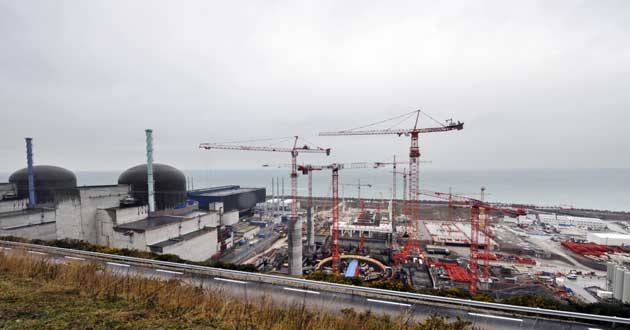
New nuclear reactors planned for Britain will produce many times more radiation than previous reactors that could be rapidly released in an accident, The Independent on Sunday can reveal.
The revelations – based on information buried deep in documents produced by the nuclear industry itself – calls into doubt repeated assertions that the new European Pressurised Reactors (EPRs) will be safer than the old atomic power stations they replace.
Instead they suggest that a reactor or nuclear waste accident, althouguh less likely to happen, could have even more devastating consequences in future; one study suggests that nearly twice as many people could die.
The EPR is the most advanced of the new generation of nuclear reactors. One is already being built in Finland and one in Normandy, France. And last week President Nicolas Sarkozy announced plans to build another in Normandy, while India signed a draft accord to buy between two and six of them. The French company EDF has said that it plans to build four in Britain. Two are expected for each of two existing nuclear power station sites, Hinkley Point in Somerset and Sizewell in Suffolk.
Until now the reactors have been widely thought to be less dangerous than those already in operation, largely because they contain more safety features and produce less waste. But the information in the documents shows that they produce very much more of the radioactive isotopes technically known as the "immediate release fraction" of the nuclear waste, because they could get out rapidly after an accident.
Data in one report, produced by EDF, suggests that they would produce four times as much radioactive bromine, rubidium, iodine and caesium as a present-day reactor. Information in another – by Posiva Oy, a nuclear waste company owned by two Finnish reactor builders – indicates that seven times as much iodine 129 is produced. And material in a third, by the Swiss National Co-operative for the Disposal of Radioactive Waste, implies that they will give rise to 11 times as much caesium 135 and 137.
This happens because the reactors are designed to burn their nuclear fuel almost twice as thoroughly as normal ones. Independent nuclear consultant, John Large, says that this "changes the physical characteristics of the fuel" and increases the immediate danger if the radiation should escape. After comparing the consequences of an accident at the new EPR being built at Flamanville, Normandy with one at an existing reactor nearby, he found that, in the worst case, it would increase the number of deaths from 16,000 to over 28,000.
Areva, the French firm that designs the reactor, says that the total radioactivity of the waste is only slightly increased, but Mr Large points out that it is the very much greater part that can easily escape that is of most concern. Areva adds that the reactors are specially designed to stop radioactivity escaping, but Mr Large argues no system can be foolproof. And in an accident during the transport of waste such protection would be irrelevant.
EDF said: "We are confident that new plants can be built and run safely."
View all comments that have been posted about this article.
Offensive or abusive comments will be removed and your IP logged and may be used to prevent further submission. In submitting a comment to the site, you agree to be bound by the Independent Minds Terms of Service.
- Print Article
- Email Article
-
Click here for copyright permissions
Copyright 2009 Independent News and Media Limited


Reduce your global impact.
Comments
The issues of nuclear energy do not stop when you turn off the reactor. Waste has to be stored (at the reactor and off site) and transported, all times for a potential release into the environment. That is the whole problem with nuclear energy. 40 years of generation offset against thousands of years of waste management. All Large is doing is pointing out some of the issues and their implication should a worst case happen. We could be like the Soviet Union and ignore the issues and assume nothing will ever go wrong, or we accept the potential consequences of our actions, good as well as bad. In the meantime you and I will pay for nuclear energy's toxic legacy either via electricity bills or through our income tax and the generous subsidies that are required to prop up the nuclear industry to make it viable.
The waste would not need to be cooled after the short-lifetime components had decayed so cooling would not be required at The Depository. The outer containers might need to be renewed occassionally but, my understanding is that most of the Waste could be vitrified which would obviate most containment risks.
Although there are risks of release associated with storage & transport they cannot be that large as there has not been a significant release that I am aware of in the last 50 years from a Commercial Operation. The releases at Three Mile Island were trivial & Chernobyl is the only real problem that I can remember. That is a special case because the Reactor Design (scaled up from a Warship Design) was inherently unstable & the Engineering knowledge was overidden by the State - something that is almost impossible in a Democracy like Britain.
One of the main reasons that Nuclear Power is more expensive than Coal, for example, is that the Reactors are overdesigned in both containment & control systems. If Coal Stations (which also produce radioactive output) were designed to the same level, I doubt that there would be a vast difference in cost. When you allow for Mining Deaths, Nuclear has probably killed far fewer people than Coal. Again the overdesign is because of fear of Nuclear.
If AGW is correct then Nuclear Fission is a vital component of reducing CO2 emmissions - at least in the medium term.
Cost is a massive issue for us here in the UK. Reality is already that the UK taxpayer will underwrite new nuclear clean up costs and insurance. Flammnville and Olkiluoto - both EPR's are already years behind schedule and enormously over budget. The nuclear past teaches us this is to be expected.....
Back to waste; landfill in not a solution for waste management of any sort, and certainly not for nuclear waste. Burying anything in the ground as far as I'm concerned is landfill - you sit and wait, fingers crossed and hope the problem never comes to the surface. The only difference, with nuclear should those canister leak or fall into the wrong hands you have issues. A real solution would be to prevent the waste in the first place, or process it so that it is far easier to deal with. Of course the first is impossible with fission, and the farce that is Sellafield and THORP shows the second is pretty hard to do as well. Vitrification works short term, but long term - again, it is all speculation. No one knows how the glass blocks will react to long term storage....it's that simple. Not a single country has a solution in place that goes beyond 50 - 100 years, and non have geological disposal repositories in place either, not even France the bastion of the nuclear age.
If I'm buying a car I like to have an idea of how much it will cost to run, how clean it is, and how safe my kids will be sat in the back. On waste management, the nuclear industry is unable to provide any of these details. I know the Nuclear industry likes to gloss over reality and facts, but I'm afraid this one just won't go away. The current nuclear waste legacy and its spiralling costs are proof if any was needed of how nuclear energy swallows money. The projects in Finland and France demonstrate what will happen in the UK. The dangers of nuclear are what will prevent it's spread and so ultimatily we will be left with a toxic nuclear legacy that may gives us lots of electricity today but will produce a nuclear hangover that will last hundreds of thousands of years.
A Depository would not be landfill, it would mean that access for inspection/future removal would be available. This would give the benefit of easy extraction in the future if a use could be found for the waste (not uncommon in the Oil & Petrochemical Industries, for example). It also allows for improvements in other means of long-term storage so waste could be tranferred in the future if a better method became available.
There would not be a UK storage problem if we had a Depository. The last 50 years of high-level waste would be approximately 1 to 3 Metres high on an area of about 2 football pitches. This is not an insuperable problem.
For many small nations a Regional Depository would probably make more economic sense (in some states the "Geologically-stable" would be a problem). Safety & transport are not insuperable problems - nuclear materials are transported around Britain on most days of the year. Cost again is minimal in the overall life of a Power Station. Present supplies of U3O8 are sufficient for present & planned production for 20 to 30 years. The Cameco Cigar Lake Mine (hopefully on-line in about 2 to years time) will, on its own, add approx 15% to present supplies & their are numerous Depoosits of U3O8 that are known but of dubious economic value at the present low prices. They are likely to become economic within 20 years as prices rise gradually. The history of Oil suggests that supply is available for centuries rather than decades.
The only possible fly in the ointment is that some unstable states may not be reliable re proliferation so a beefed-up monitoring system will be required - again I am not sure that this is insuperable. Most countries would probably be happy to accept the Fission Fuel Rods & return for processing/disposal to a few Central sites - with supply guarantees obviously.
All of these types of problems have usually already been solved in getting the petrol/diesel into your car tank. If you look at the logistics of the Oil & Gas Industries they dwarf those of Nuclear Supply.
The EPR is a newish design & new designs are almost always over budget on the first few built before settling down when all the debugging has been done. This, I think, was the experience in France & would have been in Britain if a standard design was chosen & then repeated without major changes.
I do not agree that landfill is never a solution to waste management - it makes perfect sense in many cases. In Nuclear a Depository is better for reasons outlined above.
I agree that the taxpayer does have to underwrite costs/insurance because Nuclear would only be economically efficient over multi-decadal lifespans & market systems have difficulty in raising funds over those timescales.
On a long-term, large-scale programme the costs would be relatively clear & I still maintain that they would be competitive with Coal if the Plants were not over-designed. This is especially true if comparing Nuclear to Coal with future carbon capture.
I am not aware of any spiralling costs on waste management.
Today safety regulations on nuclear industry are much more stringent than ever been.
In terms of pollution and costs a nuclear plant is much much better.
The real future in energy production from nuclear is nuclear fusion but the first reactor will be built in 50 yrs like (www.iter.org)
Alex
One path for improving the already competitive economics of nuclear fission is to make use of the knowledge we have gained in the past 50 years to improve on the fuel use percentages so we leave less unburned fuel in the used fuel elements. That is a tremendously good thing for all of us and offers the potential of UNLIMITED amounts of clean, reliable, emission free power. This source term issue is a complete red herring designed to suppress competitive nuclear power. I imagine that a good investigator could trace it to people who receive financial rewards from continued fossil fuel burning, wind turbine production and solar panel production.
Go for tidal power instead.
/Bjorn
Chernobyl is a special case (please see my reply toan earlier post).
All this has been proven in numerous experiments but industry and governments have shown no interest mainly because of the large investment already made in the existing uranium-based critical reactor technology and also because plutonium is nice to have for you know what.
Although the radioactivity of the 'high burnup' spent fuel that will be discharged from the EPRs in England is twice that of the 'legacy' spent fuel to be disposed of deep underground, the neutron radiation from each tonne is roughly ten times that of the legacy waste.
Trying to dispose of such material even after 50 years is the neutron radiation equivalent of encapsulating Sizewell B spent fuel one year after its discharge from the reactor. That is why EDF want the taxpayer to take the waste off their hands as soon as they can arrange it.
It is acknowledged by the International Atomic Energy Authority that any benefits of lower electricity costs during the operation of reactors in this way will be offset by an increase in the cost of managing the spent fuel. [IAEA-TECDOC-1299 Technical and economic limits to fuel burnup extension].
Burdens of cost, effort and worker radiation dose will be transferred to the future generations that have to retrieve the fuel from its long term storage, safely encapsulate it in containers for disposal and emplace it deep underground. These exposed individuals will not have received any benefit from the new reactors to offset the radiation detriment they suffer.
http://djysrv.blogspot.com/2009/02/gree
The anti-nuclear group has some explaining to do about its mis-representation of environmental data related to the Areva EPR. The uncritical acceptance of the information shows the paper needs to do more to check the science in claims by groups like Greenpeace.
The Posiva reports is a scenario about a cask breach in a nuclear storage site, and not about the reactor. Mr. Lean done a dis-service to his readers by relying solely on a Greenpeace spokesperson and not checking with independent experts nor with the authors of the reports cited by Greenpeace.
Two critiques (links)
http://djysrv.blogspot.com/2009/02/gree
http://nucleargreen.blogspot.com/2009/0
Especially now, with the economic crisis almost having ruined Iceland, they should be more than interested to exploit their geothermal resources.
The geothermal potential of Iceland is huge, more than sufficient for the UK in many thousands of years.
Modern HVDC cables transport the power with an acceptable 3% loss over 1000 km.
The Sahara is the next place where entire Europe easily can produce all the energy it needs and more.
The technology is available. It's both clean and safe. It's relatively low-tech and by nature extremely reliable.
A minor fault in a nucleair plant might mean you suddenly lose a couple of thousands of megawatt, while a malfunction in a solar- or geothermal-unit will set you back a couple of megawats at most.
Both the geothermal and solar solution will create abundant jobs for many years. The expertice level of the average worker doesn't need to be too high, which means you can easily adapt currently unemployed workers to do the construction.
Neither solution will produce any form of toxic waist that needs taking off for thousands of years, no terrorist attack will cause any form of dangerous situation, and most of all, you don't need to mine the energy source, it is given freely by nature...
I see the beauty of both solar and geothermal solutions. There are many rather intelligent scientists who also prefer such solutions. Why then, is it that those dreary politicians are always listening to the nucleair lobby??? Has it something to do with following the sick smell of easy money? I wonder, I wonder...
SAFETY MARGINS ARE VERY TIGHT AND THEN THERE IS THE ETERNAL PROBLEM OF THE WASTE OF COURSE
IDIOTS
Nuclear is not a quick fix, it is a long-term solution to power requirements. The waste problem is overstated in my opinion (see my previous posts on this article).
I do not know where you got the idea that safety margins are very tight - in fact the opposite is true & the Plants are over-designed/over-engineered. If the Oil, Gas & Petrochemical Industries were designed to the same standards they, probably, would not exist now.
To build, run and finally decommission a nuclear power station is at great cost financialy and environmentally we need to find a safer less toxic means of generating electricity.
Big business touts it as safe ie Windscale, Trawsffynydd (HA) and others built in a democracy but our government gives these companies vast amounts of our money to poison our world for profit not people.
Safety margins should always be tight but it isnt always so is it ie Seascale, Sellafield etc so a rethink is necessary as no design is reliable produced in a democracy or not.
Later
U3O8 (Uranium Oxide) is, essentially, no more dangerous than crude oil in terms of toxicity (though some other radioactive elements such as Plutonium & Caesium are). Why is a Depository not a good way of disposal? The waste cannot cause any harm if the site is controlled & geologically stable. In fact, the waste usually has a lower half-life than the Uranium feedstock (250,000 years) which is taken from the ground in the first place. Why is it more dangerous when we put it back in - especially since we have reduced its half-life & probably put it in a more controlled & stable site than it was taken from in the Mine. Also, we may well be able, in future, to find a way of re-using the waste as a valuable feedstock. I can quote examples of this from the Petrochemical Industry.
The cost of a Nuclear Fission Reactor is probably less, over its lifetime, than a coal Plant with CO2 capture providing a) it is run at constant full output. b) The Depository is available. c) The Plant is a part of a large-scale programme (because The Depository cost is then spread over a larger number of cost bases). Most of the cost of The Depository is the construction - the running costs would be nugatory.
If the Plants were built to a sensible safety standard, I think that they would already be at roughly the same cost per KWHr as a standard coal Plant & they would give off less radiation as well! This would mean that they are significantly cheaper than coal with CO2 capture.
The part about companies poisoning our world for profit not people is bit odd - who do you think is using the produced power (it is you & me - the people). As for profit - what is wrong with that. I do not do things unless I profit from them (monetary or otherwise) as do most of us (perhaps excluding Saints but God does not seem to be producing a lot of them these days).
Safety margins should NOT always be tight - that is the point that I have been making. They are too rigorous in Nuclear because of the "fear factor" which makes the power produced much more expensive than it logically should be. More people have probably been killed by coal plant radiation (including Miners) than in Nuclear Plants - it is just that it happens at a low annual rate so we do not see it. It is the same problem that the railways have. More people are killed by cars in a year than in Decades on the railways but we do not see it because it is a low daily number whereas the railways have one big bust up every decade or so - thus it is News.
I do not understand your reference to Seascale, Sellafield. If you are referring to the Windscale accident in 1957 then remember that the Windscale Reactor was not a civilian power reactor in any sensible definition. I suspect that it was being used to produce Plutonium for Weaponry - does anyone else have knowledge on this? Excepting Chernobyl, I am not aware of any civilian Reactor ever causing deaths from radiation to the populace so I state that the designs are reliable under any sensible engineering definition. If we are not goiing to use that engineering definition then almost every Industry that we rely on for the comforts of modern life would have to shut down.
Germany 18%, Belgium and even Nuclear country France is quiting nuclear power and goes to sun and wind.