Ocado, the eco-friendly firm that runs on diesel
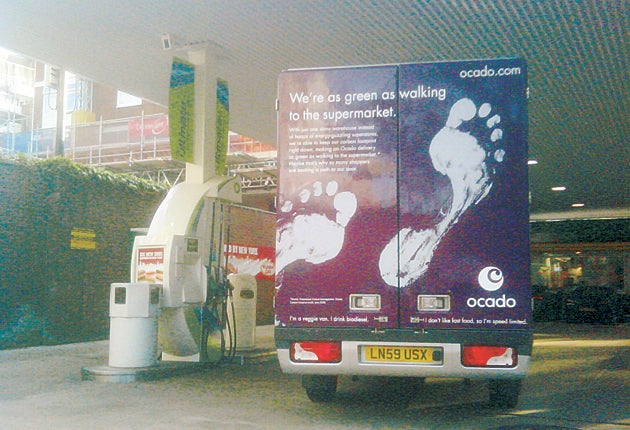
Ocado, the online "green van" delivery service that supplies groceries to customers' doors and claims to have changed the face of shopping, has been falling short of its own environmental pledges.
According to its branding, Ocado delivery vans run on biodiesel only – a marketing strategy to incentivise eco-conscious customers to use its service. But in London, drivers are filling up their vans' tanks with regular fossil-fuel diesel at a normal garage.
The offending vans were spotted and photographed last weekend by one of The Independent's readers, who witnessed the drivers filling up with regular diesel at a BP Connect garage in Shepherd's Bush, west London.
Yet under a section headed "Using Sustainable Fuel – our low emission vans", the Ocado website proclaims: "Our low-emission vans run on biodiesel, which we introduced a few years ago, when studies proved that it was one of the most efficient fuels available."
The reader, who did not wish to be named, said: "The Ocado website is a homage to the company's commitment to developing environmentally friendly and sustainable business solutions, but the photos clearly demonstrate that Ocado and its partners are selling a lie. Jason Gissing, who is co-founder of the company, certainly has some explaining to do."
When contacted by The Independent, Mr Gissing, who is now in charge of the company's external communications, admitted the truth of the allegations. "Yes, it's true that in London our vans do use regular diesel," he said.
"This is because we do not have planning permission for a tank for biodiesel at our west London depot, which opened in September. But at our other seven depots across the country we do use biodiesel in all our vans."
Ocado has more than 700 delivery vans in total and only 30 were using regular diesel in London, Mr Gissing added. "On a national basis, this accounts for less than 2 per cent of our fuel," he said. "Ninety-eight per cent is of the fuel we use is biodiesel."
He said he took a decision "not to relivery the entire fleet" when the new depot with no biofuel facilities opened, but he accepted that the vans in London were not doing what they said, and undertook to modify the website. Yesterday this was done and a note on the "green vans" page on the Ocado website now points out that some vans in London use normal diesel.
Mr Gissing said a longer-term challenge for the company was to decide whether to use biodiesel at all. "When we decided to run our fleet on biodiesel five years ago, it seemed like a sensible thing to do," he said. "But it may prove to be not so sensible."
Doubts continue to grow about the real environmental benefits of using biofuels, such as biodiesel and the petrol substitute ethanol. In theory, they are the answer to the global- warming problems of the transport sector, being produced from crops and other organic matter, and are in principle carbon-neutral, since the CO2 they release when burned was absorbed from the air when the crops were growing – and so is not a net addition to the atmosphere.
But it has become increasingly clear that biofuels may be as much a part of the problem as the solution, displacing food crops in countries such as the US, which contributes to the world rise in food prices when millions are already going hungry.
Wildlife is being harmed on a large scale in places including Indonesia, where virgin rainforest is being cut down to produce the palm oil which is one of the constituents of biodiesel. And there is a substantial use of energy involved in their production and transportation.
The Government was initially a strong supporter of biofuel use and set a target of 5 per cent of UK transport fuels to be biofuel-based by 2010. But two years ago the former Environment Agency chief executive Ed Gallagher produced a report on biofuels which pointed out the problems and recommended that the Government put the brakes on biofuel policy. The target has since been scaled back, to hit 5 per cent by 2013/14.
Join our commenting forum
Join thought-provoking conversations, follow other Independent readers and see their replies
Comments
Bookmark popover
Removed from bookmarks