Plastic fantastic! Carrier bags 'not eco-villains after all'
Unpublished Environment Agency research shows polythene may be less harmful than cotton or paper

Sign up to the Independent Climate email for the latest advice on saving the planet
Get our free Climate email
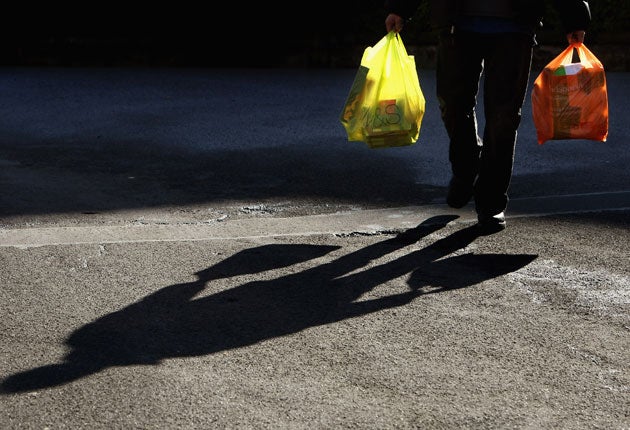
Unpublished Government research suggests the plastic carrier may not be an eco villain after all – but, whisper it, an unsung hero. Hated by environmentalists and shunned by shoppers, the disposable plastic bag is piling up in a shame-filled corner of retail history. But a draft report by the Environment Agency, obtained by the Independent on Sunday, has found that ordinary high density polythene (HDPE) bags used by shops are actually greener than supposedly low impact choices.
HDPE bags are, for each use, almost 200 times less damaging to the climate than cotton hold-alls favoured by environmentalists, and have less than one third of the Co2 emissions than paper bags which are given out by retailers such as Primark.
The findings suggest that, in order to balance out the tiny impact of each lightweight plastic bag, consumers would have to use the same cotton bag every working day for a year, or use paper bags at least thrice rather than sticking them in the bin or recycling.
Most paper bags are used only once and one study assumed cotton bags were used only 51 times before being discarded, making them – according to this new report – worse than single-use plastic bags.
However, despite being commissioned in 2005 and scheduled for publication in 2007, the research has not been released to the public.
Officially, the Environment Agency says the report, Life Cycle Assessment of Supermarket Carrier Bags, by Dr Chris Edwards and Jonna Meyhoff Fry, is still being peer reviewed. However it was submitted to the peer review process “more than a year ago”. Despite the long peer review the Environment Agency does not have a date for its publication, except to say that it will be soon.
The report set out to find out which of seven types of bags have the lowest environmental impact by assessing pollution caused by extraction of raw materials, production, transportation and disposal.
It found that an HDPE plastic bag would have a baseline global warming potential of 1.57 kg Co2 equivalent, falling to 1.4 kg Co2e if re-used once, the same as a paper bag used four times (1.38 kg Co2e).
A cotton bag would have to be re-used 171 times to emit a similar level, 1.57 kg Co2e.
The researchers concluded: “The HDPE bag had the lowest environmental impacts of the single use options in nine of the 10 impact categories. The bag performed well because it was the lightest single use bag considered.”
The 96-page report comes amid an ongoing controversy over plastic bags and plans by Wales to introduce a 5p plastic bag tax in October.
Six billion plastic bags are used across the UK annually and there is no doubt that they cause environmental problems such as litter and marine pollution as well as using up oil, and limiting their use and re-using them reduces their harm.
However the new report suggests that if shoppers to switch to alternatives, they have to use those time and time again to be greener.
Barry Turner, chief executive of the Packaging and Films Association, which represents plastic bag manufacturers, suggested the report had been “suppressed.” “They [the Environment Agency] have kept it fairly quiet and tried to suppress things,” he said.
“This [report] has dragged on and on. It was a report that could have been done relatively quickly, probably within 12 months but it has gone on for years.
“If these are the conclusions that have arrived at it wouldn’t really surprise me. It was buried because it didn’t give the right answers. It doesn’t support the political thrust at the moment.”
He added: “People at CEO level [in retailers] have been consistently telling Wrap [the publicly-funded Waste and Resources Action Programme] and Defra [Department for the Environment, Food and Rural Affairs] that they have been missing the point. They have had very closed ears on this and I have never have been able to understand why they have been so rigid in their approach.”
The Environment Agency denied the report had been suppressed. “No. The initial draft went to the review panel just over a year ago but they have not been constantly engaged in the review,” he said.
“We amended the report after the comments from the first review and then the revised report was resubmitted to them last summer but, because it was a panel and because of their other commitments, it has taken them some time to complete. We expect this to be completed shortly.”
Asked whether the draft findings had been seriously challenged, he said the reviewers had “questioned some aspects of the original draft, although much was about emphasis and balance.”
The report brings to mind another life-cycle assessment carried out by the Environment Agency, into disposable nappies, which suggested that reusable "eco" nappies were typically more damaging to the environment than disposables such as Pampers because washing uses so much carbon-emitting electricity.
Following publication of that report, the Government dropped its advice for parents to use eco nappies. The Womens Environmental Network also dropped its campaign.
So which bag should you use?
All bags have an impact. The best solution would be to use a cotton bag several hundred times, probably using it constantly for years. If you are not going to do that, a plastic bag – re-used as a bin liner – is the next best option, better than paper. Avoid accepting a plastic bag unless you need one, though.
Subscribe to Independent Premium to bookmark this article
Want to bookmark your favourite articles and stories to read or reference later? Start your Independent Premium subscription today.
Join our commenting forum
Join thought-provoking conversations, follow other Independent readers and see their replies