£5,000 incentive to buy electric cars
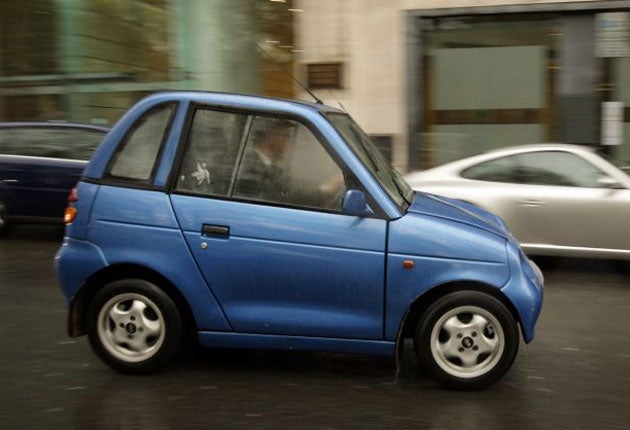
Consumers could receive incentives of between £2,000 and £5,000 to buy an electric car from 2011, the Government announced today.
Transport Secretary Geoff Hoon said the initiative — part of the Government’s low-carbon transport plan — would mean an electric car was “a real option for motorists”.
He announced the five-year initiative with Business Secretary Lord Mandelson.
The Department for Transport is beginning discussions with the motor industry and financiers to determine how best to deliver this assistance. To be eligible cars would need to meet modern safety standards and have a range and top speed sufficient to give mass market appeal.
Mr Hoon said today: "Cutting road transport CO2 emissions is a key element to tackling climate change. Less than 0.1 per cent of the UK’s 26 million cars are electric, so there is a huge untapped potential to reduce emissions.
"The scale of incentives we’re announcing today will mean that an electric car is a real option for motorists as well as helping to make the UK a world leader in low-carbon transport."
Lord Mandelson said: "Britain has taken a world lead in setting ambitious targets for carbon reduction. Low-carbon vehicles will play a key role in cutting emissions.
"Government must act now to ensure that the business benefits of this ambition are realised here in the UK. We want the British motor industry to be a leader in the low-carbon future, and Government must direct and support this, through what I call new industrial activism."
The five-year plan involves a £250m scheme to deliver a green motoring transformation and involves promoting the infrastructure and support technology and encouragement of manufacture in the UK that will place low-carbon transport at the centre of the Government’s vision for the UK economy.
The two ministers were planning to drive a new Mini E electric vehicle in Dunfermline in Scotland to demonstrate the technology of low-carbon motoring.
At present the cost of electric cars is high, with one high-performance vehicle, the Tesla Roadster, having a starting price of more than £87,000.
At the moment there is also little infrastructure in place to support the recharging that such cars need.
Last week London Mayor Boris Johnson announced a plan to introduce thousands of charging points across the capital.
This article is from The Belfast Telegraph
View all comments that have been posted about this article.
Offensive or abusive comments will be removed and your IP logged and may be used to prevent further submission. In submitting a comment to the site, you agree to be bound by the Independent Minds Terms of Service.
- Print Article
- Email Article
-
Click here for copyright permissions
Copyright 2009 Independent News and Media Limited


Reduce your global impact.
Comments
2011?? We could all be dead by then. Good one.
But there's a glimmer of hope in technology like RepRap:
http://en.wikipedia.org/wiki/RepRap
If we could free ourselves from planned obsolecence maybe some bright spark might make a retrofit engine that could be used in exsisting vehicles thereby negating the 'need' for new cars to solve the problem.
I for one wouldn't mind simply replacing "consumable components" in many products rather than buying new ones. I'm sure lots of people feel the same.
Wind power? More likely the new generation coal fired power plants.
This really wasn't thought through that well was it...
In the old days, Britain was serviced by regional and local hubs linked by rail, vans and lorries only drove to those and long distance road haulage was a rarity, didn't Blair say he was going to go back to that system in his first term?
Britain needs cheap and affordable mass transit systems, by careful regulation this government can bring this about, a freight train can take eight or more lorries off the road easily and the hauliers don't lose their jobs but change their role in moving goods to and from the freight depots and factories... thus removing congestion from our motorways, reducing pollution and allowing communities to grow again, reducing our thirst for oil too.
A thought occurs too that whilst electric long distance trucks are unviable, they are more viable in the local sense...
Hydrogen fuel cell technology will make the current (no pun intended) crop of limited range, long recharge time leccy motors of the type used in the much vaunted tessla roadster an object of ridicule.
I think all those in the public sector employees should be forced to buy at least one. Their children should be made to have one as a first car, in flurescent green or bright yellow. How cool - I am the son of a teacher look at me in my bright yellow box.. woosh!
It would certainly kill the cult of the tin box. You can imagine all those great film car chances being replaced by an electric buzz-mobile humming through the mean streets of "souff Lundin". The "Fast and the Furious" would be replaced with the "The Sound of Sewing Machine!" High speed police chases would take place only if the wind turbines were operational.
The whole thing is a farce worthy of a Jules Verne story.
The next big thing in cars should be the ones that get us from A to B with technology gurantees they never crash. Insurance companies would loose a great chunk of free money and the death toll on the road would dissappear. Now that would be worth 5k of you money.
Oh and by the way, pollution is about more than carbon footprints by the way. Although if you listen to the Government, you'd be forgiven for thinking this unfortunately isn't true.
I know it's not as glamorous and exciting as giving tax-payers' money to anyone wanting to drive around in an electric pod, but I though you might like the appeal of giving money back to people and at no cost to the tax-payer?
However, if you are happy to burn billions, can I have a few to launch my alternative, it's smarter, sexier and doesn't need the invention of a whole new power supply system, comes with a full guaranteed refund to all invested funds, oh, and it's far more eco-friendly than pods.
Oh, sorry, I forgot, we're in the world of the pod people now aren't we.
Never mind, Geoff, just be of good cheer and ignore all the jeering, ridicule and threats to your job from all your colleagues.
Better luck next time.
What about the energy used in the production of these new vehicles?
And as many have pointed out where is the power going to come from?
And as for Boris saying he will introduce "thousands" of charging points across the capital, that sounds like a stoke of genius for a city with no congestion problems...
Mine's a bike and an old Toyota Hi-lux...
Do we get the rebate in tax? Cash
I thank you
Firozali A. Mulla
In the city they may work, with people making shorter journeys, but they are impractical for long journeys, and recharge times are very slow.
Hydrogen power is the future. We're not there yet, but all signs are promising. This is a misguided step in the wrong direction.
Bravo!
What about the rest of the country?
There is more to Britain than just London, surprising though that may seem.
Anyway, this is just more pointless, going through the motions rhetoric.
I'm not getting excited about it.
G- wiz 9.66 KWhr full charge
1 charge each day for 1 year = 3525.9 KWhr
Drax could charge 6,806,772 G- wiz every year
26 million G-wiz = 3.8 drax power stations
There is no such thing as a 'green car' any more than there is such a thing as 'clean coal'. Industrial society is predicated on using energy at a hundred times the rate it is available through natural systems and is doomed to failure in the long run. Indeed, ten years from now most people will be broke and will probably be starving. But you'll never get a politician to admit such realities.
how much money should be offered to petrol stations, ralway stations, car parks, etc. for switching lights off in daytime even at sunshine.
Much much more energy is wasted, so CO2 is emitted, in this country than could be saved by those electric cars.
When and if the rest of the world ran similar lifestyle like people in the UK and USA the world had alredy been died out long time ago.
That is absolutely not for government to decide, "mass market appeal". It may be that low-speed, low-range, low-cost is what people will decide they want. After all, they'd save oodles on their insurance bills. And such cars wouldn't be desirable from a theft point of view.
The subsidy should be given for low energy consumption, without any further strings attached. Government's hand will only ensure more of exactly the same.