Green Living

Rain (AM and PM) 6° London Hi 10°C / Lo 3°C

Safety threat to planned nuclear power stations

Devastating blow as leaked letter shows regulator could pull plug on proposed UK reactors because of 'design errors'
By Geoffrey Lean, Environment Editor

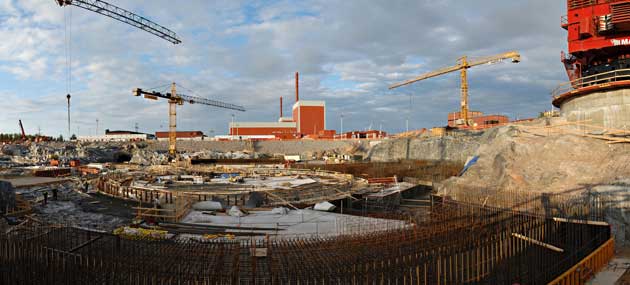
Construction of the first EPR at the Olkiluoto site in Finland is already three years behind schedule

AP

Construction of the first EPR at the Olkiluoto site in Finland is already three years behind schedule

Britain's plans to build a new generation of nuclear power stations have been thrown into jeopardy by startling official safety fears. The nuclear regulatory body in Finland, where the first of the reactors is being built, has taken the extraordinary step of threatening to halt its construction because it has not been satisfied that key safety systems will work.

STUK, the Finnish government's Radiation and Nuclear Safety Authority, says that "evident errors" have not been corrected more than a year after it raised its concerns and condemns the "lack of professional knowledge" of people working for the firm responsible for its design and construction.

This is an unexpected, and potentially devastating, blow because one of the main selling points of the new European Pressurised Reactor (EPR) has been that its safety systems will work far better than those in current reactors. It is particularly important that they do because, as The Independent on Sunday reported in February, they will produce many times as much radiation that could be rapidly released in the event of an accident.

EDF, the French electricity generator, plans to build at least four EPRs in Britain; two each are expected for existing nuclear sites at Sizewell in Suffolk and Hinkley Point in Somerset. It plans to let the first construction contracts this year and to have the first power station in operation by 2017. However, the first EPR, called Olkiluoto 3 – which is being built on an island in the Gulf of Bothnia, off western Finland – has already been plagued with problems. It was supposed to begin operating this year but its construction is now three years behind schedule, vastly exceeding its original cost of €3bn.

The new crisis has been sparked by a leaked letter from Jukka Laaksonen, STUK's director general, to Anne Lauvergeon, the chief executive officer of the French nuclear company Areva, which has designed and is building the reactor, to express his "great concern" over "the design of the control and protection systems".

He said he first raised the issue in the spring of 2008, but "we have not seen expected progress in the work on the Areva side" adding that "the attitude or lack of professional knowledge" of some of the people representing the firm in expert meetings on the issue "prevents progress in resolving the concerns. Therefore evident design errors are not corrected and we are not receiving design documentation with adequate information." He warns: "Without a proper design that meets the basic principles of nuclear safety... I see no possibility of approving these important systems for installation. This would mean that the construction will come to a halt."

John Large, an independent nuclear consultant, describes the warning as "a hell of a damp towel for the reactor", and says that STUK's ultimatum shows that "it must consider the safety issue very serious indeed". The Health and Safety Executive, which will have to approve the EPR for use in Britain, is already liaising closely with STUK.

The letter was written last December, but a spokesman for STUK said late last week that, as far as he was aware, the situation had not changed since. Areva said it had sent some more files to the Finnish utility that will operate the power station, but admitted that "there are still some problems to solve".

EDF declined to comment.

Post a Comment

View all comments that have been posted about this article.

Offensive or abusive comments will be removed and your IP logged and may be used to prevent further submission. In submitting a comment to the site, you agree to be bound by the Independent Minds Terms of Service.

Comments

Finn end of the wodge
[info]johnronan wrote:
Sunday, 10 May 2009 at 02:50 am (UTC)
Well done STUK kittos!
The notoriously dissembling arms/nuclear gravy train won't be detered easily.
Recall Sellafield so good they named it twice.
The outrageous sicknesses the fire then Dounreay discharges,then Thopre and the endless self regulating circus.The vaste overuns and overspills of waste and cash.

At the bottom line as Canadian nun Rosalie Bertell (no Immediate Danger) wrote years ago it's a dirty business from the dying miners through to radiographers to the need for weapons grade plutonium.

An island built on coal blessed with oil and gas with better wave wind and hydro options than most needs eschew this poison.
Benn armed the Nuclear Police the Americans have little enclaves where UK laws are unenforced.

Public education may be a role for all those at NRPB and Harwell while the public needs grasp that conservation and lower usage are key.
Solar so good.
Re: Finn end of the wodge
[info]colinru wrote:
Sunday, 10 May 2009 at 10:48 am (UTC)
All the problems in your first paragraph were not at Civilian Designed/Operated Power Reactors so they do not apply to this article.

If the IPCC is correct about AGW, then Coal etc. will not be a good major component of Power Production. Wind, Waves and Hydro cannot supply our present level of Power Consumption so we either reduce population or reduce Energy Usage per head (which will also reduce population since we will live lives that are shorter, nastier and more brutish if we reduce Power Consumption by the amounts needed to cope without Fission Reactors).

Solar will be hopelessly uneconomic in Britain (perhaps that will improve, in future).
Britain's additional difficulty
[info]tominlondon wrote:
Sunday, 10 May 2009 at 07:20 am (UTC)
Britain's additional difficulty is that Gordon Brown's brother Andrew (he of the cleaning bill) is director of communications for EDF. EDF has been at the forefront of campaigning for new nuclear power stations. Guess who would be in charge of that campaign.
Coal Mining ?
[info]achmelchett wrote:
Sunday, 10 May 2009 at 08:42 am (UTC)
Would opening coal pits help our energy & unemployment crisis ?.
Only am i the own my own thinking climate change wouldn't really change one way or the other very much if we did this ?.
Olkiluoto
[info]adj_a05 wrote:
Sunday, 10 May 2009 at 08:55 am (UTC)
Oh no IOS is at it again, nuclear scaremongering that is. If you bothered to check out this story properly you would see it is simply about a memo complaining about the late delivery of documentation. Here is the Finnish story http://www.yle.fi/uutiset/news/2009/05/areva_and_tvo_downplay_renewed_reactor_concerns_724301.html
More radiation in an accident
[info]colinru wrote:
Sunday, 10 May 2009 at 10:54 am (UTC)
The February article was as incorrect as this one so please stop repeating that the EPR is more dangerous than older designs. It is SAFER! The fact that some of its radioactive by-products make up a greater percentage of release in an accident is trivial - there has not been a release from any Civilian Designed/Operated Power Reactor. The Containment and Emergency Shutdown Systems have prevented any exterior release as they are designed to do (even at Three Mile Island).
Wrong, wrong, wrong
[info]tominlondon wrote:
Sunday, 10 May 2009 at 11:56 am (UTC)
Your nuclear lobbyness is showing.

Here is the full case against EPR, demonstrating how dangerous it is:

http://www.greenpeace.org/international/press/releases/illegitimate-and-dangerous-reactor-300109
Re: Wrong, wrong, wrong
[info]colinru wrote:
Sunday, 10 May 2009 at 12:25 pm (UTC)
I have no connections with the Nuclear Fission Power Business. I am not a lobbyist for them.

My heart sank when you referred me to a Greenpeace site but I visited it anyway. As I feared it was the usual unscientific, unsubstantiated crap that this Organistion often comes out with.

The article does NOT demonstrate how dangerous the EPR is. It asserts that the Energy problem can be solved by spending the money on efficiency improvements - which is, at least, partially true. It also asserts that the best solution is renewables - and I bet that they do not include Fusion in that term. This is palpable nonsense and can be shown to be so, at the present. Even if Britain improves efficiency to reduce consumption by say 30% (which is a big if) there is no possibility of British renewables being able to supply the remaining Power without Nuclear Fission or Fossil Fuels. If AGW is true then that only leaves Fission for the near future.

I know that many "Green" & "Warmist" sites say that renewables can do it but you can read a book by David Mackay (Professor of Physics, Cambridge) which shows in basic terms that this is a pipedream. The link is www.withouthotair.com and demolishes the Greenpeace arguement. It shows that Wind, Wave, Tidal and Hydro will NEVER be feasible to replace all Fossil Fuel Power in Britain.

There is a possibility that you could import renewable power (Geothermal from Iceland, Concentrated Solar Power from North Africa, as examples) but these are not yet proved at an industrial scale and would still have some aspects of Security of Supply to be considered.
Re: Wrong, wrong, wrong
[info]skyemartyn wrote:
Sunday, 10 May 2009 at 02:21 pm (UTC)
It's obvious how dangerous the EPR is if you know a little about the technology in use in these reactors. You can check out John Large's website and find some very simple presentations demonstrating how dangerous the EPR is during potential accidents. John Large is a nuclear scientist, an expert on all things nuclear. Large's presentations assume a breach of the containment and we all have everything crossed to hope that doesn't happen. These are facts. I am sure here in the UK the EPR will be safe, but since renewables won't work many countries will surely have to go nuclear as well. The nuclear industry would like us to believe they run plant free from incident but this simply is not true. Nuclear power stations here in the UK spend substantial amounts of time off-line, mostly down to faults or prolonged maintenance. Check out the IAEA for up to date figures detailing just how many hours they were generation for in a given year: http://www.iaea.org/programmes/a2/index.html

The second massive question mark is, like anything that is untested, no-one knows exactly how the EPR will react because not a single unit has been commissioned. It is brand spanking new - this is a selling point! It is based on 1950's PWR technology but it has been rebuilt from the ground up. Until you run a unit you just don't know for sure how it will behave. Plus a fault in one unit is likely to affect all units - bad news if you are going to rely on it as a base load generator.

Nuclear fission is designed for a 1930's energy system; one made up of very large single points of generation far from demand centres. I might add, these large plants are also single points of failure and extremely in-efficient. Like all other generation they need backup in case of failure. In a nuclear world there is little need for other power generation because nuclear is an uncontrollable technology. You want your plant running as close to 100% as possible, so why have a windmill or a hydro plant (except the latter maybe for a very fast response in case of a demand peak). Nuclear will also sap revenue from all other forms of generation because it is so costly. The cost of the first EPR is huge already.

There are many who advocate a renewable energy future (do a quick Google search for renewables in the UK). We waste huge amounts of energy. Just look at the cooling towers of a fossil fuel or nuclear power station. Contrary to popular belief going renewable does not mean you ditch everything that has gone before in an instant. We have the highest constant wind speeds in Europe; the largest waves in Europe; some of the strongest tidal currents; the highest tidal levels; we can even use the sun; biogas; CHP on fossil fuel plants to improve their efficiency up to 90%. We can even use coal so long as the output is dealt with. We can save energy so it doesn't have to be produced in the first place.

Nuclear advocates are very quick to tell us nuclear is safe and secure - it can NEVER fail; but they are fast to tell us renewables can NEVER work. I can see how that works for them! The money we are about to spend on buying French power stations could be much better spent on supporting renewable energy systems; could be spent on building a 21st century national grid that can cope with renewable generation; on paying people to save energy rather than waste it; to allow energy consumers to become energy producers; to allow us to build an industry in which we can lead the world, not become relent on someone else's raw material or technology. If we can split the atom in 10 years then we can harness the waves or the tides. The energy we need is all around us. We just need the vision to see past the nuclear green wash and embrace a truly secure, clean and sustainable energy future.
Re: Wrong, wrong, wrong
[info]tominlondon wrote:
Sunday, 10 May 2009 at 02:51 pm (UTC)
The whole underlying point is that centrally generating very large amounts of electricity and then distributing it through a national grid, which has to be kept in balance all the time, is old technology. The grid itself will have to be completely renewed to take the new loading, and the millions of miles of new cable required will require so much copper that the carbon footprint of extracting and producing this copper, along with the many millions of shipping miles involved in bringing it to this country, will compromise the supposedly "green" credentials of new nuclear before we've even started. The NEW way to go is locally generated electricity and abandoning big grids and big generating stations. But alas, there are powerful vested interests who are pushing for that, and who seem to have convinced our naive, backward-looking politicians that there will always be a national grid. And guess who will end up paying for the grid?
Re: Wrong, wrong, wrong
[info]colinru wrote:
Sunday, 10 May 2009 at 06:40 pm (UTC)
Tominlondon : The Grid will not need completely renewing and your statement that the Copper used will compromise the green credentials of Fission Power is simply untrue. I have, in the past designed many types of Reactor Plant and the Copper usage within and without the Plant is a minor part of the cost in price or energy (and, thus, CO2). The cost of a Grid to bring Icelandic Geothermal Power to European Mainland undersea (much more than aboveground Grids) is estimated at 3 billion dollars. This dwarfs in complexity any modifications required to the British Grid!

Renewables will need even more Grid mods to be efficient - Solar PV etc. would work best with an HVDC Grid which WOULD mean a complete renewal. Renewables need a Grid because they are much more constrained in location than Fission or Fossil Fuel Plant. What do you do when the Wind is not blowing in your area without a National Grid?
Re: Wrong, wrong, wrong
[info]tominlondon wrote:
Sunday, 10 May 2009 at 06:47 pm (UTC)
Wind is not the the only renewable energy source. Locally generated power is the only sustainable way to go (along with low-energy construction and general energy saving to reduce demand).

Enthusiastics of big, centralised heavy technologies, such as yourself, probably dislike this concept because it puts responsibility for energy production directly into the hands of those who demand it. And takes control away from people like....yourself.

Big vested interests hate anything that threatens to undermine their economic status and their political influence.
Re: Wrong, wrong, wrong
[info]colinru wrote:
Sunday, 10 May 2009 at 07:38 pm (UTC)
Tominlondon : Wind is not the only renewable but the same arguement applies to Solar, Tidal and Hydro. All of these are variable in a way that Fission and Fossil Fuel are not.

Low energy construction and energy saving will be a good but they will not get us "off the hook" without dramatic population reductions and/or changes in lifestyle that will be unacceptable to the people of Britain. If you look at the Greenpeace agenda it is impossible unless we all live next to our work, rarely travel outside our local area (and certainly never fly anywhere). THis was how most of us lived until the early-20th C but I cannot see it being politically feasible whatever you may think. If faced with that choice, most people will swallow their doubts and vote Nuclear.

I find your sneering remark about me not liking to lose control offensive and it is also untrue - I am retired and live in an area where the bulk of Power Supply is Hydro and the rest is Fission generated. What is it with those of the Green persuasion - as soon as anyone critiques your ideas you try to abuse/demean them instead of refuting their arguements.

To be blunt, I have refuted your Greenpeace link that the EPR is dangerous, I have refuted your arguement about the CO2 costs of the Grid, I have refuted your arguement that local Grids would work. Your response is not to refute my refutations (other than at the margin) but to be offensive. I posted because I know a fair bit about these topics and I was not offensive to you or others here - I could have just said that you were all idiots who did not understand the topic. That does not improve the debate or take it forward and I have no belief that you do not geneuinely believe that the arguements that you posted were both true and important (just as I do with mine).

If you do not have time to read my link to Professor Mackay, you could read a brief summary ofhis book in The Economist of April 11th, 2009 in "Books & Arts" - Page 75 in the print edition.

I hope that we can agree that renewables should be an increasing part of our supply even if we disagree that they can supply all that we need.
Re: Wrong, wrong, wrong
[info]tominlondon wrote:
Sunday, 10 May 2009 at 08:32 pm (UTC)
We can no longer have all the energy we *think* we need. We have to cut down.
Re: Wrong, wrong, wrong
[info]colinru wrote:
Sunday, 10 May 2009 at 06:03 pm (UTC)
I do understand the technology but my point is that there has never, to my knowledge, been a containment breach in a Civilian designed/operated Fission Power Station. Therefore the facts re the dangers of the EPR are trivial since they would only apply in that case. There are many Chemical & Petrochemcial processes that are inherently dangerous but we do not hear about them because the containment systems prevent toxic releases.

Of course there are breakdowns in any Reactor system so no Power Plant is on-line 100% of the time. I am not aware of any Nuclear Engineer who has suggested that it is.

The EPR is a new design and like all such will take time and money to debug. The basic technology does not suggest that they will be unable to work and settle down when scaled up to Industrial size. This is even more true of Solar CSP, Geothermal and other renewables like Fusion.

Your third paragraph seems to overestimate the problems with Nuclear "crowding out" other sources. The French generate approx 80% of their Power from Fission but still have a major Wind programme ongoing. Your comment about large Plant being innefficient is not true - they tend to be more efficient even when allowing for transmission losses (and that is before we consider moving to HVDC Grids).

Whilst I agree with the idea of improving efficiency of usage (fourth para), my point stands that Professor Mackay is very clear that renewables cannot supply anything close to our energy usage without Fission or Fossil Fuel.

No Engineer or anyone with any knowledge of Industry would ever claim that accidents cannot happen but no outsider has ever died from the leakage from a civilian designed/operated Fission station. I stand by my statement that renewables can be a valuable part of our Power Generation but there are simply not the resources in Britain to do without Nuclear or Fossil Fuel. The only way to achieve renewables-only would be to reduce Power Usage to the point where we have to reduce population or accept a standard of life that was as nsty, brutish and short as the Medieaval Period.
Solar farming.
[info]duncmac wrote:
Sunday, 10 May 2009 at 02:37 pm (UTC)
http://tinyurl.com/5sv7ap

http://tinyurl.com/663ole

http://www.desertec.org/

The solution is with us but like the electric car it has to overcome the vested nuclear interest lobby who have many politicians in their back pockets, not the least of them being Brown.

Nuclear power generation and weapons research and development are inextricably linked. Both are redundant and morally and ideologically repugnant.

To have the means to provide the world with power whilst also providing the poorest regions on earth with clean desalinated water and the means to grow and harvest food, and not to proceed with it would be a crime against humanity.

The nuclear industry is corrupt, dangerous and past it's sell by date, and like Browns cabinet must be consigned to history.
Re: Solar farming.
[info]colinru wrote:
Sunday, 10 May 2009 at 07:00 pm (UTC)
Duncmac : Your 3 links refer to the idea of using Solar PV Plants in Africa as a Power Source. This has never been tried on an Industrial Scale before. Nevertheless, if successful, this will be a useful addition to renewable supplies for Europe. However can I make three points :

- This will require an HVDC European Grid for efficiency (which does not seem to be in the price from what I can glean from your links).

- It will generate approx 100GW which is more than Britain needs but a small fraction of European consumption.

- There are security of supply considerations that are much harder to solve than for Fission. These are the place of Generation, the transit route and the fact that Britain is at the end of the Grid (witness the Gas Grid supply problems in recent times).

Nuclear is not redundant IMHO and I do not agree that it is morally repugnant. I do not understand why people find it so frightening.
EVERYTHING has a time
[info]famulla wrote:
Sunday, 10 May 2009 at 05:19 pm (UTC)
We are in a wrong boat with lots of waste in the steets and nuke wastes.
I thank you
Firozali A Mulla
A Sad Commentary
[info]billdavy1949 wrote:
Monday, 11 May 2009 at 09:13 am (UTC)
While the third runway gets the go ahead and nuclear almost the same, we have started thinking about the Severn Barrage. What a tragic wasted opportunity.

Still, at least we didn' get the super casinos nobody wanted so perhaps nuclear is going to sate our need for a flutter.

Hey ho.
New future For Britain
[info]ivorwindscale wrote:
Tuesday, 12 May 2009 at 08:17 am (UTC)
Nuclear power is a morally and financially bankrupt industry. It is so overweight with political ambition.
We are now in the situation where America and Britain are resorting to military occupation of foreign lands to ensure supply of mineral resources. The Nuclear industry sees itself as an answer to this problem but in reality ronly ends up causing nuclear arms proliferation wherever its pernicious technology is allowed to flourish.
In France the nuclear industry has practically taken over the government - note that whenever president Sarkozy travels abroad, he is always accompanied by two representatives from Areva - he is in effect their nuclear salesman.
Once the nuclear industry gets a foothold in this country we will be tied to their technology and waste products for thousands of years with no turning back - it is then that you will begin to see their political ambitions.
The truth is that in order to survive and keeps essential services running for homes and hospitals, we don't need the industries that sink massive amounts of energy and generate pollution. It is those industries such as Airports and factories that make plastic rubbish, that need to propagate the myth that we need vast energy resources. It is only to keep their empires afloat.
True green energy supplies such as wave wind and solar are the only way to go to avoid military occupations and nuclear waste. We need to put every industry under the microscope to see what their true input is in to society given ty their energy requirements and CO2 emissions. This should be an age of energy austerity.

Article Archive

Day In a Page

Sun | Mon | Tue | Wed | Thu | Fri | Sat

Select date