Green Living

10° London Hi 11°C / Lo 6°C

The Big Question: What more can Britain do to beat its addiction to plastic bags?
By Michael McCarthy, Environment Editor

Why are we asking this now?

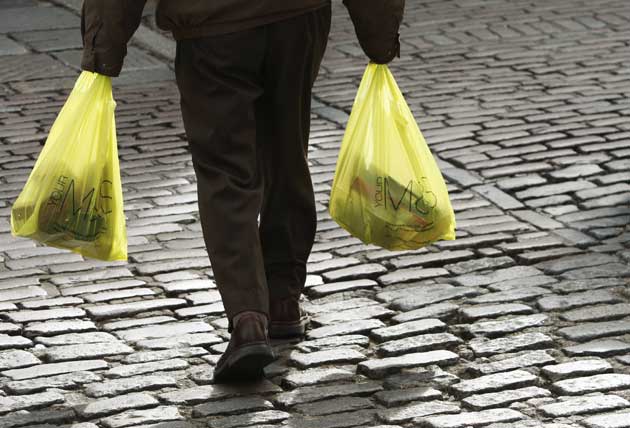
Because yesterday the Government's anti-waste body, Wrap, announced that plastic bag use in the UK had dropped from 13.4 billion in 2007 to 9.9 billion in 2008 – a reduction of 26 per cent, or 3.5 billion bags.

That's a pretty hefty reduction in just 12 months, isn't it?

Yes, indeed it is; the 3.5 billion bags which have been cut from use, laid end to end, would stretch to the Moon and back twice, or around the Earth 44 times, Wrap obligingly points out (which is a bizarre but undeniably impressive image). On the other hand, we are still using 10 billion bags a year – approximately 166 bags for every man, woman, child and infant in these islands. That's hardly a kicked habit.

So how many of those 10 billion can we cut?

There's the rub. In December, seven of the major supermarkets, which are the leading plastic bag sources, agreed that they would seek a 50 per cent reduction in single-use bags by May this year, as against May 2006. It is not clear yet how they are doing, but the rate of change indicated in the UK figures released yesterday certainly suggest that the target is achievable. But where do we go from there? In December, the Government hinted at a 70 per cent eventual reduction in UK plastic bag use (in Whitehall-speak, this is an "aspiration" rather than a target. Targets you have to meet. Aspirations, you aspire to). Could that be attained? Even if it could, we would still be using four billion bags a year. That's a long way from zero.

Why does all this matter?

Because plastic bags are one of the greatest scourges of the consumer society – or to be more precise, of the throwaway society. First introduced in the US in 1957, and into the rest of the world by the late 1960s, they have been found so convenient that they have come to be used in mind-boggling numbers: in the world as a whole, the annual total manufactured now probably exceeds a trillion – that is, one million billion, or 1,000,000,000,000,000. And according to the British Antarctic Survey, plastic bags have gone from being rare in the late Eighties and early Nineties to being found almost everywhere across the planet, from Spitsbergen, at latitude 78 degrees North, to the Falkland Islands at 51 degrees South. They are among the 12 items of debris most often found in coastal clean-ups. On land they are ubiquitous too. Windblown plastic bags are so prevalent in Africa that a cottage industry has sprung up harvesting bags and using them to weave hats, and even bags, with one group harvesting 30,000 per month. In some developing countries they are a major nuisance in blocking sewage systems.

What matters is what happens to them after use. Enormous numbers end up in landfill or incinerators, itself an enormous waste of the petrochemical products which have gone into their manufacture; but billions get into the environment, especially the marine environment, where their lack of rapid degradability makes them a persistent and terrible threat to marine life.

What threat do degrading bags present to nature?

Sea turtles mistake them for their jellyfish food and choke on them; albatrosses mistake them for squid and die a similar death; dolphins have been found dead with plastic bags blocking their blowholes. The British wildlife film-maker Rebecca Hosking was staggered by the plastic-bag-induced mortality of Laysan albatrosses on the Pacific island of Midway; she found that two-fifths of the 500,000 Laysan chicks born each year die, the vast majority from ingesting plastic that their parents have mistakenly brought back as food. As a result, Ms Hosking started a movement to turn her home town of Modbury into Britain's first plastic bag-free community, which many residents and retailers have enthusiastically joined.

So is a plastic bag-free Britain possible?

Perhaps. Who could have imagined half-a-century ago that Britain's public places would one day all become cigarette smoke-free? Of that we would all be using lead-free petrol? Who would have thought even a decade ago, come to that, that about two-thirds of us would by now be actively engaged in recycling? Major shifts in public behaviour can certainly occur.

So what would be needed to make such a change?

Above all, a general change in consumer attitudes, towards the "re-use habit" – employing reusable shopping bags. Older people will remember how this was entirely the norm before the late 1960s; households, and in particular, housewives – as they then were – had a "shopping bag", a sturdy receptacle which was used to carry items bought in the daily shopping expedition. But that was the very different pattern of household shopping then – the purchase of a much smaller number of items, on a daily basis, after a walk to small shops – which were local. Today the housewife is largely a vanished species, and many of us tend to drive to the supermarket once a week and fill up the boot with seven days' worth of provisions, for which plastic bags, of course, are fantastically useful. It's a hard habit to break.

Why have we seen such a dramatic drop in plastic bag use this year?

Because the leading supermarkets and other retailers are making a major effort to wean us from the habit, with a whole host of initiatives, ranging from "bags for life" schemes to bag-free checkouts. It is clear that habits are starting to change; reusable bags are more visible than they were even two years ago. Wrap's Dr Richard Swannell said yesterday: "When you go into supermarkets or go down the High Street, there is a real plethora of people with reusable bags."

Should the Government be putting a tax on plastic bags?

The Government is considering the idea, and Gordon Brown has said that if actions by the retailers do not achieve the desired result, then direct intervention is a possibility. What people have in mind is the example of Ireland, where in 2002 a levy of €0.22 – the PlasTax – was introduced on all plastic bags, the first of its kind in the world. This quickly prompted a quite astonishing reduction of 90 per cent, from 1.2 billion bags a year to fewer than 200,000, and an enormous uptake in the use of cloth bags – with the revenue from the tax ring-fenced for environmental clean-up schemes.

What is the Government going to do next?

In the Climate Change Act, which was introduced late last year, the Government gave itself the power to bring in a plastic bag levy. You might well think that it wouldn't give itself a power it wasn't eventually going to use. Certainly, kicking the habit completely may well require stronger action. To get a sense of the scale of the problem, check out the website Reusablebags.com, which has a "clock" showing how many plastic bags have been produced so far in 2009. At 6pm last night, the figure was 76.37 billion.

Will Britain soon be a plastic bag-free nation?

Yes...

* The trend in plastic bag use is definitely falling, which suggests we are moving in the right direction

* The Government intends to drive bag use down even further

* Ministers may bring in a tax, which in Ireland has reduced usage by 94 per cent, which will help further

No...

* We are now too attached to the weekly supermarket shop, which plastic bags facilitate

* It is unrealistic to expect everyone to return to the habits of the 1960s

* Plastic bags are simply too convenient for people to give up altogether, and they certainly hold heavy shopping better than paper ones

Post a Comment

View all comments that have been posted about this article.

Offensive or abusive comments will be removed and your IP logged and may be used to prevent further submission. In submitting a comment to the site, you agree to be bound by the Independent Minds Terms of Service.

Comments

A pittance.
[info]someofusknow wrote:
Thursday, 26 February 2009 at 01:36 am (UTC)
A pittance. The real waste is the fuel used to go shopping, which amounts to at least a hundred times the oil content of plastic bags.

Anyway, the collapse of the consumer society over the coming years will fix both problems.
bags
[info]babington wrote:
Thursday, 26 February 2009 at 06:39 am (UTC)
What is being done to deal with the millions of plastic bags already out there, presumably not rotting in landfill sites and presenting a potential disaster? Why can't the government make plastic bags illegal, like smoking indoors in public places - or any bags for that matter? People should be forced to recognize that if you don't take your own bag shopping, you don't get anything to carry your shopping with.
[info]brossen99 wrote:
Thursday, 26 February 2009 at 07:09 am (UTC)
Plastic bags would not be a problem if all our waste was incinerated instead of being pointlessly recycled in many cases. The energy in bags could be turned into useful electricity, the same principle applies to all other plastic packaging. After all plastic is made from a fraction of oil which was once only suitable for burning in things like ship boilers. I believe that the IoM can get up to 10% of its base load electricity supply from waste incineration, how more renewable that that can you get, the rest of the country could be doing likewise but for politicians foolishly appeasing the Eco-fascists.
Councils
[info]johnnynorfolk wrote:
Thursday, 26 February 2009 at 07:46 am (UTC)
Stop my council insisting that all rubbish is put in plastic bags before being put in the wheely bin.

I would think the plastic wrapping on products needs to be reduced first, my plastic bags have at least a second use.
A Good Article
[info]frankiew wrote:
Thursday, 26 February 2009 at 08:20 am (UTC)
Another good article Mr McCarthy. You are now writing articles about Pollution on which we who respect this world and who cares for this world of ours should be focussing on instead of the the misconception and fixation and nonsense and distraction that CO2 be a pollutant that causes "global warming".
Plastic carrier bags
[info]mssuperior wrote:
Thursday, 26 February 2009 at 08:25 am (UTC)
Charge much more for them. People take lots when they are free or cheap.Charge much less for rubbish bags. make carrying them a figure of ridicule. (They aren't the most stylish, face it.) Don't let supermarkets have their name on them. (no profit from advertising then.). Or print 'I'm fat because I eat all this and I'm stupid' on them. Just don't provide them at the checkout, but make just one checkout for people without brought-along bags. The wait might dissuade.
Degrading thoughts
[info]junkkmale wrote:
Thursday, 26 February 2009 at 09:28 am (UTC)
Reuse is best, as best one can assess.

However, I do have a question prompted by this, if in another, related area: 'What threat do degrading bags present to nature?'

A lot of alternatives, and also with packaging, now seem to involve biodegradability in various forms. What do these things biodegrade to, and what are the consequences? By my reckoning it can often be Co2 or, worse, methane, and that is surely a concern in greenhouse terms?
Plastic Postal Bags
[info]dave1234b wrote:
Thursday, 26 February 2009 at 09:40 am (UTC)
The biggest source of waste plastic bags in our house is the amount of post (and Newspapers) that use plastic bags for packaging. We fill a normal Supermarket bag with this material for recycling every 2/3 weeks.
As usual, Britain trails behind!!
[info]kjackson76 wrote:
Thursday, 26 February 2009 at 10:20 am (UTC)
I lived and worked in Germany 5 years ago and had to make sure I took bags with me to the supermarket. You'd also get fined if you didn't properly separate your waste. These are very small inconveniences, so why is it taking so long for us to do the same? People are just too goddamn lazy to change behaviour without there being some form of coersion.

Further reading:

http://www.independent.co.uk/environment/plastic-carriers-nasty-old-bags-508467.html
Plastic Bags
[info]jjackson42 wrote:
Thursday, 26 February 2009 at 01:03 pm (UTC)
In Holland free bags are simply not available from Supermarkets!! If you want one, you buy it for about 15p., and EVERYONE takes an old bag with them when they go shopping.

Aldi and Lidl do this over here - how long before the other supermarkets are brave enough to follow their example???

Soon, I hope
Ban Plastic Bags
[info]zebcity wrote:
Thursday, 26 February 2009 at 02:13 pm (UTC)
For some time now there has been a ban on free carrier bags in France and everyone takes the re-usable ones shopping with them. When the re-usable one wears out or breaks the store will replace it free of charge. It also isn't a requirement that rubbish be bagged before being thrown out since in the small village where I lived the rubbish was collected from the large, communal bins every single day - including Sunday.
Easy Peasy.
[info]argospete wrote:
Thursday, 26 February 2009 at 06:34 pm (UTC)
Simple, force "Super Markets and Business" to return too the "Strong Brown" recyclable degradable paper bag. We just love too follow USA. Just watch their supermarket clips. "NO PLASTICS BAGS AT CHECK OUT"
Another way of curbing the plastic waste menace:
[info]maxdet wrote:
Thursday, 26 February 2009 at 07:07 pm (UTC)
Much of the pollution fears which stem from the use of plastic bags and the worries about their ill effects could be avoided if retailers and fast food outlets could be persuaded to switch to oxo-biodegradable plastic for their shopping bags and food packaging.

Although degradable plastics of various types are now being dangled temptingly in front of us, all promising an environmental El Dorado, oxo-biodegradable plastic is the only one which you can programme to degrade to a pre-set timescale, from as little as six months onwards. Yet apart from the Co-op and Tesco and a handful of fast-food chains, it is not widely used in the UK, though it is becoming popular overseas, particularly in developing countries.

Bags and packaging made of 'oxo-bio' will degrade completely after a short lifespan with no messy fragments for animals or marine life to gobble up. The degradation process is automatic, so it will literally 'disappear' at the end of its short life, even if it is not collected and disposed of.

This is one reason why it has become popular in countries with a big plastic waste problem, but difficulties in clearing their rubbish and waste products. Remarkably, perhaps, for a plastic, the oxo-bio variety is completely free of methane even if dumped in a landfill and you can also recycle it together with other plastics, which should be helpful for environmentally conscious local authorities when the recycling market picks up.

The next viable alternative is hydro-biodegradable plastic, which quite a number of companies are using. It does degrade, but it takes time and you can't "tell" it when to degrade in advance. It also leaves fragments once it has degraded and, sadly, it emits CO2 too quickly and copious amounts of methane in a landfill. Recycling? Forget it! Hydro-bio can't be effectivly recycled.

What we surely need is a plastic which does degrade; does so quickly without harming the environment and which can also be recycled if you live in an area with effective recycling facilites. Other countries seem to have latched on to oxo-bio. Why can't we?
plastic and bags
[info]woebetold wrote:
Thursday, 26 February 2009 at 07:13 pm (UTC)
OK lets just put this all into a real perspective. Plastic bags are the front wrapper for the huge volume of plastic encased, plastic enwrapped products that consumers carry out of any store. Consumer products are raging crude oil plastic devourers and the carrier bag issue detracts rational consideration for the huge amounts of plastic that is decanted into the hessian and cotton carrier bags.
For instance, there is the equivalent of 4 plastic carrier shopping bags in each pack of Sanitary pads and Incontinence products that shifts off the shelf and out the store and into the waste stream, and 10 fold in disposable nappies. None of these products are recyclable. By developing products that are devoid of crude oil derived plastics, as in the case of Natracare feminine hygiene products which are totallky plastic free, we are taking responsibility for the products impact post consumer as they are biodegradable. I fear that focus on the plastic shopping bag has done very little to divert the same amount of zeal towards avoiding purchasing products made from high percentages of materials derived from crude oil such as polyethylene (your plastic shopping bag) polypropylene, the nice soft covers used in sanitary pads and baby nappies, wipes, dishclothes, and of course those fabulous water bottles, plastic food trays and boxes! Lets also distinguish between degradable and biodegradable so consumers are not misled.
Keep plastic bags
[info]recyclerest wrote:
Friday, 27 February 2009 at 09:42 am (UTC)
I mostly use a 10-year old carry bag, but also use two supermarket plastic bags per week, which I use as bin liners at home.

If they start charging for it, I'll have to buy plastic bin liners instead. So the amount of waste plastic bags is the same, but I'll have to spend money on it. Not a good idea.

We should encourage minimal use and increase reuse rather than forcing people to start buying plastic bin liners.
PLASTIC BAGS
[info]baglady2 wrote:
Friday, 27 February 2009 at 11:29 am (UTC)
Plastic bags are not a fatality (except to fauna) - we have choices:

-DON'T throw away the little transparent ones you use to wrap your supermarket fruit and veg. If treated gently, the labels come off without damaging the bag, which can be used up to a dozen times and then, once they are soiled or split, wrapped round meat or fish remains to stop them stinking out the general rubbish.

-DON'T use either plastic or paper for carrier bags, neither is strong enough for a big shop. Fair Trade cotton is available from the Coop and is both easier and much more pleasant to use.

"If they give you lined paper, write the other way."
Plastic Bags
[info]brianwalker wrote:
Friday, 27 February 2009 at 12:19 pm (UTC)
Its very simple to stop people using plastic bags. Do what the French do. In French shops / supermarkets you don't get given plastic bags. Everyone takes their own bag(s) with them when shopping. If you need a bag you have to buy one. Why do we make such a fuss about it here?

Brian Walker
Re: Plastic Bags
[info]recyclerest wrote:
Friday, 27 February 2009 at 01:54 pm (UTC)
The issue is that people who never buy bin liners ever, will have to start buying them. Same amount of plastic end up in landfills (no reduction), but out of pocket.
Ban plastic bin liners
[info]recyclerest wrote:
Friday, 27 February 2009 at 02:02 pm (UTC)
These are used only once. Plastic carry bags are used multiple times before ending up as bin liners. One plastic bag per person per week is plenty for non-recyclable rubbish.
just ban them
[info]f_face369 wrote:
Wednesday, 4 March 2009 at 11:31 am (UTC)
I don't get it. Surely a blanket ban across the country would be the "most Britain can do"?

Shops would make more money through selling reusable bags. Shoppers only need to buy 2 or 3 and keep them in the car or remember to take them to the shop (they manage to travel from the shop with full bags, so surely than travel to the shop with empty ones).

All it takes is a blanket ban by the government so as to ensure continued level playing field between all shops.

Seriously, if it takes this much effort to simply reduce (not even eliminate) plastic bag use, given the far bigger causes of climate destablisation that we need to address, the human race is well and truly screwed!
plastic bags
[info]dickbarton2 wrote:
Friday, 6 March 2009 at 07:11 am (UTC)
just dont allow them in supermarkets
Plastic Bag Myths exploded.
[info]jimmyneil wrote:
Wednesday, 11 March 2009 at 02:41 pm (UTC)
Can everybody, especially the Government, please try to stick to some easily calculated facts and not spin, hype and misconceptions? In 2004 - 2006, Scotland's Parliament spent an estimated £2 million investigating a proposed levy or tax on plastic carrier bags. It was rejected unanimously (including a Green Party member) by the Environment Committee who was charged with examining the consequences of such a tax. They concluded that the unintended consequences in 2006 were far more damaging to the environment than the perceived benefit gained by reducing plastic bags by way of a tax. Since then it is noticeable that retailers have introduced alternative products, cotton, jute, nylon, woven and non woven polypropylene carrier bags which they SELL to the public as well as heavier and bulkier paper bags all replacing the lightweight plastic supermarket bags.

Detailed analysis of these "new" currently available alternative products by measuring weight of bags, bulk of bags and the transport and storage implications result in frightening statistics for the UK.
If a reduction of 75% of the 13 Billion lightweight bags estimated to be used annually were to be achieved, and an educated estimate based on an examination of the resultant spread of the alternative products purchased is made then the following facts would be the inevitable result

1. The weight of carrier bags would increase from 139,000 tonnes per annum to 413,000 tonnes per annum
2. The weight of transit cardboard and corrugated packaging for carriers would increase from 9,200 tonnes to 34,500 tonnes
3. The bulk of carriers would increase from 362,000 cubic meters per annum to 2.355,708 cubic meters per annum
4. The number of full ( unlikely) pallets thundering through our streets would increase from 996,000 pallets to 6,478,000 pallets per annum.

Furthermore no account is taken in these calculations of all the extra black refuse sacks, swing bin and pedal bin liners, nappy bags, dog dirt bags, sandwich and food bags that would need to be BOUGHT by the public to replace the lightweight bags they currently use. In Eire, where the "plastax " was hailed as a success, the public now cannot buy fresh fruit, vegetable, bakery or deli products without being saddled with polystyrene collation trays or clam shell plastic trays, all of which is between 7 and 12 times as heavy as the small plastic produce bags we use in the UK. Don't be fooled - Eire has a waste mountain as a result of this tax.

In all other spheres of industry, the mantra is to use less resource and lighter products to meet a product demand without compromising on performance. This is EXACTLY what the lightweight supermarket bag does. Use them and reuse them where hygienically possible, recycle them at the over 4,000 collection points in the UK, but understand fully the unintended consequences of our misconceived desire to salve our green conscience by foolishly demonising the lightweight plastic bags - a product which is cheap, raw material efficient, lightweight , waterproof , reusable and 100% recyclable.

The politicians and the pen pushers who expound these theories should do a little simple arithmetic before they catch their spaceship home.

Plastic is simply fantastic.

A concerned Scot.
platic bags
[info]excutioner wrote:
Wednesday, 29 April 2009 at 11:02 pm (UTC)
its not jusst plastic bags its plastic everything ! doesn,t matter where u go in britain it is a complete scourge - this plasic litter problem it makes one feel ashamed to be living in such a dismissive irresponsible arrogant ! society . how dare we a so called civilised society inflict such damage to our beutiful inviroment . what we need is more extreme campaigning and just as much emphasis based on litter damage to that of lets say smoking ? because the consequences long term are just as bad - if not worse . people need to be shown pictures and footage of some kind, of just how damaging their piggy selish behaviour has become , and can no longer be ignored?? the softly pussy footing approach doesn't work , SHOCK ! TACTICS DO ! otherwise it'll never be resolved until its to late . why not get these worthless little arrogant creatures that are serving no other purpose other than a pointless one ie (trouble making youths) get to work and clean it up . Gary

Article Archive

Day In a Page

Sun | Mon | Tue | Wed | Thu | Fri | Sat

Select date