£20m of ivory seized as poachers return to their prey
The decision to allow a sale of ivory to China and Japan could be fuelling a rise in smuggling, reports Cahal Milmo
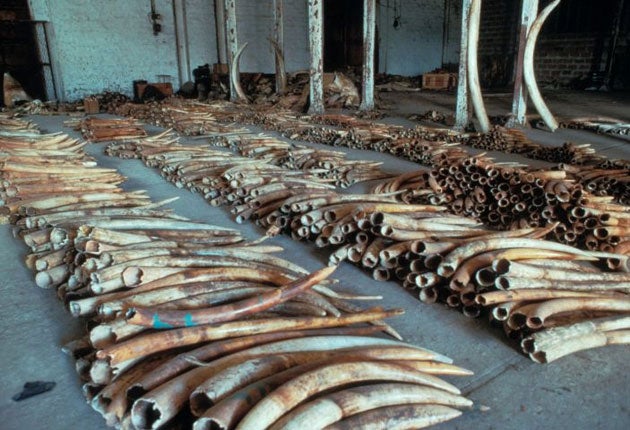
Investigators have seized £20m worth of illegal ivory in south-east Asia in the past six weeks, including the third largest haul of elephant tusks on record, The Independent has learnt.
Customs officials in Vietnam last month discovered 1,200 sections of tusks from up to 900 elephants, weighing 6.23 tonnes, hidden inside a consignment of waste plastic which had been sent from the Tanzanian port of Dar es Salaam.
Conservation bodies said that poaching in countries from Kenya and Tanzania to the Democratic Republic of Congo (DRC) and Sudan is reaching levels not seen since a global ban on ivory sales was imposed in 1989 and was placing the remaining wild elephant population in danger of extinction.
The seizure, which was accompanied by the interception in Thailand of a tonne of raw ivory from DRC, follows a controversial decision last October by the Convention on International Trade in Endangered Species (Cites), to approve the sale to China and Japan of 108 tonnes of tusks from four southern African countries with sustainable elephant populations. The British Government, which is a key signatory to the convention, voted to support the sale.
Conservationists yesterday claimed that the ivory confiscations and increase in poaching were proof that fears expressed at the time of the sale that it would fuel renewed demand for illegal tusks have come true.
An authoritative American study warned that poaching deaths are on a par with the late 1980s and the remaining large groups of elephants outside protected reserves could be extinct by 2020 without improved enforcement.
Campaigners believe the legal trade is being used as a disguise to smuggle ivory to China, where there is burgeoning demand for name seals, carvings and polished tusks and concern that newly introduced counter-trafficking measures are inadequate. Vietnamese officials said last week they believed the consignment seized in Hai Phong port from a Malaysian vessel was destined for China.
It is estimated that about 37,000 African elephants are killed by poachers each year. Figures obtained by The Independent show that in Kenya alone, the number of poached elephants has doubled in the past 12 months while officials in Tanzania are also investigating a reported large increase in poaching in the country's protected game parks. The elephant population in DRC is estimated to have fallen by a third in the past five years.
Michael Wamithi, director of the International Fund for Animal Welfare (Ifaw) elephant programme, said: "These alarmingly successive incidents are an indication that there is an escalation in elephant poaching in African range states, and an upsurge in illegal trade of ivory in the Far East markets. Although investigations are still ongoing, we suspect that the 6.2-tonne ivory haul in Vietnam was headed for larger markets in China, where legal ivory markets could provide cover for illegal trade. Vietnam has a small market unlikely to be able to absorb or demand such quantities."
The ban on the sale of ivory has been credited with halting a catastrophic decline in Africa's elephant population throughout the 1980s, when 70,000 elephants a year were being slaughtered by poachers. Elephant numbers across the continent are estimated to have fallen from 1.3 million to 625,000 before the prohibition was introduced in 1989.
Cites denied a link between the sale of ivory from South Africa, Namibia, Botswana and Zimbabwe last October, which was accompanied by a 10-year moratorium on further sales, and any increase in poaching or smuggling. The organisation's exhaustive Elephant Trade Information System (Etis) suggests that smuggling went down in the wake of the last sanctioned ivory sale in 1999, although the amount seized each year has now been increasing since 2005.
But Traffic, the wildlife trade monitoring organisation, reported in February that illegal ivory prices had risen to $1,500 (£1,000) per kilogram. The figure is disputed by Cites, which points out that the average price during the sale of legal ivory was $162 per kilogram and suggests that such a black market price is unsustainable. But campaigners say there is ample evidence that poaching is becoming increasingly rampant, with hunters and dealers targeting and decimating specific herds in the face of inadequate enforcement by host countries.
Poached ivory is currently sold for about $38 per kilogram in Kenya, where hunters have recently targeted the famous Amboseli elephants, killing 15 in the past year. With adult male elephant tusks weighing up to 50kg, the death of a single elephant can represent a year's income for a farmer or hunter. The result is a growing trade which is funnelling poached ivory from across Africa to criminal gangs with export links to the Far East. Traffic, which provides smuggling data to Cites, said the latest seizure in Vietnam proved there were sophisticated middle-men based across eastern Africa capable of amassing large quantities of ivory and smuggling it across the Indian Ocean.
Mary Rice, executive director at the Environmental Investigation Agency which provided much of the evidence that led to the original ivory ban, said: "There is an increase in poaching in many areas and we have an increase in seizures in Asia. These are not one-off opportunistic shipments, they are obviously consistent and organised."
Join our commenting forum
Join thought-provoking conversations, follow other Independent readers and see their replies
Comments
Bookmark popover
Removed from bookmarks