A giant leap for British salmon
Remarkable comeback in South Wales, where coal pollution turned rivers black
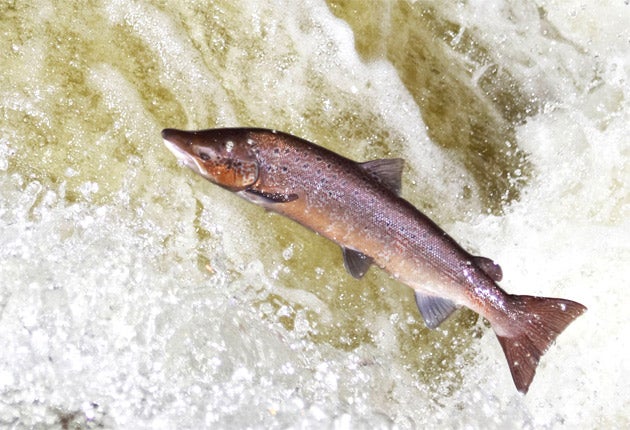
The rivers of the South Wales coalfield once ran black with mining waste and were so polluted in places that no life could survive. But, in one of the most remarkable environmental turnarounds Britain has ever seen, a 20-year effort to clean them up has paid off – salmon have returned to all of them.
Watercourses such as the Ebbw, the Rhymney, the Taff and the Rhondda, whose names for many people are still redolent of a blighted landscape of pitheads and slag heaps, now have salmon running up them from the sea to spawn.
The revolution has been brought about by 20 years of work by the Environment Agency, local authorities and angling clubs, in the wake of the collapse of the South Wales mining industry at the end of the 1980s.
It is part of a significant improvement in water quality across England and Wales, continuing for nearly two decades, which has seen salmon coming back to once heavily polluted rivers such as the Thames, the Mersey and the Tyne.
But the return of the "king of fish" to the South Wales valleys, confirmed by the Environment Agency, is perhaps the most extraordinary ecological recovery of all.
For most of the 19th and 20th centuries, coal production dominated the region, reaching a peak on the eve of the First World War, when the industry supported 620 mines employing 232,000 men and producing 57 million tonnes of coal a year – a fifth of the entire output of Britain.
This meant that an enormous pollution load was dumped in the region's rivers, especially of coal dust, and it has been estimated that the River Taff alone received 100,000 tonnes of colliery waste in a single year, with equivalent loads dumped in neighbouring rivers and streams.
In many places the watercourses were devoid of all life, and there is a site on the River Taff called Black Weir, so named because that was the colour of the water carrying its coal-dust load. Yet by last year, the Taff was so clean that it hosted the Rivers International Flyfishing Championships, at Merthyr Tydfil.
The clean-up began as the coal industry shrank: by 1975 it was down to 42 mines employing 30,000 men. After the unsuccessful miners' strike of 1984-85, the remaining pits began to disappear, until in 1994 the last one, Tower Colliery at Hirwaun, was closed by British Coal. A group of miners bought it with their redundancy money and continued operating it but it finally closed two years ago next week, marking an end of 200 years of deep coal mining in South Wales.
The industrial sector's loss has become the environment sector's gain. The whole network of once-polluted coalfield rivers, ranging from the Ebbw in the east, through the Rhymney, the Taff (with its tributaries the Cynon and the Rhondda) and the Ely, to the Ogmore, the Llynfi and the Afan at Port Talbot in the west, now have salmon in them, said the Environment Agency's head of fisheries, Mat Crocker.
"There are now salmon in all of the rivers of the South Wales coalfield that once ran black with coal," Mr Crocker said, "and last year we tracked one salmon to the top of the Rhondda, thanks to a huge turnaround in water quality, and works to help fish swim further upstream."
In cooperation with various partners, the agency has been installing fish passes to help migratory fish, such as salmon and sea trout, get above weirs and other obstacles – five have been installed on the Taff.
But water quality is also vital. The ability to host salmon – which need very clean water with a high oxygen content to survive – was "the ultimate test of a river system", said Mr Crocker said.
"You have to get everything right. The salmon spawns at the very top of the river in the shallows, then the young fish has to work its way all the way down to the sea, and then eventually work its way back up again.
"The river water quality has to be right, end to end. There's also got to be enough water in it, as well. If you have over-abstraction, there's not enough water for the fish to get over obstacles."
The return of the salmon to the coalfield rivers was "a triumph", Mr Crocker said, but he stressed that the improvement was not only in South Wales. "Water quality across the rivers of England and Wales has continued to improve for the last 19 years," he added.
Tony Rees, treasurer of the Merthyr Angling Club and chairman of the South-East Wales Rivers Trust, said the return of the salmon to the Welsh valleys was "absolutely fantastic". He said: "I'm very proud of the way the valleys have come back. When I started fishing as a boy, you couldn't fish the River Taff below Merthyr because of the pollution. Now you can fish the River Taff from its source in the Brecon Beacons all the way down to Cardiff Bay."
Join our commenting forum
Join thought-provoking conversations, follow other Independent readers and see their replies
Comments
Bookmark popover
Removed from bookmarks