Asian hornet on the way to prey on honeybees
Invasion of predators across Channel threatens massacre of bee colonies
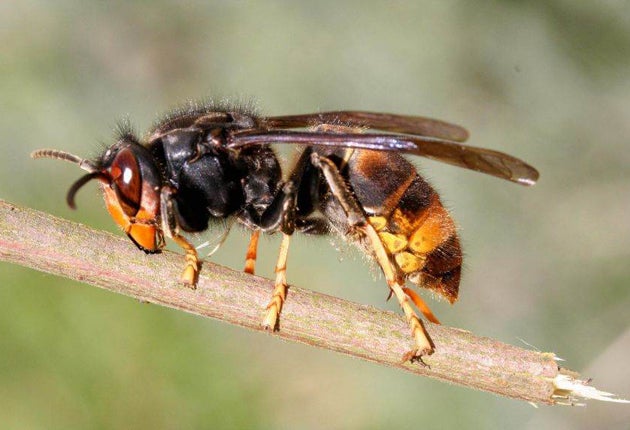
If you are nervous around stinging insects, you might think that bees are bad, wasps are worse, and hornets are positively horrible. Well, you ain't seen nothing yet.
A new hornet may be on the way to Britain which puts our native breed to shame in terms of aggression, especially towards honeybees – which it massacres. The Asian hornet, Vespa velutina, is strongly established in France, where it is thought to have arrived from the Far East in a consignment of Chinese plant pots in late 2004, and beekeepers and entomologists are concerned that it may now spread across the Channel, especially as climate change brings warmer summers.
Although Britain's native hornet, Vespa crabro, occasionally takes bees, its threat to them is as nothing compared to that from its eastern relative.
Groups from five to 50 Asian hornets hover in front of a beehive, picking off single honeybees, decapitating them and stripping off their wings and legs before making off with the "meat ball" to their nest to feed their young.
As the attacks continue, the honeybee colony stops flying and has to consume its own stores, a development which eventually weakens it to such a point that a hornet invasion force can enter the hive and pillage it completely. Whole hives can be destroyed in this way relatively rapidly.
In Asia, honeybees have evolved a defence: they form a ball of workers around the intruders, engulfing the hornets and killing them en masse by "asphyxia-balling" – in effect, by heatstroke. This behaviour has also developed among honeybees in Cyprus towards the Oriental hornet (Vespa orientalis), which in Greece and Italy has long posed threats to honeybees.
In France, however, the bees have not yet had time to evolve effective defences against their new predators, merely attempting in vain to sting them to death, and honeybee losses are mounting as the invading insects spread. From one nest discovered in 2004 in Aquitaine, in France's south-west, there were 2,000 in the Bordeaux area by 2007, and some apiaries around Bordeaux were by then suffering up to 70 per cent colony losses. Now the insects are believed to have spread much further north and may even have reached the Channel coast.
Last summer there was concern in France that the public might be at risk from Asian hornets, with several attacks on people reported from the départment of Lot-et-Garonne, where in August hundreds of the insects attacked a mother on a stroll with her five-month-old baby before turning on a neighbour who ran over to help. They then pursued two passers-by and two Dutch tourists on bikes who were treated in hospital for multiple stings. The incidents caused local councils to issue alerts, warning people with bee allergies to be "extremely cautious" and urging people never to attempt to destroy an Asian hornet nest themselves but to call on specialists.
Now British experts fear the insects could arrive in Britain either by crossing the Channel – as other continental insect species have done in recent years – or by being accidentally imported. "People are on the lookout for it, most definitely," said Tim Lovett, of the British Beekeepers' Association. "It is an unpleasant little critter."
A UK-based honeybee health company, Vita (Europe) Ltd, plans to have a hornet trap ready by the end of this season. "As yet there seems no way of controlling the spread of the Asian hornet, despite the best efforts of firefighters who are the only ones equipped to destroy their nests, which are usually high in tree tops," said Vita's Dr Max Watkins. "We cannot tell if or when the hornet might reach Britain, but since it is already near St Malo in northern France and since it seems to survive well in these climates, its arrival in the next few seasons looks likely. We expect to have a trap patented and in production by the end of this season."
Join our commenting forum
Join thought-provoking conversations, follow other Independent readers and see their replies
Comments
Bookmark popover
Removed from bookmarks