Badgers: To cull or not to cull? Either way, they are not as nice as they look
Farmers want to stop the spread of TB in cattle. But Brock will fight back, says Harry Mount
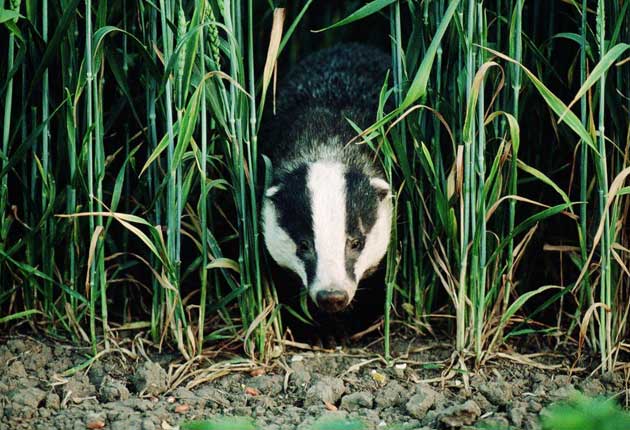
I blame The Wind in the Willows. Until Kenneth Grahame published his tales from the riverbank in 1908, badgers were firmly in the non-cuddly-animal category. But once Badger had installed himself in the subconscious of generations of schoolchildren – the solitary but wise, kind and principled creature who bathes Mole's wounded shin and gives him and Rat a slap-up dinner – the battle was over.
E H Shepard, the original illustrator of The Wind in the Willows, also helped to anthropomorphise the badger, and move him into cuddly territory – alongside seals, rabbits, and ickle polar bears. The arrival, in 1920, of Bill Badger in the Rupert Bear comic strip in The Daily Express sealed the deal.
Badgers are now so popular that Badger Groups, whose members track the animals' activities, make up the biggest fan club for a single species in the country. So, when, in the next few days, the Government gives the expected green light to a badger cull in south-west England, prepare for howls. In west Wales too, an experimental cull has been in the offing for several years. A cull is to designed to halt TB in cows, which is thought to be spread by badgers. Last week, however, this was stalled, while the Welsh government re-examines the evidence on the connection between badgers and the disease.
The jury has been out on the connection ever since the first dead, TB-infected badger was discovered in the Cotswolds 40 years ago. Ferrets, foxes, deer, cats, rats, mink and even Grahame's dear old mole can carry the disease. But none, apart from deer, carries it quite as effectively as badgers, who can survive despite being infected. Circumstantial evidence suggests that badgers are the most likely suspects, but some argue it the other way round: it's the cows that are spreading TB to the badgers. Farmers, though, are firmly in the first camp, and you can see why they're worried – 25,000 cows are infected every year in the UK, and are sent to the abattoir, at a cost of £63m to the taxpayer.
The Government tends to agree with the farmers, although official language is carefully hedged: "Badger culling has the potential to reduce bovine TB in cattle .... No other country in the world with a similar reservoir of bovine TB in wildlife has eradicated TB from cattle without stringent wildlife control measures." So you can see what a mess the whole thing is, with two of the most outspoken, implacable groups in Britain – farmers and animal rights protesters – lined up against each other.
And what about the poor, benighted black-and-white-striped, omnivores – officially, Meles meles of the weasel family – at the heart of this bristly debate? Well, truthfully, they're not that benighted – except in that they're nocturnal. Precisely because they usually come out only at night, you don't tend to see them – and that adds to their allure.
There are, in fact, plenty of badgers, particularly in Pembrokeshire – where the Welsh cull was due to take place. And there are many others throughout Britain, which has more badgers per square mile than anywhere else in Europe: more than 21 per cent of all European badgers live on our shores. Numbers are stable, if not increasing. Between the mid-1980s and the mid-1990s, the population grew by 60 per cent, from 250,000 to 400,000, as badger groups expanded and spread to new areas.
I spend much of the year in west Wales, and they're everywhere: burrowing in their sett by the gate at the top of the lane; lying dead by the side of the road, taken out, not by a government-licensed assassin but by a passing Land Rover. Examine one of these dead creatures and you'll see that they are far from cuddly. They are purpose-built for excavating their setts, with short, powerful front legs and long, sharp claws. Extensive musculature around the neck, front legs and shoulders, makes them not only extremely strong but also stocky – like hairy bouncers who've done too much gym work on their upper body.
They're designed for killing, too. In The Wind in the Willows, Badger's home is piled high with apples, turnips, potatoes, nuts and jars of honey. Grahame, understandably, didn't refer to Badger's vice-like jaws and his capacity to ingest game, eggs, small mammals (including rabbits, hares, mice, moles, voles and shrews), earthworms and roots. Once a badger gets its teeth into you, you'll have a job unlocking those gnashers.
No one expects children's writers to be naturalists but, all the same, Grahame got badgers wrong in practically every detail. Yes, they are occasionally solitary, but they are more likely to live in so-called clans, of anything up to 15 animals. In Badger, Timothy Roper goes so far as to call the animal "one of the most social of UK mammals". Nor are they the sluggish creatures of legend. "Badgerly" isn't used much any more; but the word was once in vogue, meaning elderly and grey-haired. In reality, the creatures can reach 20mph. I once accidentally surprised one in Pembrokeshire: I was on my bicycle but it sprinted well ahead of me before scuttling under a hedge. They're big, too – the largest naturally occurring carnivore in Britain, in fact, weighing in at around 8kg and growing to as much as 12kg.
Not that they've always been here. The ancestor of the badger originated in South-east Asia before migrating to Western Europe – and Britain – around three million years ago. Earlier, they were used by humans, like most other animals by humans , for food and clothing. From the Bronze Age until the 17th century, badger meat – said to taste like mutton, with notes of fungus and leaf mould – was eaten in Britain. The leftovers were used for leather and pelts; their fat was turned into soap and cooking oil. Their bristles are still used for badger-hair shaving brushes. Half a millennium ago, the Tudor Vermin Acts offered bounties for their corpses.
The enclosure of the British countryside in the 18th and 19th centuries intensified the vilification of the badger, by then considered a threat to game birds and their chicks. Badger-baiting with dogs was also popular (illegal, it continues today), not least because badgers competed with foxes for earths and so found another natural enemy in hunters. So badgers had a rough time of it, until about a century ago, as numbers declined and gamekeepers increased. It seems to be coincidence, but Grahame wrote his masterpiece when badgers' fortunes were at their lowest.
Whether or not it is thanks to him, the badger was increasingly protected in the 20th century. Badger-baiting had been banned in Britain since the Cruelty to Animals Act of 1835, but the 1992 Protection of Badgers Act made it illegal to injure, kill or take a badger, or to interfere with its sett. An exemption allowing fox-hunters to block setts to prevent them becoming refuges for their prey lapsed with the 2004 Hunting Act.
All in all, the population is stable enough to put up with localised reduction in the West Country and Wales, hotspots for bovine TB. If a cull in the West Country does bring down the incidence of bovine TB, then the badger population will have to be controlled there and in other hotspots. If not, and the experiment is ended, the badger population will soon bounce back. Either way, the whole debate would have been a lot calmer if Kenneth Grahame had made Badger of Badger Hall the bad boy of the book. Who now cares for the poor, unloved toad?
Join our commenting forum
Join thought-provoking conversations, follow other Independent readers and see their replies
Comments
Bookmark popover
Removed from bookmarks